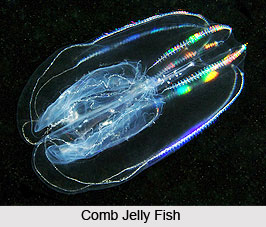
 Comb Jelly is a peculiar jelly fish more organized than other coelenterates. In view of its special organs of locomotion - eight `combs` or rows of ciliated plates - they are grouped under a special Class Ctenophora (from Greek ktenos, comb; phoros, bearing). It is a very beautiful, free-swimming animal, floating on the open sea, emitting iridescent colours; many of its kind are phosphorescent. The creature is widely distributed and is abundant in various parts of warm seas. Comb-jellies are generally pear-or egg-shaped - hence the name sea-walnuts - but some are long and like ribbons.
The animal has an oral end where the mouth is situated and an opposite (arboreal) end bearing sensory organs. Eight comb-like ciliary bands are arranged over the body longitudinally, extending from near the oral end to near the arboreal end. By a rhythmic movement of the cilia along the bands the animal is propelled through the water. With a few exceptions comb-jellies have a pair of long tentacles, each one arising from a pouch on either side of the arboreal end. These tentacles are sensory. They have no stinging cells but a series of adhesive glue cells which capture food - minute organisms floating on the surface - and carry it to the mouth. The mouth opens into a narrow gullet where most of the food is digested. The gullet opens into a funnel which branches radially and distributes nutriment to all parts. Part of the undigested food is ejected through the mouth and part through the anus.
Each comb-jelly produces both male and female germ cells. These, when mature, are first discharged into the gullet from where they escape through the mouth to outside water. Here some of the eggs get fertilized and develop directly into adult comb-jellies.
Some of the common and interesting comb jellies found along the Indian coasts are; Pleurobrachia, with an ovoid body somewhat compressed laterally with eight prominent ciliated bands of equal length. The body is 2.5 centimeters long and the tentacles are nearly 14 centimetres long. The body is transparent and therefore as it moves in water only the tentacles are seen waving. Beroe is a thimble-shaped comb jelly without tentacles. The body is long and conical, laterally compressed and measures ten to eleven centimetres long. There is another called Cestus (Venus`s Girdle), which is a long ribbon-like comb jelly more than two centimetres broad and thirty to thirty three centimetres long. It is a very attractive animal, exhibiting green, blue and violet colours when swimming.