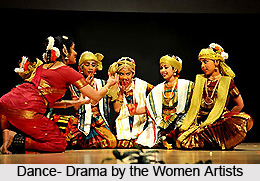
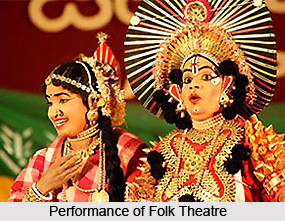
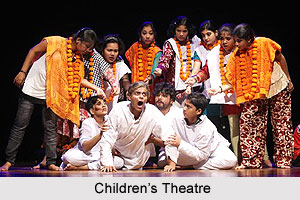
 Children`s theatre has been an essential part in rural India, and traditional Indian theatre. The audiences gather indiscriminately, to be a part of the theatre. This form of theatre mainly contains stories from Indian mythological places. Conventionally, children, as actors, have constituted another facet of Indian theatre. Young boys born in performing families, or show casing their talent independently, are trained by senior gurus, both in secular folk forms and devotional temple genres. After years of strenuous training, young boys pick up the trick and start performing in small parts, eventually moving to play adult roles, after spending time playing the parts of women. Some of the boys are hand picked by their gurus to continue with the female impersonation.
In many religious recitals, children actually play the central figures, like swarups (incarnations) in Ramlila or Raslila, whose primary function is to represent deities like Sita, Lord Rama, Lord Krishna and Radha, receiving the worship of devotees as part of production. They almost become live gods for that period of time. There is more traditional acting by children as lead characters occur in various parts of India.
The earliest modern experiment with drama for young children came under Rabindranath Tagore, after he actually founded his ashram for boys at Santiniketan in West Bengal. He made theatre productions all by himself and took care of all the necessary details, and always insisted that it should open up the world of education of pupil. In the year 1908, he even started writing plays of educational value. He wrote an original English play named King and Rebel (1913) that was meant for pedagogical exercises to enhance the fluency of the language among boys. He even made children theatre a compulsory subject.
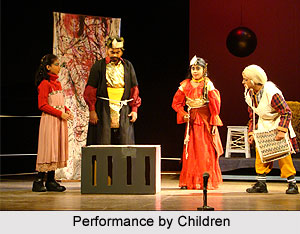 Other stalwarts of children theatre include Sankaradas Swamigal, who initiated the famous Tamil movement of boys companies by forming the Samarasa Sanmarga Sabha (1910) and Tattuva Minalochani Vidya Balasabha (1918) teaching young boys the art of acting. In Karnataka the company by Gubbi Veeranna, started a travelling children`s theatre in 1925. The following year, G.R. Shirgoppikar (1885-1956) assembled rural Marathi children into Anand Sangit Mandali, employing hid own experience and expertise in sound effects, trick senses and slides.
Late Prime Minister, Pandit Jawaharlal Nehru, specifically fond of children had initiated policy of constructing of constructing purpose-built auditoria for them in the major cities. The very active Children`s Little Theatre in Kolkata shifted into its own premises in the year 1974.
Another playwright named Bajaj taught at various schools in Delhi and staged around fifty student productions. Currently, many troupes have actually helped children with special needs. Theatre Action Group (1973) formed by Barry John worked with the disadvantaged and disabled to make precious contributions to remedial theatre. These productions developed out of workshops with children. In order to stage an educational drama for school children, a theatre group was also set up by the traditional Gujarati actor named Pransukh Nayak in the year 1980. In the Indian state of Tamil Nadu, Velu Saravanan and M. Ramasamy, became renowned as children`s-theatre specialists. In Karnataka, in the year 1991-93, Ninasam undertook its project of theatre-in-education, Shalaranga, to generate cultural awareness in schools of Kannada with a series of workshops. Theatre for developmental purposes often involves street kids in Kolkata. Nandikar has series of programmes lined up for street children. Zarin Chaudhuri, from city of Kolkata also runs internationally famous group of blind children and physically challenged named Blind Opera.