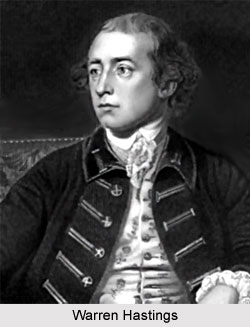
 Nandkumar was an Indian tax official, most familiar for his connection with Warren Hastings, the first Governor-General of Bengal. He was nominated as the collector of Burdwan in 1764 in place of Hastings, which resulted in a historical-standing enmity. Thus was initiated the case of Nandkumar.
Within the period of 11th and 13th March 1775, Nandkumar (1705-1775) sent several letters and other documents implicating Hastings in fraudulent practices to the Governor-General`s Council in Calcutta. A majority of the Councillors - Sir Philip Francis (1740-1818), George Monson (1730-1776), and John Claverlng (1722-.1777), declared their intention of investigating the charges of Hastings` presumed taking of a bribe. Their resolution and evidence was forwarded to the Company`s attorney in London.
On 6th May 1775, John Hyde (c.1737-1796) and Stephen Le Matstre (d. 1777), Justices of the Supreme Court of Calcutta, were acting as Justices of the Peace. They committed Nandkumar to trial on the charge of forgery as provided for within the English law of forgery.
Within the period of 8th to16th June 1775, Nandkumar came to trial for forgery in the facilities of the old Mayor`s Court in Calcutta. On receipt of the case, the Jury required only an hour to determine a guilty verdict. Nandkumar`s case had already taken a hideous turn in the hands of the implicating masters, when the lawmakers had attempted to debase Nandkumar and his strong statement against Hastings. However, the case`s final findings were completely unprecedented for native population.
On 5th August 1775, Nandkumar was hanged. The case of Nandakumar however had an immense impact on the British law system and changes in the arena of administration, law and over all governance were witnessed.
In October 1775 , as an immediate effect, the Governor-General-in-Council restored Mohamad Reza Khan to the position of Naib Subah in charge of criminal justice in Bengal and to administer the Sadar Nizamat Adalat which was moved from Calcutta to Murshidabad.
In April 1777, the British East India Company created the post of Advocate General in the Supreme Court and appointed Sir John Day to the position. His responsibilities included conducting the Company`s suits before the court.
As an aftermath to the Nandkumar case, on 22 July 1777, Hastings was in a hurry to amend his role as a governor commanding respect. In consequence, he separated the roles of civil justice from revenue collection as carried out then. In lieu of instructions from the Company, Hastings established a Diwani Court for civil jurisdiction at Dacca. Only in 1780 were the other provincial courts similarly modified.
On 11th April 1780, the Governor-General and Council issued Regulations for the Administration of justice. It had the intent of embodying the rules of 1772, of reducing friction between revenue and judicial authorities and in promoting the impression of Justice done.
On 17th April 1780, a regulation provided for the Indians of Bengal, Bihar and Orissa to continue to use their Mohammedan or Hindu laws in the `Mofussil` (places and areas that did not fall under city categories, remote districts). This practice was generally repeated in future regulations and in Bombay and Madras. As possible, the courts attempted to apply Armenian law in Calcutta and Parsi law in Bombay. Hastings, together with his council of generals also tried to make hasty efforts by granting supreme native rights in city jurisdictions.
On 18th October 1780, the Governor-General-in-Council revived the Sadar Diwani Adalat to hear appeals regarding revenue cases from lower courts. In a highly controversial decision, Hastings placed Sir Elijah Impey (1732-1809), Chief Justice of the Supreme Court of Calcutta, also at the head of this court thus creating every appearance of a conflict of interest. As a consequence, the Court of Directors ended the appointment in 1782 and the House of Commons recalled Impey in May 1782 to face impeachment proceedings.
These were substantial evidence that British administration were consciously aware of their terrible wrong-doing of hanging Nandkumar and dismissing his case as forgery.