 Bohra Community, also known as Bohora community, is involved in trading. They emigrated from Gujarat to different parts of the central and western region of the country. Bohra community mainly speaks Gujarati language. They are residing principally in the regions of Nimar, Nagpur District and Amravati District. Burhanpur is the headquarters of this community in the Central Provinces of India. The name of Bohra caste has probable been derived from the Hindi term `byohara`, meaning a trader. Further, some claim that the word Bohra, which is also spelled as Bohara or Vohra, is derived from Gujarati word vohorvu or vyavahar, which means to trade. The term Bohra most commonly is applied to the Dawoodi Bohras.
.
According to some historical accounts, Abdulla, a missionary, came from Yemen to Cambay in 1067 AD. It is believed that with his powers, he converted the king Sidhraj of Anhilvada Patan in Gujarat, and he embraced the new faith. For around two centuries and a half the Bohras prospered in the state, however with the establishment of Muzaffar Shah`s power (1390-1413 AD) and with the spread of Sunni doctrines the Bohra and other Shia groups suppressed. Since then, their number gradually decreased. In around 1539 the headquarters of the sect was fixed at Surat. Bohras are Shias of the Ismaili sect of Egypt. In the state of Gujarat, there are two classes of Bohras - firstly the traders (Shias) and secondly a large group of cultivating Bohras (Sunnis). Subsequently, the community of Bohras divided a number of times to form the Jafari Bohras, Sulaymani Bohras, Dawoodi Bohras, Aliyah Bohras, and other groups.
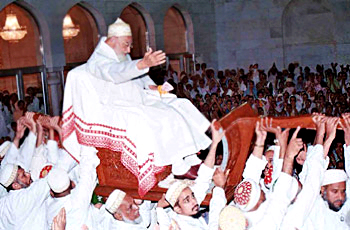
The Bohras are considered as very civilised and enterprising. They also form one of the most industrious classes in the central province. Bohras generally deal with hardware, and are very enthusiastic traders. However, some of them are only hawkers. In the past, they were also considered as travelling merchants. They do not charge any interest on loan amount. The people of Bohra community can be easily recognised with their tightly wound turbans and little skull-caps, and their loose trousers and long flowing robes. When the women of this caste go out they put a dark cloak over the head which covers the body to the ankles.