 Bhringaraja is a medicinal plant that is popularly known for its usage in the growth and nutrition for healthy and beautiful hair. This plant attracts the admiration of the practitioners of Ayurveda, Herbal practice and other relative practices due to its effective result and immense value in the hair products. Beside this, the plant is essentially a storehouse of various beneficial medicinal properties.
Bhringaraja is considered to be a cosmopolitan weed. This plant is commonly found throughout India in wet or moist cultivated fields. The plant grows in profusion by the roadsides and wastelands in bunches.
The scientific name of Bhringaraja is Eclipta prostrata. This plant is commonly named differently in different languages. This plant is known as `Kesuti` in Bengali, `Kaluganthi` in Gujarati, `Mochkand` in Hindi, `Kadigargu` in Kannada, `Kyonni` in Malayalam, `Bhringuraja` in Marathi, `Kesarda` in Oriya, `Kaikeshi` in Tamil and `Bhangra` in Urdu.
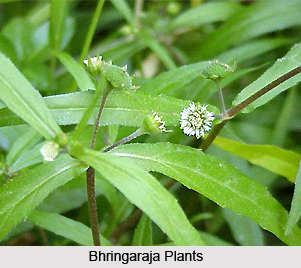
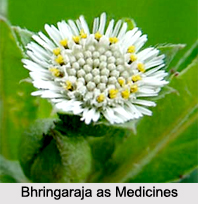
Bhringaraja plant is an erect or prostrate, much-branched and hairy herb. This plant often roots at the nodes. Leaves are opposite, sessile, oblong-lanceolate, up to 10.5 cm long and 2.5 cm wide, apex is acute and margins are serrulate. Flowers are small, white axillary peduncled rayed heads and are 0.6cm to 0.8 cm in diameter. Involucre is campanulate, ray florets have pistillate, disc florets are bisexual; pappus is structured in two minute, connate scales. The corolla of pistillate flowers are ligulate, bifid, those of bisexual flowers have the tubular with four or five lobes. Achenes are of ray florets triquetrous, warted and the disc florets are compressed.
Bhringaraja is one of the ten herbs constituting the group known as `Dasapushpam` (i.e. ten flowers) in Ayurveda. Each plant of this group is considered useful for expelling intestinal worms, curing cough and asthma, and for treating night blindness, eye diseases, headache and diseases pertaining to the hair and its growth. Bhringaraja is colossally used in traditional Indian medicine as a tonic and deobstruent to treat hepatic and spleen ailments and in various chronic skin diseases. The fresh plant is considered as having the properties of anodyne (pain reliever).
Bhringaraja plant is rubbed on the gums to relieve toothache and is generally applied with a little oil to relieve headache. The plant combined with sesame oil is applied to treat elephantiasis. The plant juice is administered with aromatics to treat jaundice and fevers. Bhringaraja juice is mixed with honey to cure catarrh in infants. Among the inhabitant of northeastern Karnataka, the whole plant extract is applied to promote the healing of cuts and wounds, and it is also used to treat earache in children. The root has the emetic and purgative properties. It is applied externally as an antiseptic to ulcers and wounds also in cattle. Some inhabitants of Indian states use this plant in culinary practices. The leaves are used in chutneys in some parts of India.
 Bhringaraja's whole plant is used for various medicinal purposes. In tattooing, the natives after puncturing the skin rub the juicy green leaves of Eclipta prostrata over the part; which gives the desired indelible colour, namely a deep bluish black.