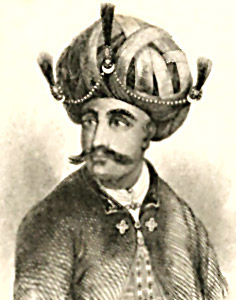
 In 1781, in response to the need for revenue to fight the war in Madras against Hyder Ali, Warren Hastings, the Governor-General of India, had pressed Chait Singh (d.1810), ruler of Benaras, to make additional revenue payments in 1778 and 1779 of five lakhs as a sort of war tax. In 1780, Sir Eyre Coote (1726-1783) had requested that Chait Singh be asked to supply troops 2000 in number. After a period of no response, Chait Singh offered 500 infantry and 500 cavalry troops. Hastings felt this to be an insufficient response and in July 1781 left for Benaras to "discipline" Chait Singh.
On 13th August, some miles outside Benaras, Hastings met with Chait Singh and after unsatisfactory negotiations felt Singh should be arrested. On 16th August, two companies of the Bengal Army proceeded to Benaras to arrest Chait Singh, but were cut to pieces when the city exploded in rebellion. The rebel ruler escaped with his treasury to Ramnagar. Hastings brought up additional Company troops to recapture lost areas and to drive Chait Singh towards Bundelkhand.
On 19th September, Hastings concluded the Treaty of Chunar.
In January 1782, Hastings remained in the Benaras region for a time to settle the area. Holding the belief that the mother and grandmother of Asaf-ud-daula, Nawab of Oudh, had been in conspiracy with Chait Singh, Company forces captured the fort at Faizabad, where the two begums were staying. He then confiscated some fifty-five lakhs of rupees for the Company treasury.
During the years of 1783-1830, the issue of the Nawab of Carnatic`s debts came to the forefront when Fox`s India Bill of 1783 was discussed in the House of Commons. From 1767 to 1777, the Nawab had become indebted to the servants of the British East India Company to the amount of 3,440,000 pounds. The Company arranged for the Nawab to make annual payments of 480,000 pounds and saw the debt paid off by 1804. At that time, however, it was determined that the Nawab`s new indebtedness totalled 30,000,000 pounds. In 1805 a commission of Bengal civilians began to investigate these claims and by 1830 determined that 2,687,000 pounds represented a valid total.