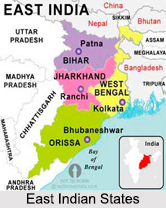
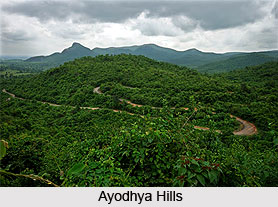
 Ayodhya Hills is a hill located in the Purulia district of the state West Bengal. It is situated on the boundary of Purulia district and Jharkhand. It is one the famous tourist spot in West Bengal. Ayodhya Hills is a part of the Dalma Hills and extended part of Eastern Ghats range. Highest peak of Ayodhya Hills is "Gorgaburu". The nearby populated town area is Bagmundi. During the full moon day in Baisakh every year the tribal people of nearby areas come and join in the game of hunting wild animals.
Legend of Ayodhya Hills
According to an Indian Epic "Ramayana", Lord Rama and Sita had come to Ayodhya Hills and stayed during their exile. Sita was thirsty and Ram pierced an arrow through the Earth`s soil crust and through that water gushed out. Sita quenched her thirst. The place is known as "Sitakund".
Features at Ayodhya Hills
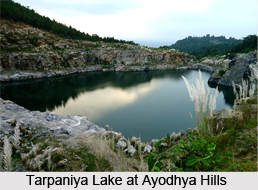
A visit to beautiful waterfalls, deep forests, tribal villages, Gorgaburu and Mayur hills are sure to captivate senses of the nature lovers and the tourists. The presence of a variety of wild animals in the forests makes this place more adventurous. Gorgaburu, the highest peak of the Ayodhya Hills is situated at a magnificent 2850 feet. There are various deep forests and numerous waterfalls located amidst the hill. Several tribal villages are also situated on the hill. A trip to the Mayur hill will provide a spectacular view of the Ayodhya Hills, just like it has been portrayed on a canvas. Some magnificent waterfalls like Ghagkocha Falls, Brahmani Falls and Turga Falls can be visited covering short distances by foot from nearest motorable roads. Another unforgettable experience is the panoramic view of the lakes and reservoirs located throughout the Ayodhya Hills like Tarpaniya Lake, Khairaberia Lake, Upper Ayodhya Dam and Lower Ayodhya Dam.
 Near Ayodhya Hills, there is "Turga Dam" and the lake, and the pleasant waterfall formed by the River Bamni. The site of the Turga Dam site is a perfect tourist spot, where the visitors can spend their day. The place is also well-known for its fresh water springs and stream. One can also expect a glimpse of the wild animals residing in the forests of the hill such as elephants, wolves, wild pigs, deer, peacocks, cheetahs and numerous kinds of birds. While on a trip to forests, it is advisable to opt for a forest guide.
Best Time to Visit Ayodhya Hills
The months between September and March are considered to be the best time to visit Ayodhya Hills. During this period, the place provides ideal setting for camps.
How to Reach Ayodhya Hills
Purulia, which can be reached by boarding a number of trains which run on a daily basis. The town can be reached both by road and by train from Kolkata, which will take some 8-9 hours only depending on the traffic. The place can be reached by car from Purulia and Birbhum stations.