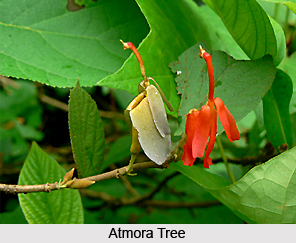
 Atmora is a small tree or a shrub which is found typically on the forest edges in India. The Botanical name of Atmora is Helicteres isora L. Atmora is also known by a number of other names in different languages in India like Murdasing in Gujarati, Kavargi and Yedamuri in Kannada, Isvarmuri and Kaivun in Malayalam, Modimodi, Murimuri, Kaval, Murmuria and Ovla in Oriya, Avarttani and Mringashinga in Sanskrit, Gubadarra, Nuliti, Kavanchi, Syamali and Valambiri in Telugu, Jonkaphal, Marorphal, Bhendu and Marorphali in Hindi, Kivani in Konkani, Kewan, Maradas-ing, Kevani and Varkati in Marathi, Jonkaphal, Kupasi, Bhendu and Marorphali in Punjabi, Kaiva and Valumberi in Tamil and Marorphali in Urdu.
Atmora is a semi-deciduous shrub or a small tree which grows to a height of about five meters with grey bark. The young shoots of this small tree are covered with stellate hairs. Leaves of Atmora are bifarious, 4 to 20 centimeters long and 2.5 to 15 centimeters wide, oblong, obovate or nearly round, base cordate, 3-nerved, apex shortly acuminate, margins crenate-serrate and upper surface is closely dotted with stellate hairs. The petioles are 0.5 to 1.5 centimeters long and the stipules are subulate and are 0.6 centimeters long. The flowers of this plant are solitary or in sparse clusters, and are 2.5 to 4 centimeters long, with red reflexed petals turning pale blue when old. The fruits of Atmora are 2 to 4 centimeters long, greenish-brown, beaked and cylindrical with spirally twisting carpels, which on ripening untwine and scatter the enclosed small seeds. There are two varieties which are distinguished as Var. tomentosa, distributed primarily in northern and central India, in which leaf undersurfaces are glabrous and Var. glabrescens, distributed in the southern parts of India, in which both leaf surfaces are nearly glabrous. In the central parts of India, flowering occurs between the months of July and December and fruiting occurs from October to March. Atmora trees are generally leafless between February to March and April to May.
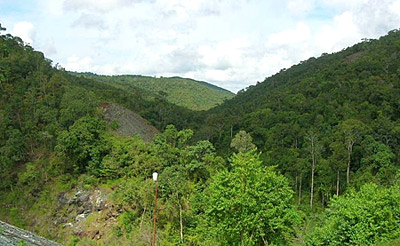
In India, Atmora is typically found on forest edges and in the understorey of dry secondary forests and flourishes on rich humus soils on sites receiving at least thirty centimeters of annual rainfall well-distributed throughout the year.
The stem barks and root of Atmora are considered to be expectorant, demulcent, and astringent to the bowels and anti-galactagogue. They are applied topically to treat scabies. The juice of the root is very helpful in treating empyema, stomach disorders and in the Konkan region it is used in the treatment of snake bite and diabetes. Among the Gonds of Uttar Pradesh and the tribal inhabitants of southern Andhra Pradesh state, it is given to treat rabies and dog-bite. The stem bark is prescribed for dysentery, diarrhea and biliousness. A paste made from the leaves is used to treat skin ailments, including eczema. The pods are fried and given to children to kill intestinal worms. An aqueous extract of the seeds is sometimes used to treat dysentery and to relieve stomach pains. The dried fruit is mildly astringent and demulcent, and reportedly useful for treating intestinal ailments. It is also prescribed for colic, flatulence, dysentery and diarrhea. Among the Bhils of Rajasthan, an extract of the fruit of Atmora is given orally to children to relieve diarrhea. The powdered fruits mixed with neem oil (from fruits of Azadirachta indica: Meliaceae) are used as a massage oil for treating paralysis among the tribal inhabitants of eastern Bihar. The powdered seeds are also used in this region to give relief from stomach pains. The inner bark of this tree yields useful fiber.