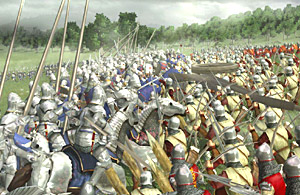
 Art of warfare during Middle Ages seems like a colossal and episodic affair, with every meticulous attention being bestowed upon every single object living and non-living. The very concept of warfare witnessed a massive change. The army equipments during middle ages were somewhat changed. The conventional number of weapons for a full military equipment was thirty-six. The commentator of the Dvyasrayam enumerates them as follows: (1) cakra (discus), (2) dhanus (bow), (3) vajra (thunderbolt), (4) khadga (sword), (5) ksurika (knife), (6) tomara (javelin), (7) kunta (lance), (8) triiula (trident), (9) sakti (spear), (10) parasu (axe), (11) maksika, (12) bhalli (a kind of spear or lance), (13) bhindimala (sling), (14) musti (hilt), (15) lunthi, (16) sanku(dan), (17) pasa(noose), (18) pattisa (spear with sharp edge or some other weapon with three points), (19) rsti (spear, lance, or sword), (20) kanaya (a type of arrow), (21) kampana, (22) hala (plough-share), (23) musaia (mace), (24) gulika (a ball as a missile), (25) kartari (knife; Hindi katari), (26) karapatra (saw), (27) taravari (one-edged sword), (28) kuddala (pick-axe), (29) dusphota (a kind of explosive), (30) gophani (sling), (31) daha (probably a fire-dart), (32) daccusa, (33) mudgara (hammer), (34) gada (club), (35) ghana (iron club, weapon shaped like a hammer or mace), and (36) karavalika (cudgel, sword, or one-edged knife).
The conventionalisation of army equipments may signify the stereotyped character of military science during the Medieval age. The significance of defensive armour in the art of warfare in Middle ages naturally increased in the period when battles largely took the character of hand-to-hand combats The Aparajitaprccha cites some varieties of kavacas made of iron and steel, one or two ahgulas in thickness. The tanutrana was made of thick cloth. The helmet formed the principal part of a warrior`s attire.
The Prabandha-cintamani refers to the commissariat department in the army of Prthviraja Cahamana. There is also reference to the department of medical service in the Kashmir army. The evidence of the Rajatararigim illustrates that soldiers were sometimes paid travelling allowances to meet their marching expenses. In the Sisupala-vadba and the Tilakamanjari, it is enlightened that private merchants accompanied the army. The bad condition of roads in the early medieval period must have created difficulties in army-transport.