 Emperor Jahangir had possessed considerable interest in architecture. He is known to have constructed extensively - palaces, hunting lodges and tombs. However, religious buildings and their constructions are rare, despite his devotion to Muin ud-Din Chisthi. Under Jahangir, Mughal architecture demonstrates considerable continuity as the concepts mature. Architecture in Bengal during Jahangir was a highly unlikely attempt, quite moved away from his father, Akbar and yet again, vastly different from his son, Shah Jahan.
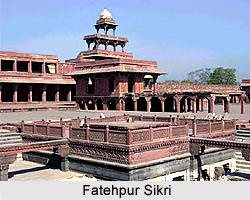
Many aspects of Jahangir`s architectural style, quite familiar in Bengal too, possess strong roots in the buildings of Akbar. They are not, however, always the roots one might expect. Tombs, for instance, those Jahangir had built for Akbar and Shah Begum, are not based on older Timurid-inspired tomb-types but rather on Akbar`s multi-storied palace pavilions. The few surviving palaces Jahangir had constructed, on the other hand, are modelled on older palace types, such as Akbar`s trabeated pavilions in Fatehpur Sikri, even continuing the dominant use of red sandstone. Now though, surfaces are, at times more highly articulated and white marble, previously utilised only for tombs at the shrines of saints, was introduced for palace architecture. This sets the stage for the substantially more extensive use of white marble under Shah Jahan.
 Jahangir not only had encouraged the nobility to build, especially in the hinterlands, but also often was of the habit to reward them by advancement in rank. If in Akbar`s period architecture at the frontier was often a symbol of Mughal power, in Jahangir`s reign, it was an indication of authentic presence, serving permanent populations as well as encouraging trade across the empire. Hindu rajas, also members of the Mughal nobility, had begun to built palaces on their ancestral lands that incorporated trends at the Mughal court. The styles of all these structures, as in Akbar`s time, had introduced new aesthetics to the provinces, ones that usually echoed contemporary tastes in the major cities of Agra and Lahore. Yet, thinking beyond the significant cities like these mentioned previously, hinterlands where Jahangir had boosted his noblemen to build, also had assimilated `Mughal-ish` type of construction, as can be comprehended as under. As a result, architecture in Bengal during Jahangir, as a genuine style of Mughal architectural expression, was accomplished capably by Mughal court viziers and ministers posted in lands like Bengal, many a times Hindu.
As witnessed previously in Bengal`s architecture during Akbar, architecture of Bengal under Jahangir also had to grapple with rebellious forces, at times posing as hindrances to wrapping up an architectural dream. As such, Islam Khan, Jahangir`s governor of Bengal from 1609 to 1613, was legendary to have terminated and quashed rebel activities that had plagued the Mughals in Bengal since Akbar`s time. Islam Khan thus had moved the capital from Akbarnagar (Rajmahal) to Dhaka, then named `Jahangirnagar`. Little remains of early 17th century Dhaka (then an integral part of India), except some small river forts utilised against pirates - a constant threat to Mughal authority.
Outside of Dhaka, the Jami mosque at Atiya in Tangail District, presently in Bangladesh, constructed in 1609, is the sole dated monument of Jahangir`s era in all of Bengal`s architecture. This is the latest mosque here built in a pre-Mughal regional idiom. It consists of a single-domed square prayer chamber with a triple-domed veranda projecting on the east, suggesting that in areas away from Mughal administrative centres; there was little influence from the mainstream Mughal architectural tradition.
The memoirs of Mirza Nathan, a noble posted in Bengal since the early 17th century and serving in the rebel prince Shah Jahan`s army, lends insight into several architectural projects of the time in Bengal during Jahangir, a perfect instance of princely patronage. Amongst these, are a palace at Akbarnagar and a new fort at Garhi. Today acknowledged as Tehagarhi, Garhi is just 30 km northeast of Akbarnagar (Rajmahal). The fort, situated at the traditional approach to Bengal, was bastioned with stone walls. The walls, constructed of alternating layers of local brown and black stones, appear uniform. Partially still standing, the fortifications remain as testimony to solid workmanship in spite of speedy construction, stellar instances of imperially patronised architecture in Bengal during Jahangir, however under Shah Jahan as a prince.