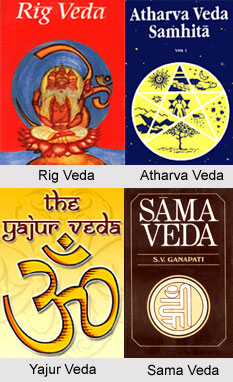
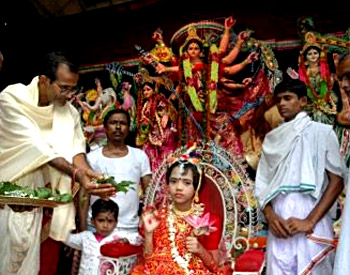
 Ancient Indian Society as depicted in the Tantra tradition is quite different from the conventional society. Tantra is a religious concept dealing systematically with the social states of ancient India and as per the scholars a significant role had been played by Tantra in the ancient Indian society. The primary facets of tantric society is that it provides freedom to every individual irrespective of caste, creed and sex, regarding religious rites and observances and teach ways to `Mukti` or liberation through enjoyment that is `bhukti.` The ascetic practices of the Brahmanical religion are not favoured in Tantric traditions and the conservative Smriti rules are also ignored. For instance, even a low-class man, who has attained a high level of Tantric Sadhana, is to be saluted by a Brahmin. Further, for Kumari Puja, even a low-class girl of the requisite qualification can be selected by a Brahmin. Tantric ideas already appeared in the Atharva Veda. According to some scholars Tantra is also regarded as `Sruti` that is normally used to refer to the Veda.
According to the principles of Tantra, the utmost goal can be achieved not by rejecting the pleasures of the senses, but by their indulgence in a prescribed manner. Tantra did away with many of the caste restrictions of the ancient Indian societies imposed by Smriti Shastra. It throws light upon the gates of religion even to those people who were barred from many of the Vedic rites. Instead of the degradation of the body Tantra looks upon it as the microcosm, and it also prescribes ways and means for its preservation.
 Tantra believes that whatever is in the universe exists in the body. According to Tantric traditions the body is believed to consist of six chakras or circles and has three principal nadis (vein or artery). The undeveloped religious energy within the body is called Kundalini and Tantric Sadhana mainly intends at rousing this spiritual energy.
In Tantric worship, great stress is laid on mandalas, mudras and yantras. These mean respectively mystic circles, hand-poses and figures. According to Tantra, Kumari puja, that is worship of a virgin girl of a particular age, formed a vital part in ancient Indian societies. For this purpose, an unmarried girl of any caste, possessing the essential qualities was selected including the daughters of lower classes. As far as the ancient societies in Tantric traditions are concerned, the Guru is said to occupy a very vital place in Tantra. While the priest (purohita) plays a major role in the Brahmanical religion, based on the Veda, he does not hold any high place in Tantra. According to some Tantras, one`s mother is considered as one`s best Guru. The basic accessories to Tantric sadhana are madya (wine), mamsa (meat), matsya (fish), mudra that is various hand-poses. In Tantric traditions, human nature has been divided into three chief classes according to inclinations and attitudes of mind namely Divya (divine), Vira (hero) and Pashu (animal).
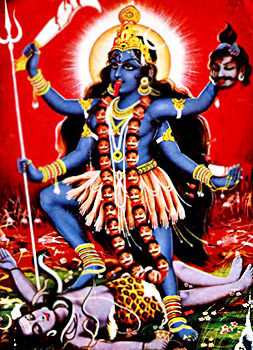
As regards puja (worship) in ancient societies both internal (manasa) and external (bahya) pujas were ordained. In some works, great weight is attached to antaryaga or mental worship in which the five Tattvas are regarded as theoretical and not concrete things. Tantra contains a lot of spirituality, occultism, enchantment and marvel. Worship on a dead body is held to be highly effective in Tantric practices. Interestingly, contrary to the Brahmanical practice, Tantra includes the Atharva Veda among the main subjects of study. Among the prominent deities in ancient Indian societies, Goddess Kali occupies a very important place according to Tantra.
Tantra accords a high status to women of the ancient Indian societies. Tantra considers that one`s wife is one`s Shakti and that her position in life is indispensable. A man without a wife was not allowed to any social rite. Moreover, a person, taking to any particular mode of Tantric life and worship, is urged to look upon women with great reverence. He should not beat them and should show respect to them.
Apart from these, the tantric beliefs also denounced the caste system that was prevalent in the ancient Indian societies. Sudras were equally entitled to Tantric diksha as members of the higher castes. A kumari of the Sudra caste may be worshipped even by a Brahmana who can take her prasada. Further, the Mahanirvana Tantra recognises a caste in addition to the usual four castes. It is called Samanya. A man of this caste is allowed to take to the avocation of any caste, other than Brahmana, for livelihood. Though Tantra permits the follower to get pleasure from life, yet it does not encourage levity.
Thus the ancient society as depicted in the Tantric traditions is quite different from the Brahmanical system.