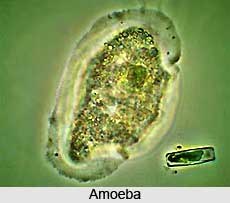
 Amoebas are single-cell, animal organisms, belonging to the protozoa family. Most species are free-living and can be seen in the water of any small freshwater pond, the larger forms being just visible to the naked eye. Parasitic forms occur in many animals, inhabiting the intestinal canal, and are mainly saprophytic, though a few are causative of disease, like Entamoeba histo-lytka which is responsible for amoebic dysentery in man.
Within a single cell, the amoeba contains all the capacities necessary to maintain animal metabolism. The amoeba moves by throwing out cytoplasmic buds, or pseudopodia, into which the rest of the cytoplasm flows in a streaming movement. When a suitable nutrient particle is encountered, the amoeba throws out pseudopodia around it and engulfs it. The particle may remain in a bubble, or food vacuole, into which digestive juices are poured. When the nutrient material has been digested and absorbed from the vacuole, which acts like a primitive intestine, the amoeba moves away, leaving behind the indigestible remnants.
Reproduction in Amoeba is normally by binary fission. From time to time, a type of sexual reproduction, or conjugation between two individual amoebas, with some exchange of genetic material, occurs. The conditions necessary for conjugation to occur are not properly understood. Under unfavourable conditions like drying of the pond, or, in case of a parasite increased resistance of the host, the amoeba resorts to encystment for self-preservation. The cyst consists of a chitinous shell with which the amoeba surrounds itself and at the same time divides itself into 2, 4 or 8 daughter cells, enclosed with the cyst. When conditions are again favourable, the cyst bursts open to release the contained cells, each of which becomes an individual amoeba.
This article is a stub. You can enrich by adding more information to it. Send your Write Up to content@indianetzone.com