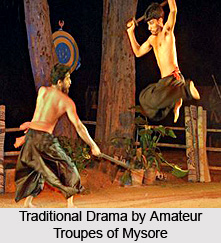
 Amateur Troupes of Mysore was, perhaps the most skilled and influential groups of performing artists. Amateur troupes of Mysore were divided into various groups, and one of the significant parts of the group was the Amateur Dramatic Association (A.D.A) which came into being 1909 owing to the enthusiastic efforts of some talented lawyers, teachers and merchants of Bengaluru. The Association sought to follow the footsteps of the famous Suguna Vilasa Sabha of Madras (Chennai) - the premier amateur dramatic association of South India, and did succeed in standing on an equal footing with established professional companies like the Ratnavali troupe of Varadachar and the Chamaraiendra Karnatak Natak Sabha patronised by the Mysore palace. Thanks to the labours of some enthusiastic workers, the paying membership of the troupe steadily expanded, placing the Association on a firm financial footing. The A.D.A. sponsored Drama Competitions offering prizes to the best of plays received. In 1919, T. P. Kailasam, "the Father of the Modern Kannada Drama" wrote down his first play Tollu Gatti for the competition and was awarded the first prize. The success of the troupe in various centres of Andhra Pradesh, Hyderabad and Mysore earned a great reputation for it and later brought continuous and munificent patronage from the Mysore palace, particularly after Yuvaraja Kantirava Narasaraja Wodeyar became a patron of the Association.
T. Raghavachari of Bellary, one of the most brilliant of the stage artists of Karnataka and Andhra Pradesh was the luminary of the Association. Under his leadership, selected members of the association took frequent weak-end-trips to near about cities and often to Bellary and Chennai to stage plays in Kannada language, Telugu language, Hindi language and English. In May 1931, a select band of artists went on a short tour of North India under the leadership of T. Raghavachari, visiting Mumbai, Shimla and Kolkata and giving three or four of their masterpieces in Hindi, Telugu and English in each centre. On the whole the tour was a distinct artistic triumph and the Amateurs came with flying colours from the critical and discerning theatre-goers of North India.The Association got plays written by Masti Venkatesha Iyengar (Talikote, Shanta), C. K. Venkataramiah {Mandodari, Nachiketa), Pandit Taranath (Deenabandhu Kabir), Bellave Narahari Sastri, Sosale Garalapuri Sastri, A. N. Krishnarao and Kailasam. Apart from T. Raghavachari, the Association could boast of a galaxy of brilliant artists like K. Bhimasenarao, who played the main roles opposite to Raghavachari, K. S. Vasudevarao who portrayed the heroine with distinction, the irresistible Naidu brothers, the talented M. L. Srinivasa Sastri and B. Muddu Krishna. A little later, the Association had the honour to have Devudu Narasimha Sastri, Motganhalli Subrahmanya Sastri Kanakalaxmamma, Annapoorna, Padmavati and other talented artists on its rolls.
The Association steadily built up a good library and by 1931, it was receiving 47 journals and newspapers in exchange for Rangabhoomi, the Kannada monthly issued by the Association. In addition, the Association conducted a Music class, weekly Reading classes and discussions on subjects connected with the theatre. Public lectures were frequently arranged. The Association registered itself formally, regularly elected its office bearers, published its detailed annual reports, a rarity then, distributed printed synopsis of the play among the audiences whenever it staged a play. Two Art-Festivals and a Drama Conference came to be organised by the Association and these celebrations attracted critics, playwrights and actors from all over India. The Art Festival of 1919 was inaugurated by Rabindranath Tagore. The All India Dramatic Conference was presided over by Sarojini Naidu. Scholars like C P. Ramaswami Iyer, Dr. and Mrs. Cousins and Dr. C. R. Reddi took part in the deliberations of the conference. Mahatma Gandhi witnessed the performance of Deenabandhu Kabir in Hindi (written by Taranath) on 19th July, 1927 and expressed great satisfaction with the performance and the laudable work done by the A. D. A. He also wrote a short introduction to the play. T. Raghavachari died in 1946. This was a grievous blow from which the Association never recovered. The great service rendered by the Association to the Kannada stage for about three decades made it an established symbol of the ideals of the Amateur theatre of Karnataka. The Association was in a way, entirely responsible for making the people theatre-minded and elevating the stage to a position of honour. It brought about a new awakening among the people with its Play competitions, Art Festivals and Dramatic Conferences, in which artists, playwrights and critics were brought together to discuss issues connected with the stage. It earned for the theatrical art of Karnataka a great reputation in other regions of the country and it preserved the story of the contemporary stage of Karnataka in the columns of Rangabhoomi and the Theatre, a story that is assuming the position of history, so far as the land`s theatre is concerned.
The literary and dramatic association of Mysore along with Chaya Artists started off a dramatic movement in Karnataka. These two association provided opportunities to several playwrights and authors to deliver the best possible plays.