 Homa therapy comes to us from the Vedas, an ancient body of knowledge in Sanskrit. The foundational tool in Homa therapy is Agnihotra. The term Agnihotra can be divided into two parts `Agni`meaning fire and `hotra`meaning healing.
Agnihotra is a vedic yajna performed at dawn and dusk and is the smallest form of Yajna. The process of Agnihotra consists of making two offerings to the fire exactly at the time of sunrise and sunset accompanied with chanting of two small Sanskrit mantras. Agnihotra in Sanskrit is a karmadharaya compound meaning an offering or sacrifice to Agni or consecrated fire .
Agnihotra can be practiced everywhere It can be done inside the house and also outside,under a tree,near a water body ,any place that requires cooling. Everyone benefits from this yajna from air to the microorganisms in the soil. Anyone can perform Agnihotri irrespective of caste , class, age, creed, nationality and even religion .Originally Agnihotra was performed exclusively by men but in today`s age it is open to both genders. Not only men or women even the children can perform Agnihotra. All that required is an attitude of devotion (bhakti) and faith (sraddha). It is somewhat a proven fact that Agnihotra reduces stress, improves one`s thought and health whilst enriching the stability of the mind.
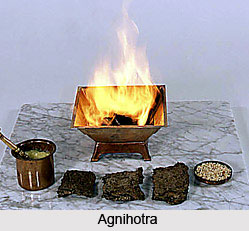
The offerings for Agnihotra consists of two pinchful of uncooked rice grains smeared with a few drops of pure ghee (clarified butter). The ghee acts as a carrier of subtle healing energies. The fire is prepared out of dried cowdung cakes in a small copper pot (clay pot can also be used). The most important aspect of the pot is it`s shape and size. Agnihotra copper pot in the west is referred as the Copper pyramid because of it`s shape.
Observation of exact sunrise and sunset timings is most important condition for performing Agnihotra if full benefit is to be gained. Another important aspect of Agnihotra is that the pronunciation of the mantras should be clear and without haste. Experiences of various people say that the chanting of the mantras gives a certain pleasure. Another important point is that the fire should be without smoke and should be fully ablaze.
Agnihotra is therefore regarded a process of purification of the atmosphere through a specially prepared fire. It also has a healing effect on the soil, the plants and earth. Precisely, it is the antidote for all the problems we have created for ourselves. By bringing about changes in the atmosphere it brings about changes in Prana. Prana (life energy) and the mind are the two sides of the same coin and therefore the beneficial change is transposed to the realm of mind. A lot of energy is gathered around the Agnihotra copper pyramid just at Agnihotra time. A magnetic type of field is created, which neutralizes negative energies and reinforces positive energies. Nothing is destroyed but only changed. Agnihotra also has a good effect on the body. It renews the brain cells, revitalizes the skin, purifies the blood and also neutralizes pathogenic bacteria. The smoke that is emanated and goes into the blood and lungs has an excellent effect on the circulatory system. The smoke also has a good effect on the brain and nervous system. Many people all over the world who practice Agnihotra have felt that sitting in Agnihotra atmosphere reshapes the mind nicely, delicately and effortlessly. They feel as if a protective film surrounds them.