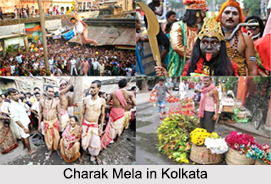
 Charak Mela in Kolkata stands unique in the scenario of Bengali festivals. It is a festival dedicated strictly to penance. Charak Puja is now often hosted in the rural parts of West Bengal, but also Kolkata has its glory of Charak that is described in the Bengali book "Hutom Pachar Noksha". Hindus celebrate the festival for the most part on the last two days of the month of Chaitra. This period is well-known as Chaitra Sankranti when Sun will enter Pisces sign. Charak Puja is a traditional Bengali festival celebrated mainly in the rural areas.
Origin of Charak Mela in Kolkata
 According to some historians, there was a time in Middle Ages when Buddhism was placed in India; Buddhists monks took shelter in numerous places. One of them was in Bengal where they converted to Hinduism. With them the Tantric rituals of Buddhism also came, which involving rituals of counting brutal self-punishment.
In Bengal, Dharmathakur is usually worshipped by the scheduled casts like Bauri, Bagdi, Hari, Dom etc. Dharmathakur have been originated from Dharmaraj of Buddhism. Although Dharmathakur is identified by a shapeless stone and its Vahana is represented by terracotta horses, there have been instances where Buddha idol has been worshipped as Dharma Thakur in the villages of Bankura. There are still villages where Dharmaraj is placed.
Celebration of Charak Mela in Kolkata
Traditional Charak Mela includes savage and spiritual acrobatics which are held across small and big towns in West Bengal, culminating in Latu Babu-Chhatu Babur Baazar in North Kolkata on the last day of the Bengali calendar year. On the day of the Charak Puja, the eve of the Bengali New Year, devotees at Latu Babu-Chhatu Babu Baazar join themselves to huge rotating swings symbolising the different cycles of life. The fair at Tarakeshwar lasts for quite a few days and it also attracts a big number of devotees. Thousands of people offer their puja to Lord Shiva on that day.
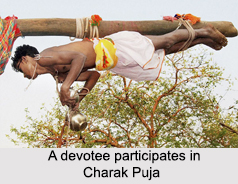
Two persons are hooked at the back with the iron hooks and hanged from a 10 to 15 feet high pole on two sides of the "chakra" (wheel). The other devotees make the formation rotate seven times. Some devotees pierce an iron rod through their tongue. Elevated structures are made with bamboo, the height ranging from anywhere between 10 to 15 feet. The ground on which they fall is scattered with glass, thorns, knives and other deceitful objects. The blessing of God keeps the devotees secure from all the potential dangers and harms. The devotees also spear their body parts without feeling of any ache. The festival not only reflects the blind faith but also the enthusiasm to believe in self-punishment on the road to attain deliverance.