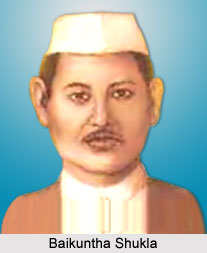
 Baikuntha Shukla, also known as Baikunth Shukla, was an Indian independence activist and one of the renowned Indian revolutionaries. He was the nephew of Yogendra Shukla, who was one of the founding members of Hindustan Socialist Republican Association (HSRA). Shukla was hanged for the assassination of Phanindra Nath Ghosh who became a British government approver that led to the death sentence of Rajguru, Sukhdev and Bhagat Singh. Baikuntha Shukla was born in the year 1910 in Jalalpur village in the district of Muzaffarpur (now Vaishali). During his early years, he received elementary education from the school in his village. Later Shukla became a school teacher in a lower primary school in the village of Mathurapur. Baikunth Shukla was instigated into the Indian independence movement at a rather young age. In the year 1930, he took active part in the Salt Satyagraha movement. He was in contact with various revolutionary associations such as the Hindustan Seva Dal and the Hindustan Socialist Republican Army (HSRA).
Revolutionary Activities of Baikuntha Shukla
Baikuntha Shukla actively participated in the Civil Disobedience Movement that was conducted in the year 1930. He was arrested and imprisoned in the Patna Camp Jail. Later he was released along with other members of the Satyagraha after the agreement of the Pact between Mahatma Gandhi and Lord Irwin. Later Baikuntha Shukla met with the members of the Hindustan Socialist Republican Army (HSRA) and became an Indian revolutionary, who made significant contributions to the Indian freedom struggle. After the trial of Bhagat Singh, Sukhdev and Rajguru in the Lahore conspiracy case, the well known Indian freedom fighters were executed. This incident enraged all the revolutionaries of the period and shook the whole nation. Phanindra Nath Ghosh, who was previously a prime member of the Revolutionary Party, deceitfully betrayed the cause by becoming an approver and provided evidence that led to the execution of the revolutionaries.
Baikuntha Shukla was commissioned to devise a plan for the execution of the traitor Phanindra Nath Ghosh. This was considered as an act of ideological vengeance. Shukla effectively and successfully carried out the execution on 9 November 1932. Eventually Baikuntha Shukla was detained by the British Indian Police and tried for assassination of Phanindra Nath Ghosh. Shukla was convicted and given the death sentence. He was hanged in Gaya Central Jail, at the age of 28, on May 14, 1934.