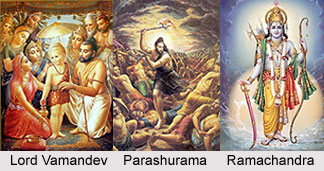
 Treta Yuga is the second among the ages of mankind or four yugas, in the Hindu religion, and follows Krita or Satya Yuga of perfect mortality and also precedes the Dvapara Yuga. The most memorable events of Treta Yuga were Lord Vishnu`s fifth, sixth and seventh incarnations as Vamana, Parashurama and Rama respectively. The Dharma bull that epitomizes mortality actually stood on three legs during this phase.
Vamana
Vishnu incarnated as dwarf son of Aditi to block King Mahabali of Asura race, the grandson of Prahlada, for completing the sacrifice which would allow him to overshadow Indra in splendor and power. The worried and jealous Devas persuaded Vishnu to send Bali, a disciple of his, to Patala, the underworld. Vishu took advantage of king`s kindness and refused to go back on his word, but allowed him a posh dwelling in one of the lower worlds. He also gave him the boon of being able to visit his subjects once every year which is celebrated in Onam festival.
Parashurama
Vishnu incarnated as Brahamana Parashurama during this era as there were too many battle like Kshatriya inflicting the Earth, and so he had to wipe out the most of the world`s warriors. But some of the Kshatriya was created, and population grew again. Eventually Parashurama, the Vishu avatar ended and he continued to live on as a mighty warrior hermit. Before acknowledging Ramachandra`s supremacy he confronted with him. He dwelled in Dwapara Yuga, having duel with Bhishma for Amba`s sake and also taught Karna who to use Brahmastra. He also vowed that he will never teach or be a mentor of Kshatriyas.
Ramachandra
The main feature of this era is the rise of demon, the king of Lanka, Ravana. He conquered all the three worlds and terrorized everyone. The Devas were also junior to him. His son Meghanada has earned the name Indrajit after defeating king of heaven, Indra. Then Lord Vishnu incarnated himself as the son of Dasaratha, King of Sun Dynasty and named Lord Rama. However, after the jealousy of his step mother Lord Rama was sent to an exile where he confronted with Ravana for having kidnapped his wife, and hence restored peace on earth.