Introduction
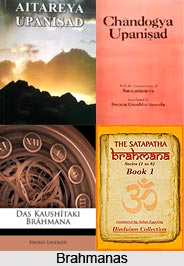 Brahmanas form the second greatest class of works belonging to the Vedas. The Brahmanas actually give the instructions for a proper performance of ritual and sacrifice. All the rituals of the Brahmana are of an outward nature. The ritual proceeds primarily through speech, breath and mind. The mantras or the chants are the main power of the ritual. The main Brahmanas are the Aitareya, Kaushitaki, Chandogya, Taittiriya and Shatapatha Brahmana. The Brahmans are sometimes much longer than their respective Upanishads.
Meaning of Brahmana
The word Brahmana means first a single explanation or utterance of a learned priest, of a doctor of the science of sacrifice, upon any point of the rituals. Used collectively, the word means, secondly, a collection of such utterances and discussions of the priests upon the science of sacrifice. For although the Brahmanas fortunately contain much that has only a distant reference to the sacrificial cult, for instance, cosmogonic myths, ancient legends and narratives, yet the sacrifice is the one and only theme from which all the discussions start, on which everything hinges. It is believed that several Brahmins from 600 BC onwards have authored these textbooks on rituals and prayers. Again, it is said that later, Ved Vyas, the arranger of the Vedas, has compiled the Brahmanas.
Content of Brahmanas
 The content of Brahmanas can be easily understood by taking a look at a few of the works of Brahmana literature. The Brahmanas are a splendid proof of the fact that an enormous amount of religion can be connected with very little morality. Religious acts, sacrifices and ceremonies, are the one and only subject of all these extensive works, but morality is a thing with which these works have nothing to do. On the contrary, sacrificial acts are not only performed in order that the gods may fulfil the very materialistic wishes of the sacrificer, but also very frequently in order to injure an enemy. Indeed, the Brahmanas give directions for the priests, how, by means of the sacrifice, they can injure the sacrificer himself by whom they are employed, if, for instance, he does not give them enough presents. They need only perform the prescribed ceremonies in reverse order, or employ spells at the wrong place, and the fate of the sacrificer is sealed.
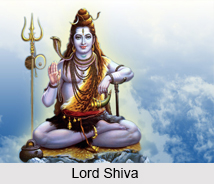
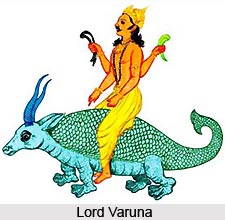
Gods in Brahmanas : In the Brahmana works, the religious and social conditions have changed very much since the time of the Rig Veda. The old gods of the Rig Veda still appear in the Yajur Veda Samhitas and in the Brahmanas, just as in the Atharva Veda. But their significance has wholly faded, and they owe all the power they possess to the sacrifice alone. Furthermore, some gods who still play a subordinate part in the Rig Veda step into far greater prominence in the liturgical Samhitas and in the Brahmanas, as Lord Vishnu, and especially Rudra or Lord Shiva. Paramount importance is now attached to Prajapati, "the lord of creatures," who is regarded as the father of the gods (Devas) as well as of the demons (Asuras). The word Asura, which, corresponding to the Avestic Ahura, in the Rig Veda, still has the meaning of "endowed with miraculous powers" or "God," and appears especially often as an epithet of the Lord Varuna, henceforth has exclusively the meaning of "demon" which it always has in later Sanskrit. Again and again mention is made in the Brahmanas of the battles between Devas and Asuras. Yet there is nothing monumental about these battles, as, for instance, the battle between Indra and Vrtra in the Rig Veda, but the gods and Asuras exert themselves to surpass each other by means of sacrifices. For in these Brahmanas the gods actually have to make sacrifices if they wish to accomplish anything.
 Sacrifice in Brahmanas : Nothing is more significant for the Brahmanas than the tremendous importance which is ascribed to the sacrifice. The sacrifice is here no longer the means to an end, but it is an aim in itself, indeed, the highest aim of existence. The sacrifice is also a power which overwhelms all, indeed, a creative force of Nature. Therefore the sacrifice is identical with Prajapati, the creator. "Prajapati is the sacrifice" is an oft-repeated sentence in the Brahmanas. "The soul of all beings, of all gods is this, the sacrifice." "Truly, he who consecrates himself for the sacrifice, he consecrates himself for the All, for only after the sacrifice follows the All; in making the preparations `for the sacrifice, for which he consecrates himself, he creates the All out of himself."
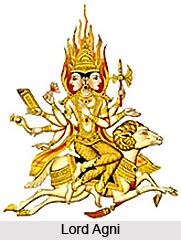
In countless places in the Brahmanas the sacrifice is identified with the Lord Vishnu and equally frequently with the creator Prajapati. But the year, too, is identified with Prajapati countless times, while on the other hand Lord Agni, as the fire-altar, is also regarded as the year, because the building of the fire-altar takes a whole year. Thus we read: "Agni is the year, and the year is these worlds," and immediately afterwards: "Agni is Prajapati, and Prajapati is the year." Or, "Prajapati, indeed, is the sacrifice and the year, the new moon night is its gate, and the moon is the bolt of the gate." A prominent part is here played by the symbolism of figures.
Equally significant is everything which is connected with the sacrifice, the sacrificial utensils no less than the prayers and formulae, the verses and their metres, the chants, and their melodies. Every single sacrificial act is treated with the greatest circumstantiality: enormous importance is attached to the most trivial circumstances, to the least details. Whether an action is to be performed to the left or to the right, whether a pot is to be put in this or in that spot on the place of sacrifice, whether a blade of grass is to be laid down with the point to the north or to the north-east, whether the priest steps in front of the fire or behind it, in which direction he must have his face turned, into how many parts the sacrificial cake is to be divided, whether the ghee is to be poured into the northern or the southern half or into the centre of the fire, at which instant the repetition of a certain spell, the singing of a certain song has to take place- all these are questions upon which generations of masters of the art of sacrifice have meditated, and which are treated in the most searching manner in the Brahmanas. Upon the correct knowledge of all these details does the rise and fall of the sacrificer depend.
 It is believed that those who know the guides through the wilderness of sacrificial art, are the priests, and it is no wonder that the claims of the priestly caste in the Brahmanas, as already in some parts of the Atharva Veda, exceed all bounds. Now the Brahmans were frequently declared to be gods.
Morality in Brahmanas : Moral reflections are not found too often in the Brahmanas. Only occasionally certain such moral reflections can be seen such as for instance when the Asuras defeated the gods by falsehood, but the gods gained the ascendancy in the end. It is said that in like manner when men speak the truth, they may suffer adversity at first, but will prosper ultimately, while though the liars may have success for a time, they will surely perish in the end. Generally speaking, however, it is very characteristic of these texts that there is hardly any mention of morality in them at all.
These explanations found here and there in the Brahmanas are of importance in that they throw light upon the moral views and social conditions of the period to which the Brahmanas belong.
Narratives in Brahmanas
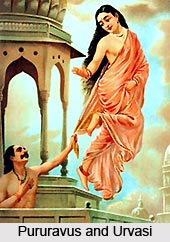 Narratives in Brahmanas are many in number and they deal with a variety of themes. These narratives are of great importance to us as they are the oldest examples of Indian narrative prose. This prose of the oldest epic compositions frequently alternates with verses. However, it has been seen in some of the narratives, such as that of Pururavus and Urvasi, the verses appear not only in the Rig Veda collection, but in language and metre belong to the oldest Vedic compositions too. Moreover, it there is seen in the Aitareya Brahmana an Akhyana in which the Gathas or verses scattered among the prose approach the epic in language as well as in metre.
Unfortunately few narratives have come down in entirety, barring a few such as that of Sunahsepa. Mostly, the stories are prepared for the purpose which they are to serve- the explanation or justification of a sacrificial ceremony. Consequently, it is sometimes not easy to extract from them the nucleus of an old legend or an old myth. Moreover, by no means are all the narratives which in the Brahmanas derived from old myths and legends, but they are often only invented for the explanation of some sacrificial ceremony. Apart from this prime purpose of explanations of sacrificial ceremonies, there are a number of other themes with which these narratives deal. While there are some stories dealing with the attributes of women, there are also numerous narratives in the Brahmanas which deal with the origin of some matter or some institution.
Such legends of origin, to which also the creation-legends belong, are designated as Puranas, in order to distinguish them from the Itihasa (or Akhyanas), as the stories of gods and men are called. Among these narratives, too, there are such as were merely invented by Brahmana theologians, while others date back to old, popular myths and legends, or at least are founded upon a tradition independent of the sacrificial science. Thus, the origin of the four castes is frequently related in the Brahmanas. The creation-legends are very numerous in the Brahmanas. Just as these creation-legends usually being by relating that Prajapati "torments and mortifies himself," so it is often read that, after the creation was accomplished, he was described, through which his strength had to be restored.
Concept of Brahmin in Brahmanas
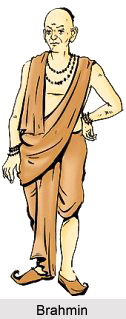 Concept of Brahmin in Brahmanas is such that the Brahmins were raised to an almost God like status. According to the Brahmanas, there are two kinds of Gods, namely the divine Gods and the learned ones on earth, the Brahmins. The Brahmins are said to be the human gods. The sacrifice is divided between these two gods. The sacrificial gifts are for the gods, the presents (Dakshinas) for the human gods, the learned and studying Brahmins. By means of sacrificial gifts man pleases the gods, by presents he pleases the human gods, the learned studying Brahmins: these two kinds of gods transfer him, when they are satisfied, into the blessedness of heaven.
Brahmin has four duties. These include Brahmanic descent, corresponding conduct, fame (gained through erudition) and "ripening of the people"(i.e. offering of sacrifices, by means of which people are made ripe for the Beyond). These ripened people also have four duties towards the Brahmins. They must show them honour, give them presents, may not oppress and not kill them. The property of a Brahmin may under no circumstances be touched by the king; and if a king gives his whole country with all that is in it, to the priests as a sacrificial fee (Dakshina), then it is always understood that the property of Brahmins is accepted. A king can certainly oppress a Brahmin, hut if he does so, evil will befall him. At the consecration of a king the priest says "this man, ye people, is your king; Soma is the king of us Brahmins," to which the Satapatha Brahmana observes:" By this formula he makes the whole nation as food for the king; the Brahman alone he excepts; therefore the Brahmin must not be utilised as food; for he has Soma as his king." Only the murder of a Brahmin is real murder. In a quarrel between a Brahmin and a non-Brahmin the judge must always decide in favour of the Brahmin, for the Brahmin may not be contradicted.
Everything which for some reason or another is taboo, which one may not touch, and cannot use otherwise, as, for example, the stone and earthenware vessels of a deceased person or a cow (intended for the Agnihotra milk) which becomes stubborn or ill, must be given to the Brahmin, especially the remains of sacrifices and food which are taboo for others, for "nothing injures the stomach of a Brahmin." Thus, at last, the conclusion is arrived at, that the Brahman is no longer a "human god" by the side of the heavenly gods, but that he raises himself above the gods. Already in the Satapatha Brahmana it is said that in Him all deities are incorporated. This presumption on the part of the priests, the beginnings of which is seen in the Brahmanas, is not only of the greatest interest for the history of culture as an example of priestly arrogance, but it is also the precursor of a phenomenon which can be traced through the whole of Indian antiquity.
Thus, already in the Brahmanas, the priest exalts himself over the gods through the sacrifice. In the epics one reads of countless stories of ascetics who, through asceticism attain to such ascendancy that the gods tremble upon their thrones. Thus the according to the Brahmanas, the Brahmins occupy a very important position, almost god-like.
Brahmanas in Vedas
 The Brahmanas in the Vedas form an essential part of the Vedic texts. They exist in the form of a commentary on the particular Vedic text and deal with the various aspects of prayer and sacrificed in minute detail. Every Veda has its own Brahmana attached to it. These are discussed below.
Rig Veda Brahmanas : To the Rig Veda belongs the Aitareya Brahmana. It consists of forty Adhyayas or "lessons," which are divided into eight Panchakas or "fifths." Tradition names Mahida Aitareya as the author of the work, though it is possible that in reality he was only the compiler or editor of it. This Brahmana deals chiefly with the Soma-sacrifice, besides the fire-sacrifice (Agnihotra) and the feast of the consecration of a king (Rajasuya). It is supposed that the last ten sections are of later origin.
In the closest relationship with this Brahmana is the Kausitaki or Brahmana, also belonging to the Rig Veda, and consisting of thirty Adhyayas or "lessons." The first six Adhyayas deal with the food-sacrifice (fire-laying, fire-sacrifice, new and full moon sacrifices and the sacrifices of the seasons), while Adhyayas VII to XXX deal with the Soma-sacrifice fairly agreeing with the Aitareya Brahmana. The Kausitaki Brahmana is later than the Aitareya Brahmana. However, while the latter is not the work of one hand and of one period, the Kausitaki Brahmana is a uniform work.
Sama Veda Brahmanas : To the Sama Veda belongs the Tandya Maha Brahmana, also called Panchavinisa, i.e. "Brahmana consisting of twenty-five books." This is one of the oldest Brahmanas and contains some important old legends. Of special interest are the Vratyastomas, and the description of sacrificial ceremonies by means of which the Vratyas were received into the community by the Brahmans. The Sadvimsa Brahmana, i.e. "the twenty-sixth Brahmana," is only a completion of the Tandya which consists of twenty-five books. The last part of the Sadvimsa is the so-called "Adbhuta Brahmana," a Vedanga text on miracles and omens.` The Jaiminiya Brahmana of the Sama Veda is even older than the Tandya Maha Brahmana. This work is of special interest for the history both of religion and legend, but unfortunately the manuscript material is so fragmentary that it cannot be edited.
Yajur Veda Brahamanas : The Taittiriya Brahmana of the Black Yajur Veda is nothing but a continuation of the Taittiriya Samhita, for the Brahmanas were already included in the Samhitas of the Black Yajur Veda. The Taittiriya Brahmana, therefore contains only later additions to the Samhita. There is to be found here only a description of the Purusamedha, the symbolical "human sacrifice" and the fact that the sacrifice is missing in the Samhita is one of the many proofs that it is only a rather late production of the science of sacrifice.
To the white Yajur Veda belongs the Satapatha Brahmana, "the Brahmana of the Hundred Paths," so called because it consists of one hundred Adhyayas or "lessons." This is the best known, the most extensive, and doubtless, also on account of its contents the most important of all the Brahmanas. There are two recensions of this Brahmana, that of the Kanvai and that of the Madhyandinas.
In the latter the hundred Adhyayas are distributed among 23 Kandas or books. The first nine books are simply a continuous commentary on the first eighteen sections of the Vajasaneyi Samhita. They are decidedly older than the last five books. Probably also Books I to V are more closely connected. In them Yajnavalkya, who at the end of Book XIV is called the author of the whole Satapatha Brahmana, is often mentioned as the teacher whose authority is conclusive. On the other band, in Books VI to IX, which deal with the fire-altar building (Agnicayana), Yajnavalkya is not mentioned at all. Instead of him another teacher, Sandilya, is quoted as an authority, and the same Sandilya is also regarded as the proclaimer of the Agnirahasya, i.e. of the fire-altar mystery, which forms the contents of Book X. Books XI to XIV, besides appendices to the preceding books, also contain a few interesting sections on subjects which are otherwise not dealt with in the Brahmanas. At the close of this extensive work is the old and important Brhadaranyaka Upanishad.
The difference between the Brahmanas which belong to the separate Vedas lies chiefly in the fact that the Brahmana of the Rig Veda, in the presentation of the ritual, emphasize that which is of importance to the Hotar priest, who has to recite the verses and hymns of the Rig Veda, while the Brahmanas of the Sama Veda are chiefly concerned with the duties of the Udgatar, and those of the Yajur Veda with the sacrificial acts to be performed by the Adhvaryu.
In the essentials of their contents the Brahmanas all agree fairly well with one another. In the main the same subjects are always deal with and all these works bear the same stamp.