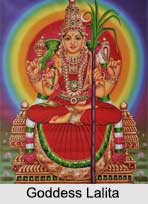
 Goddess Lalita is considered as the embodiment of Para Shakti or the ultimate female power. She is also called "Tripura Sundari" as Her Body consists of three Shaktis that is Brahma, Vaishnavi and Raudri. Goddess Lalita Tripura Sundari is referred in Hindu literature time and again. The Lalita Sahasranama illustrates her charismas from head to foot. She is described as the one who recreates the universe. She was manifested through a Maha Yajna performed by Maha Shambhunatha.
Iconography of Goddess Lalita
Lalita or Tripura Sundari together combines the features of Goddess Kali and Goddess Durga. She has Kali"s determination and Durga"s charm, grace and complexion. She is described in great detail as extremely beautiful, gorgeous and erotically inclined. She has a third eye on her forehead. Lalita is said to be four-armed and clad in red dress. She is the heavily ornamented and sits on a lotus seat laid on a golden throne. Lalita carries in her hands various Shaivite attributes.
In Adi Shankaracharya"s book "Tripura Sundari Ashtakam" describes Goddess Lalita as a Mother, she portrays as giving shelter. In this book, Lalita as the mother nourishes breasts akin to mountain peaks that give birth to rivers. She is represented as wearing a blue dress with red spots, holding a pot of honey, her eyes quivering with intoxication.
Legends of Goddess Lalita
Legends associated with Goddess Lalita are found in mythological texts. "Devi Bhagavata", "Durga Saptashati" in Markandeya Purana by the sage Vyasa and "Tripura Rahasya" narrated by the Lord Dattatreya are some such texts. Books related to Tantra also mention the Goddess.
As per legends, Goddess Lalita represents the Panchabhuta: earth, water, fire, air and space. She always appears as though she is 16 years of age. This description is interpreted in another way as well. According to this theory Goddess Lalita appears in the form of 16 nityadevis. While depicting the war between Bhandasura and the goddess, Lalita Sahasranama Stotra mentions the nityadevis. Lord Shiva married her in the avatar of Kameshwara.
Lalita Sahasranama Stotra
Lalita Sahasranama Stotra, the hymn of 1000 names of Lalita is the best one venerated by the followers of all the traditions. The spiritual masters of the past have written several commentaries on the Lalita Sahasranama Stotra. They have firmly established that the hymn contains the essence of the Mantra Shastra of the entire world. They have thoroughly analysed and described each name of the hymn from various aspects.