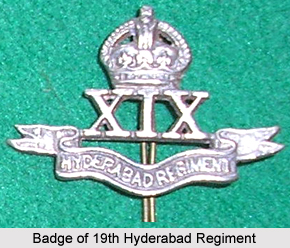
The 19th Hyderabad Regiment was an army infantry unit of the British Indian Army. The unit remained in service from 1922 to 1947. After the First World War, the British Government of India restructured and reformed the entire line of regiments in the British Indian Army. The single infantry regiments were joined to form larger multi battalion regiments that comprised of 4 to 6 battalions each. As a result, the 19th Hyderabad Regiment was established in 1922 by the merger of 7 former British Indian army units. The military regiment served valiantly during the Second World War. After the Indian independence, the 19th Hyderabad Regiment became a part of the Indian Army and was re-designated as the Kumaon Regiment.
History of 19th Hyderabad Regiment
The 19th Hyderabad Regiment was established by the merger of the 95th Russell`s Infantry unit, 99th Deccan Infantry, 98th Infantry regiment, 97th Deccan Infantry (4th Infantry of Hyderabad Contingent), 96th Berar Infantry unit (3rd Infantry of Hyderabad Contingent) and 94th Russell`s Infantry (1st Infantry of Hyderabad Contingent). The 94th Russell`s Infantry was appointed as the 1st Battalion 19th Hyderabad Regiment; the 96th Berar Infantry became the 2nd Battalion; the 97th Deccan Infantry regiment was appointed as the 3rd Battalion; the 98th Infantry was designated as the 4th Battalion; the 99th Deccan Infantry unit was assigned as the 5th Battalion; and the 95th Russell`s Infantry became the 10th (Training) Battalion, 19th Hyderabad Regiment. Later the /50th Kumaon Rifles was merged with the 19th Hyderabad Regiment in 1923 and was renamed as the 1st Kumaon Rifles.
 In 1939, the infantry unit consisted of 4 regular battalions, including the 1st battalion (Russell`s), 2nd battalion (Berar), 4th battalion and the Kumaon Rifles. During the Second World War eight more battalions were raised. Eventually two more battalions (1st Hyderabad Infantry and 2nd Hyderabad Infantry) were formed and were included as apart of the Indian State Forces.
Military Operations of 19th Hyderabad Regiment
The troops of the unit served in Burma, Singapore, Malaya, Persia, North Africa and the Middle East. The 19th Hyderabad Regiment was stationed in Hong Kong during the commencement of the war. Later it was sent to Middle East and served with the 24th Indian Infantry Brigade. In 1941, the troops, under the leadership of Major General William Slim, participated in the Anglo Soviet invasion of Iran. Eventually they were sent to Persia as part of the garrison.
After the country achieved freedom in 1947, the 19th Hyderabad Regiment was disbanded.