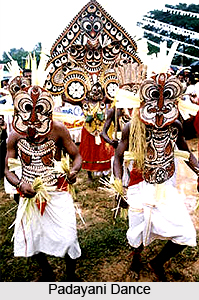
 Padayani dance is one of the popular traditional folk dances of Kerala state of India. Generally, padayani dance is associated with the festivals of certain temples in southern Kerala like Alappuzha, Kollam, Pathanamthitta and Kottayam district. It is performed in Bhagavati temples in honour of Bhadrakaali.
Padayani means a `row of warriors`. This dance form is an amalgamation of music, dance, theatre, satire, facial masks, and paintings. In relation with this folk art, there are mainly series of divine and semi-divine impersonations in the performance of the dance.
Origin of Padayani Dance
Padayani was practiced by magico-medicine men of Kerala in order to heal the illnesses that were not amenable to medical modalities of intervention. The Tinta endogenous section of Ganaka mainly used to design and perform this in the form of psychic or spiritual healing. Then this art form turned into a divine ritual tradition in association with festival occasions of Bhagavathy temples of Kerala. Eventually in Kollam, Pathanamthitta, Alappuzha and Kottayam districts of Kerala, the Nair folk became the performers of the modern form of Padayani art, but the design and making of costumes vested with Kaniyar people.
Myth and Performance of Padayani Dance
The popularity of padayani is immense in Kerala as this dance is a medium of worshipping goddess Kali. The story line comes as- after killing daruka, an asura, goddess was in anger. Then bhoothagana, servants of lord siva, dances in front of her to diminish her anger, else her anger would result in the destruction of the whole world. In memory of this incident, the participants wear masks called kolam and enact the story.
The songs of this dance are age old and have been handed down from the ancestors over the years. The lyrics are in simple Malayalam language. Traditionally, only a single musical instrument is used to accompany this dance form called thappu.
The dance begins with heating the thappu which is placed in such a way that it faces the fire. Then after sometime, the dance movements start. The entire performance of padayani comprises of various dance forms with different names such as madan, marutha, yakshi, pakshi, kalan kolam and bhairavi kolam. Marutha is not lengthy and is essayed in the form of drama.
Kalan Kolam is the major attraction in padayani. This form narrates about a child who is begging his life to lord siva while death comes in his 16th birthday. At that time kalan, the god of death comes and tries to take the life of markandaya, the boy.
Bhairavi kolam is the dance to worship goddess. It is the biggest kolam and uses many laths of areca tree. The kolam is headed by more than one person due to its heavy weight. The percussion instruments that accompany the padayani dance are patayani thappu, chenda, para and kumbham.
Design of Mask
The performers take stage, wearing huge masks or Kolams of different shapes and colours. The Kolams are made of the green of the lath itself (kamukin pacha), kari (carbon), manjalpodi, sindooram etc.
The Kolams are beautifully painted and designed using various colours. The colours used to make kolam are purely natural. The most important Kolams usually presented in a padayani performance are Bhairavi (Kali), Kolam (god of death), Yakshi (fairy), and Pakshi (bird). These colourful Kolams add more beauty and charm to the overall performance.