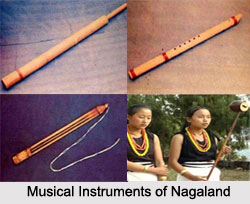
Nagaland’s indigenous music is further enriched by a variety
of handmade wind instruments
crafted from bamboo and other natural elements. Bamboo mouth
organs, flutes, and trumpets are common across tribes, each with its own
construction technique and purpose. The use of cup violins, drums made from
cattle hide, and large log drums, often housed in morungs (youth dormitories), demonstrates
the integral role of music in daily tribal life.

Jemji - The Jemji is a traditional wind
instrument of Nagaland, distinguished by its bold, sonorous tone and unique
construction. Made from the horn of a Mithun, a revered semi-domesticated
bovine native to the region, the Jemji stands as both a musical and cultural
symbol among the Naga tribes.
Crafting the Jemji requires skill and respect for tradition.
The natural curve of the mithun’s horn is hollowed and shaped into a wind
instrument capable of producing deep, echoing notes that can carry across long
distances. Its sound is often described as powerful and haunting, making it an
ideal accompaniment for ceremonies, gatherings, and storytelling sessions.
In traditional performances, the Jemji is typically played
alongside other indigenous instruments such as the Tati, the Theku, and the
Asem. Together, these instruments create a rich, layered soundscape that forms
the heart of Naga folk music.
Malen – The Malen is a delicate and distinct
traditional wind instrument from Nagaland, cherished by the Ao tribe for its
simplicity and seasonal significance. Unlike the more commonly known bamboo
flute, the Malen is crafted from the stump of a paddy plant, making it both
unique in form and deeply connected to the rhythms of agricultural life.
Small in size, just about four to five inches long and as
slender as a lead pencil, the Malen is easy to make and play. It is typically
crafted during the harvest season, a time of celebration and gratitude, further
embedding it into the cultural practices of the Ao people. Its creation from
the remnants of the paddy plant also symbolizes a resourceful and respectful
relationship with nature.
Though modest in appearance, the Malen produces a soft,
melodic sound that carries the joyful spirit of harvest time. Often played in
informal settings or as part of seasonal festivities, it provides a gentle
musical backdrop to songs, storytelling, and communal gatherings.

Atutu - The Atutu is a traditional bamboo trumpet crafted
and used by the Pochury tribe of Meluri in Nagaland. Made from a specific
variety of bamboo, this unique wind instrument is a reflection of the tribe’s
craftsmanship and cultural wisdom. Each Atutu is carefully assembled from
multiple components, all carved and fitted by hand to form a long, resonant
trumpet.
The Atutu holds deep cultural and ceremonial value. One of
its most symbolic uses is during the Nazhu festival, an important celebration
for the Pochury people. Towards the end of February, the Atutu is blown to mark
the arrival of the festival, its powerful sound echoing across the village as a
call to gather, rejoice, and uphold tradition. Throughout the festival, male
members of the community continue to play the trumpet in their morungs (youth
dormitories), adding a musical rhythm to the evening atmosphere.
Beyond its ceremonial role, the Atutu has long served
practical purposes in village life. Its loud, far-reaching sound was
traditionally used to scare off birds and wild animals from rice fields,
protecting crops from damage. Herd’s men also used it to scare away wild
animals from the cattle. In older times, the Atutu also served as a
communication tool, its blast signaling danger, announcing enemy movement, or
even declaring war. It was, in many ways, the village’s voice of urgency and
celebration alike.
Bamhum - The Bamhum is a modern yet deeply rooted
musical innovation from Nagaland, a wind instrument like no other, created by
musician and cultural visionary Moa Subong. Crafted from bamboo and played by
humming instead of blowing, the Bamhum redefines accessibility in music,
allowing even beginners to create melodious sounds with ease.
What sets the Bamhum apart is its simplicity. Unlike
conventional wind instruments, it doesn't require breath control or formal
training. Instead, the player hums into a specially designed hole at one end of
a hollow bamboo tube. A natural node is preserved within the bamboo, where the
vibrations are processed, and a rattle at the opposite end amplifies the
sound—producing a distinctive, earthy tone. The pitch and rhythm are entirely
controlled by the player’s voice, making it a highly expressive and personal
instrument.
The bamboo used in the Bamhum is the strong, durable kind
typically reserved for fencing, ensuring both longevity and acoustic richness.
Its organic structure and handcrafted design reflect a deep connection to
nature and indigenous tradition—values central to Naga culture.
Moa Subong’s creation was not only a musical breakthrough
but also a cultural milestone. For his ingenuity, he was honored with the
National Award for Grassroots Innovation, recognizing the Bamhum as a tool of
creative empowerment. The instrument became a signature element in the sound of
Abiogenesis, the genre-blending band led by Moa and his wife, Arenla Subong.
Through their music, the Bamhum has helped introduce Naga folk fusion to a
global audience, carving a niche for Northeast Indian sounds in the world music
scene.
Alim - The Alim is a traditional bamboo flute
cherished by the Ruangmei community of Nagaland. As an aerophone, the Alim
produces music through the vibration of air, creating a soft, poetic resonance
that has long been a part of the tribe’s musical identity. With its mellow
tones and calming presence, the Alim has become a companion of solitude and
reflection.
Handcrafted from a carefully chosen bamboo stick, the Alim
typically features four to six finger holes. When the player blows through the
blowhole and alternately covers and uncovers the holes, the flute releases
airy, melodic notes that flow with grace and subtlety. The sound of the Alim
captures the natural beauty of Naga life, its rhythms echoing the wind through
bamboo groves, its tones mirroring the emotional depth of Naga folklore and
traditions. Though simple in design, the Alim requires a sensitive touch and
breath control, turning every tune into a deeply personal expression.

Jingkieng Bung - The Jingkieng Bung, also known as
Jingkieng Ksiar, is a traditional bamboo mouth organ from Nagaland, cherished
for its soft, soothing tones and cultural significance. Crafted entirely from
bamboo, this wind instrument reflects the Naga tribe's
deep-rooted connection to nature, music, and indigenous craftsmanship.
Measuring approximately six and a half inches in length, the
Jingkieng Bung consists of several bamboo pipes of varying sizes. Each pipe is
carefully cut to produce a distinct note, and when played together, they create
a gentle, harmonious melody. Often called the “midnight musical instrument,” it
is known for its calming, almost dreamlike sound, ideal for quiet evenings and
reflective moments. It is played mostly inside the dormitory Zuki; where young
girls sleep. This mouth organ is also called the "Midnight Musical
Instrument".
What sets the Jingkieng Bung apart is its simplicity. Both
in construction and playability, it requires no formal training, making it
accessible to musicians of all skill levels. Yet, despite its modest design, it
delivers a rich emotional depth, capturing the soul of Naga folk music.
Kong-ali - The Kong-ali is a traditional mouth harp
from Nagaland, known for its distinctive twang and expressive tone. This simple
yet captivating instrument holds a special place in the musical heritage of the
Naga tribes, often used as a tool for personal expression and artistic
performance.
Typically crafted from bamboo or metal, the Kong-ali is
small and portable but powerful in sound. To play it, the musician holds the
frame against the mouth and gently plucks the reed. The mouth acts as a
resonating chamber, allowing the player to modulate pitch and tone with subtle
movements of the lips and breath. Despite its minimalist structure, the
Kong-ali is capable of producing a wide range of melodic effects, from soft
murmurs to rhythmic pulses.
From village festivals to sacred rituals, the traditional
instruments of Nagaland continue to echo the stories, beliefs, and spirit of
its people, an enduring testament to the cultural depth of this northeastern
Indian state.