Samkhya philosophy or the school of enumeration is also known as Sankhya, the
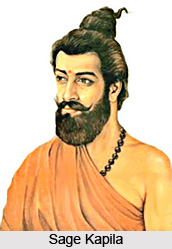
Sanskrit meaning of which is enumeration. It is one of the six schools of Indian orthodox philosophy and is believed that sage
Kapila was the original founder of this school of philosophy. In fact it can also be said that Samkhya was one of the earliest Indian attempt towards a systematic philosophy. It is generally accepted by all that the Samkhya has two schools of philosophy. One is the theist school and the other is the atheist school of philosophy. Though presently there are no purely Samkhya schools existing in
Hinduism, yet its influence is felt in
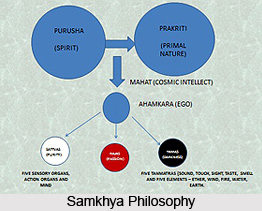
Yoga and Vedanta schools. Samkhya philosophy regards the universe as consisting of two eternal realities: Purusha (the universal self) and Prakriti (the basic matter of which the universe is consisted). It is therefore a strongly dualist and enumerationist philosophy.
Purusha is the centre of consciousness, whereas,
Prakriti is the source of all material existence. Samkhya forms the philosophical basis for Yoga of
Patanjali as well. Thus, the school of Indian philosophy has deeply influenced the Hindu Yoga. They are sometimes referred to as Samkhya - yoga school, Yoga forms the practical methodology to achieve the goal, while Samkhya provides the rational analysis of the Truth.
The Samkhya system proposes the theory of evolution (prakriti-purusha) that is accepted by all other systems. The purusha (soul) of this system is unchanging and is a witness to the changes of prakriti. Hence the Samkhya system is based on dualism wherein nature (prakriti) and conscious spirit (purusha) are separate entities not derived from one another. Samkhya is essentially atheistic because it believes that the existence of god cannot be proved. Generally, the Samkhya system classifies all objects as falling under one of the two categories: Purusha and Prakriti. Metaphysically, Samkhya maintains a revolutionary duality between spirit/consciousness (Purusha) and matter (Prakrti).
The Samkhya school of Philosophy says that the purusha is an unrelational element and a state of pure consciousness which presides over every individual mind. In this state of the mind the unconscious state of the mind attains its completeness in the form of becoming a state of consciousness. Purusha refers to a state of emancipation which is incomprehensible and transcendental. It is above all kinds of human experience. Samkhya school of philosophy regards that purusha is the ultimate state of metaphysical liberation. It is a state of culmination whereby the mental faculties of an individual are freed from all kinds of grossness and is in the state of renouncement. Rather it can be said that purusha is the absolute tranquility of the mind. The Samkhya thought states that only then can the spirit be liberated when an individual possess the knowledge of distinguishing between the conscious purusha and the unconscious Prakriti.
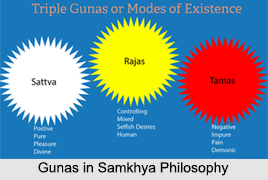
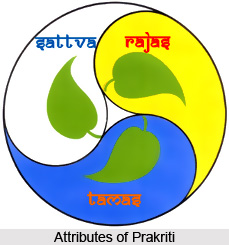
According to the Samkhya philosophy, the Prakriti is the original matter and is composed of the three gunas or sattva composed with the elements of truth and virtue. Sattva means a state of illumination, joy and rejuvenation. Rajas are present in all that is active, fiery, or aggressive, and Tamas is the principle of darkness, dullness, and inactivity. These gunas work in association with each other in order to bring about manifestation of the inner potentialities of the self. The gunas not only work in association with each other but they also work together in groups so that the manifestation of the whole is possible. The union of the gunas brings about self expression of the individual whole and the community whole as such and consequently manifestation of more developed forms takes place. It can also be said that Prakriti is the manifestation of all physical events of the universe. The Samkhya philosophy states that when an individual does not have the realisation of the true state of purusha, he is easily misled by the physical entity or the prakriti.
The two entities of existence are of prime importance according to the Samkhya philosophy. It emphasises on the single existence of the Prakriti and says that the purusha has multiple entities. Prakriti according to the postulates of the philosophy is the gross, unintelligent being and is the ultimate manifestation of all physical entities. The purusha, on the other hand, is the intelligent being who is a passive enjoyer. The philosophy also believes that an individual is not able to transcend from the state of purusha to the state of prakriti.
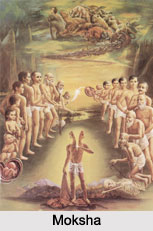
The Samkhya system is based on Satkaryavada. According to Satkaryavada, the effect already exists in the cause. Cause and effect are seen as different temporal aspects of the same thing - the effect lies latent in the cause which in turn seeds the next effect. More specifically, Samkhya system follows the Prakriti-Parinama Vada. The Samkhya Philosophy says that when the purusha is in a state of ignorance it easily identifies itself with the prakriti and gets periled with the elements of Mahat, Manas and Ahamkara which are essentially the products of the prakriti. The philosophy states that unless the mind becomes free from all kinds of bonds and falsehood it cannot achieve the state of
Moksha. Some other forms of the Samkhya philosophy states that moksha can also be attained by developing the higher faculties of the mind which means a state when the mind is free from all kinds of negative emotions.
Samkhya, like all other systems of Indian philosophy, regards ignorance as the root cause of bondage and suffering. It emphasises on the fact that a pure mind is essential to make living in this universe worthwhile. Unless human mind gets rid of all gross elements it is not possible to achieve a state of eternal bliss.