 Indian Folk paintings are pictorial expressions of village painters which are marked by the subjects chosen from epics like Ramayana and Mahabharata, Indian Puranas as well as daily village life, birds and animals and natural objects like sun, moon, plants and trees. The colour used expands vast range of vivid vibrant colours to subdued low hues, but mainly derived from the natural material, while papers, clothes, leaves, earthen pots, stone and mud walls are used as canvas. Folk paintings evolved in various region of India depending mainly upon the rural cultures, mythological stories and everyday rituals. The different types of Folk arts are Patas of Bengal and Orissa, Talpatrachitra of Orissa, Madhubani or Mithila style, Rajasthani Painting, Pahari painting, Jain art at Gujarat, Warli paintings of Maharastra, Thakga, Monpa and different South Indian Folk arts.
Indian Folk Paintings are so variable from region to region because of the availability of material in different area. Whereas in arid Rajasthan the colours in the folk painting are vibrant and lustrous, painters in colourful Bengal seem to search relief in sober subdued tones. Artists in Orissa pick out palm leaves for painting. While north India found the whitewashed walls for colourful paintings, Oriya artists choose red-clayed wall for white and black paintings.
Indian Folk Paintings of Bengal
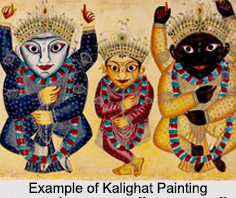
Bengal seems to be always far away of court life and the convention of temple art in the paintings. Here the most powerful medium of painting is Pata painting which emerged in the Kalighat area of Kolkata by the Patuas, who used simple bold lines and flat colours to describe the Hindu gods and goddesses like Shiva, Durga, Kali, Krishna, Lakshmi, Ganesha as well as daily rural life. They used to sell the pats in the local market to the pilgrims of Kalighat temple for their earnings. In the 19th century when European art became popular and the sell of Patas reduced, the Patuas selected the same medium to mock westernised civilisation.
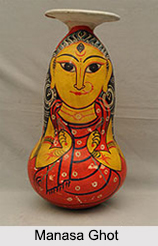
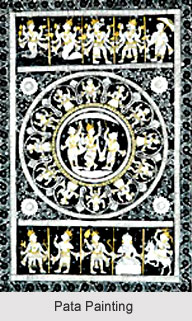 Manasa Mangal, based on Goddess Manasa, has always been a very popular subject and the Pats are used during the song of Manasa in the rural areas. The charms of Manasa Mangal Pats are that they are made on piths. Even today many Patuas in the districts of 24 Parganas, Bankura, Birbhum, Midnapur can be found. They use the basic colours like red, yellow, blue, black and sometimes green and brown. They paint usually on cheapest variety of papers and even on old newspapers, called Jarano Pats which are average 12 to 15 feet in length and one to two feet wide.
Indian Folk Paintings of Orissa
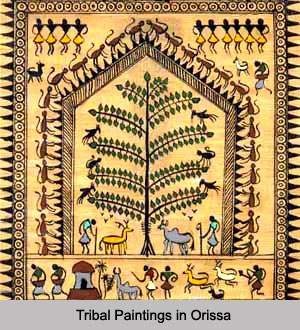
In Orissa, two types of folk paintings are popular. The first one is Patas. When the pilgrims of Jagannath Temple wanted to buy some memento, Jagannatha pat was their obvious choice. The painters of this are hereditary Chitrakaras, which literally means artists, also known as Maharajas, live close to the temple premises. The other one is palm leaf etching, locally called Talapatrachitra, one of the most ancient forms of art. The idea came while during writing manuscripts some artists felt to decorate it. The palm leaves are cut into standard size and supported by two wooden planks stringed through a hole in the centre. The artists who practice this art live in Puri and Cuttak.
Indian Folk Paintings of Bihar and UP
Madhubani or Mithila art is persistent in some areas of Bihar and Uttar Pradesh, mainly in the districts of Darbhanga and Muzaffarpur, parts of Mongher, Bhagalpur and Saharsa. It is told that the painting evolved when king of Mithila, Janaka, asked the painters to draw the marital ceremony of his daughter Sita with king of Ayodhya, Rama. The village women paint the pictures of Ramayana, Mahabharata, Krishnalila and other Hindu mythologies as well as birds, animals and other natural objects on the mud walls of their hut. In recent times, it is done on paper and clothes. The Santal paintings are simple and rich in colour.
 Indian Folk Paintings of North India
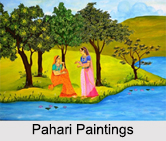
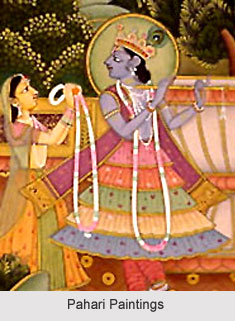
The Pahari paintings evolved in sub-Himalayan areas like Himachal Pradesh, Jammu and Kashmir and Punjab during the dynasty of Rajput kings.It uses beautiful scenes of mount Himalaya as a backdrop and describes epics and mythological stories in without idealization, and in painting outdoors in order to capture the fleeting qualities of nature often using soothing, powdery colour tones.
Indian Folk Paintings of Rajasthan
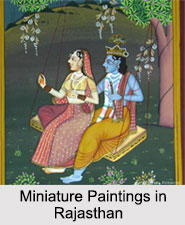
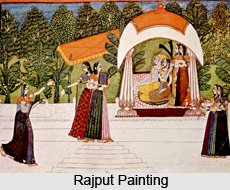
In Rajasthan, the folk paintings are usually done on some specific occasions like marriage, birth ceremony and festivals. This tradition of folk paintings is found in villages and rural areas practiced by various tribes. They are very original, fresh and done with raw-hand. The paintings of the Bhills involve bridal chamber, Goddess of clan, Lord Shiva, dancing men and women and different birds and animals. These pictures are made with colourful delight and fine expression on the wall at the entrance of the houses. Sanjhya is another form of Rajasthani folk art, which is ritual wall painting. Young girls, especially the newly weds in Mewar and Malwa regions, paint the walls for around 15 days during the Pitrapaksha, the period when ancestors are remembered and offered ritual oblation by Hindus.
Indian Folk Paintings of Gujarat
In Gujarat, the Jain community played a pivotal role in development of art including painting and left an ever lasting water mark for centuries to arrive and flourish. The Jains employ artists to produce illuminated versions of the Jain sacred texts in the libraries called Jain Gyan Bharati, established by aristocratic nobility.
Indian Folk Paintings of Maharastra
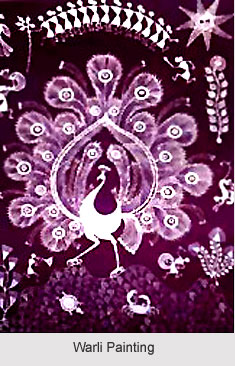
Warli painting of Maharastra is a gift from a small tribe of the same name living in the state and is one of the most intriguing forms of Indian folk paintings. These paintings are executed in white on austere mud wall with the spontaneous expressions of folk life, customs and beliefs.
Indian Folk Paintings of South India
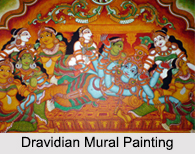
Paithan in the Godavari plateau in Deccan is also the home of peculiar folk style, which is remarkable for its originality, and boldness of brushwork. The art in rest of South India though does not come under the folk section, the paintings of gods and goddesses on the small shrines of Tamil Nadu and on the temple floors in Kerala done actually with coloured powders, have some of the vitality of folk paintings.
Indian Folk Paintings of North East
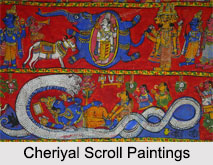
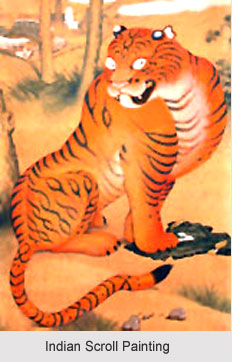
Dragon painted on wood is typical example of Monpa art of Sikkim, Arunachal Pradesh and other places in the North eastern states of India. The theme in the Monpa painting has traditional Buddhist influence. Another form of Buddhist art is Thangka, which are paintings done on flat surface and are painted or embroidered Buddhist banners. Thangkas are hanged from monasteries or are carried by Lama`s in ceremonial procession. When they are not required to display, they can be rolled up and thus also known as scroll painting. The most common form of Thangka is upright rectangular form.
Art is being created before human eyes. Yet in a more real sense it already exists, also before profane eyes, in the enticing tones of Indian folk painting. One can dwell at ease within one beautifully achieved trick of reality, while observing the creation of another as Indian folk paintings stand by the limitless ocean of artistic excellence.