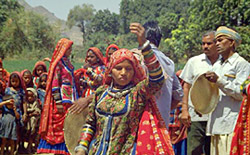
Nyishi tribe is one of the principal tribes of Arunachal Pradesh in north-eastern India. It is the largest groups of tribes scattered in the provinces of Upper Subansiri, Lower Subansiri, Kurung Kumey, Papum Pare, East Kameng and in some parts of west Kameng district of Arunachal Pradesh. The Nyishis are also known as "Nishings". The cultural exuberance of the Nyishis is rightly being explicated in various elements like music, festivals, lifestyles etc. Artistic fervour of a Nyishi tribe is also a well-known fact amongst all the people of Indian subcontinent.
Origin of Nyishi Tribe
All Nyishis trace their descent from legendary ancestor, Abotani and they are basically the inhabitants of the western half of the Lower Subansiri district of Arunachal Pradesh. Belonging to the Indo- Mongoloid group, the Nyishi tribes follow the languages of the Tibeto-Burman language family. They are well-built, fair in complexion and medium to tall in physical structure.
Society of Nyishi Tribe
Nyishi family is generally patriarchal and polygamy is practised. Polygamy signifies one"s social status and economical stability during hard times like clan wars or social hunting and other social activities. Nyishis evolved a joint family system; generally no individual owns properties.
Costumes of Nyishi Tribe
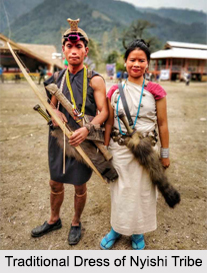
Nyishi tribes have developed a special way of decking up themselves. No one fails to identify a Nyishi due to his or her special apparel. Usually, male Nyishi keep their hair quite long and also tie the hair locks in a tight knot just above the forehead.
The people of this tribal group are known for their costumes and hairdo. They bedeck their hair in a special way. The knotted hair near forehead is called "Padum" richly goes with the cane bands. On his head, a Nyishi tribe also wears "Bopia", which is a neatly embroidered "cane cap". The looks of the Nyishi also nicely gets emphasized due to his manner of smoking of a pipe in his mouth and also an elongated bladed knife, popularly known as "Dao". Usually, the Nyishi tribes wear cane bands round their waists.
Occupation of Nyishi Tribe
 The Nyishis are mainly agriculturists and they commonly practice shifting cultivation. It is also because of the lack of plenty of appropriate land for wet rice cultivation that the Nyishi tribes are almost completely depending on "slash and burn cultivation", which is commonly known as "Jhum Cultivation". Permanent cultivation is also being progressively adopted, where ever it is feasible.
The people of this tribal group have also adopted the occupations of hunting and fishing. The Nyishi women are engaged in weaving whereas basketry is a popular handicraft among the men-folk of this tribal group.
Religion of Nyishi Tribe
Christianity is the major religion among the Nyishis. Most Nyishis have been converted to Christianity by Christian missionaries in the 1970s. Their religion involves belief in spirits associated with nature. They had the peculiar belief that after death, his spirit moves to the "village of the ancestors". The Mithun is treated sacred because in almost all ceremonial rituals, sacrifice of Mithun is compulsory.
Festivals of Nyishi Tribe
Festivals and social rituals are integrated in the life of Nyishi tribe. The Nyishis observe a number of ceremonies in the villages. One of their important community festivals is known as "Nyokum", which is performed once in a year in the month of February with splendour and gaiety. The significance of Nyokum festival is to ensure better cultivation, protect the grains from natural calamities and for the prosperity and well being of the villagers.
Men and women belonging to this tribal community rejoice by dancing, singing and feasting as part of the ceremony. The Nyishis have a number of songs and dances for different socio-religions festivals. The "Rikampada" is the most popular and significant song and dance of Nyishi tribe.