 Women in the Quit India Movement formed a prominent part of the agitating crowds. Congress aided British in the World War II, since, September of 1939. Congress acted according to the agreement, which stated, that in exchange for their service, the Government would function along the lines of righteousness, justice, and dutifulness to the colonized nation. It was also promised, that with the termination of war, British would grant India her much coveted independence. However, the British showed no keenness to respond to these clauses. In November, Congress withdrew from the ministry and embarked on a campaign of agitation. During, this time, many Indian women had already entered the arena of politics. While, some women had become members, others had even turned out to be leaders of student associations, peasant movements, and labour unions. Women, had in fact, attained the right to election to legislative seats and their appointment to positions of power and authority.
When the Gandhian movements had started, people had great expectations. Mahatma Gandhi began with anti-war lectures along with the Satyagrahi (peaceful protesters, following Gandhian ideology). They exhibited non-cooperation to the wartime emergency conditions imposed by British. 400 Congressmen and women were arrested and jailed in 1940. By June of 1941 almost 20,000 were thrown into prisons. But the movement, being weak in character, faded away soon.
On August 8, 1942, the All-India Congress Committee met in Mumbai and passed a resolution calling for British withdrawal from India. Thus the Quit India Movement was launched. The Quit India resolution spoke directly to women "as disciplined soldiers of Indian freedom" and attracted them to the movement. Women participated whole-heartedly in the movement and too part in the various protests that were taking place at the time. The techniques were the same as Gandhi`s previous methods- salt-making, boycotts of courts and schools, picketing cloth and liquor shops, and non-payment of taxes. The movement began in the cities with strikes, demonstrations, and clashes with the police and moved to the countryside where peasants rebelled against landowners and the agents of British authority. Women participated in the initial strikes and demonstrations in cities, were among the radical students who organized peasant movements, and, when protest was suppressed, joined the secret under ground.
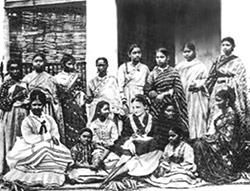
Women leaders of Quit India Movement
The participation of women in the Quit India Movement took many different forms. Usha Mehta, a committed patriot set up a radio transmitter, called the `Voice of Freedom` to disseminate information about the war for freedom. News of protest and arrests, deeds of young nationalists and Gandhi`s famous `Do or Die` message for the Quit India movement were circulated amongst the masses. Usha and her brother persisted with their task of broadcasting until their arrest on November 12, 1942. Usha was sentenced to four years jail.
In the rural areas large numbers of peasant women joined men in protesting against taxes, land tenure, and landholder`s rights. At the end of September 1942, peasants attacked police stations and destroyed telegraph lines in four sub-divisions of Midnapur District. The British responded with repressive measures and a new round of violence began. On September 29 the people of Tamluk sub-division marched on the town with the intention of capturing the court and the police station. Face to face with the soldiers guarding the court, they hesitated. Matangini Hazra, a seventy-three-year-old widow, stepped forward, lifted the Congress flag, and gave her first public speech. She urged the crowd onward in the name of Gandhiji and refused to stop when challenged. The people of Midnapur District continued their resistance and were brutally repressed.
Aruna Asaf Ali was another leader of the Quit India Movement. When she moved to Delhi with her husband, Mata Rameshwari Nehru introduced Aruna to the Delhi Women`s League and Satyavati Devi brought her into the Civil Disobedience Movement. Aruna broke the salt law, was arrested, sentenced, and imprisoned in Lucknow. She became a leader of the underground movement in 1942 and was forced to remain in hiding until 1946. During her three and a half years in hiding, Aruna was constantly in motion, urging people to liberate the land from foreign rule. Some historians have labelled Aruna as the most important leader of the resistance. She is widely remembered for having hoisted the national flag at Mumbai during the Quit India Movement.
Sucheta Kripalani was another prominent woman leader of the Quit India Movement though her tactics were far removed from those of Aruna Asaf Ali. She had started working in the Congress office in 1939 and in 1940 she was chosen to organize a women`s department of the Indian National Congress. The women`s department wanted to raise the political consciousness of women and identify Congress with social change that benefited women. Clearly this new department intended to co-opt the functions of the national women`s organizations and place women under the control of the Indian National Congress. The women`s department had hardly begun its work when Sucheta offered individual Satyagraha and was imprisoned for two years. She was out of prison when Congress leaders were arrested in 1942 and, hearing the news, decided to go into hiding. Sucheta`s first job was to establish contact with groups still active throughout India and encourage them to continue non-violent activity. Wearing a variety of disguises, Sucheta travelled from province to province to keep leaders in touch with one another and help them plan activities. In 1944 she was captured and lodged in Lucknow jail as a `dangerous prisoner.`
Thus the involvement of women in the Quit India movement took different forms, from active protests to the organisation of non-violent movements. Methods notwithstanding, the participation of women in the Quit India Movement went a long way in making it a success.