 Wide-ranging preserves and national parks that have been built here over the years enrich the Eastern region of India. Amongst them, Sundarbans Tiger Reserve deserves special mentioning. The reserve is situated to the southeastern province of Kolkata, West Bengal. Very recently it has been declared to be amongst the World Heritage Sites. The story of its formation is worth to take a note. This marshy area was partitioned in 1947comprising of a total area of more than 4,200 sq km. More than half of the mangrove forests of the Indian subcontinent form an integral part of Sundarbans Tiger Reserve. As per very recent survey that has been carried out, the Sundarbans Tiger Reserve covers an area of 2,585 sq km. Out of it, almost 1,000 sq km is made up of brooks and water bodies.
History of Sundarbans Tiger Reserve
Wide-ranging preserves and national parks that have been built here over the years enrich the Eastern region of India. Amongst them, Sundarbans Tiger Reserve deserves special mentioning. The reserve is situated to the southeastern province of Kolkata, West Bengal. Very recently it has been declared to be amongst the World Heritage Sites. The story of its formation is worth to take a note. This marshy area was partitioned in 1947comprising of a total area of more than 4,200 sq km. More than half of the mangrove forests of the Indian subcontinent form an integral part of Sundarbans Tiger Reserve. As per very recent survey that has been carried out, the Sundarbans Tiger Reserve covers an area of 2,585 sq km. Out of it, almost 1,000 sq km is made up of brooks and water bodies.
History of Sundarbans Tiger Reserve
In 1658 Shah Suja for the first time treated the forests of Sundarbans as source of revenue. Later in 1737 the lands of 24 Parganas was ceded to the East India Company and became the jagir of Lord Clive. During this time there was continuous reclamation of mangroves for settlement and agriculture. For the first time in 1879 an area of 4690 sq. km was declared as Protected Forests which were subsequently declared as Reserved Forests in 1928 and 1943. In pre independent India, the area was part of the erstwhile Sundarbans Division with its headquarters at Khulna, Bangladesh. After independence an area of 4262 sq. km came under a new Division called as 24 Parganas Division with headquarters at Alipore, Kolkata. It was from this Division that the Sundarban Tiger Reserve was created under Project Tiger scheme on 23.12.73 by the MOEF, Govt. of India. The seasonally flooded Sundarbans freshwater swamp forests lie inland from the mangrove forests on the coastal fringe. The Sundarbans is intersected by a complex network of tidal waterways, mudflats and small islands of salt-tolerant mangrove forests. The interconnected network of waterways makes almost every corner of the forest accessible by boat.
Climate of Sundarbans Tiger Reserve
The best season to visit Sundarbans is between October and February as the rivers are calm and free from turbulence. Although the tract is situated south of the Tropic of Cancer, the temperature is equable due to its proximity to the sea and a heavy rainfall and humid climate prevail. The summer extends from middle of March to mid of June with maximum temperature of 36 degree C. Winter stays from December to February with minimum temperature of 9.2 degree C. Usually from the middle of June the monsoon lasts up to middle of September. The autumn lasts from mid September to November. Rough weather lasts from 15th March to 15th September and the fair weather prevails between mid Septembers to mid March. Average annual rainfall is 1920.30 mm. Average humidity is about 82% and is more or less uniform throughout the year.
Topography of Sundarbans Tiger Reserve
The area is bound by the river Matla in the west which also forms the boundary with the territorial Forest Division of 24 Parganas (South). The rivers Kalindi, Harinbhanga and Raimongal in the east form the international boundary with Bangladesh Sunderbans. On the south of the Reserve lies the Bay of Bengal. The northwest is bounded by rivers Bidya and Gomdi which form a boundary with the revenue villages bordering the Tiger Reserve. The sources of all rivers especially on the western side are progressively getting silted up resulting in the rivers getting more brackish and shallower. All these rivers experience tides diurnally. The tidal amplitude on an average is 2.15 mts. (max. 5.68 meter and minimum 0.96 meter). A network of rivers, channels and creeks intersect the entire area.
Wildlife of Sundarbans Tiger Reserve
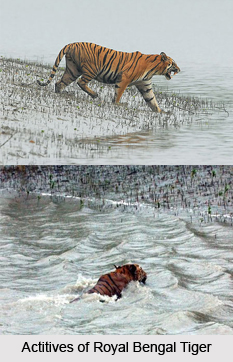
The main variety in the Sunderbans Tiger Reserve, tigers tend to come into conflict with the intruding human population. Before embarking into the forests, honey gatherers, woodcutters and fishermen treat the tiger as deity and sought his blessings. Although the disagreement at times threatens to confront all conservation work, the Project Tiger management is taking steps to alleviate the situation. Recommended measures include wired effigies in fishing boats.
Sunderbans Tiger Reserve is ideal abode of wild flora and fauna. About forty mammalian species are found. Few amphibians like the Jungle Cat, Leopard and Fishing Cat are quite significant. Boat trips can be thrilling, enabling a tourist to take a glimpse of Gangetic Dolphins, Clawless Otters, giant Estuarine Crocodiles and Fishing Cat, Leopard-cat, Jungle Cat, Common Palm Civet, Jackal, Gangetic Dolphin, Spotted Deer (Chital), Wild Boar, Clawless Otter, Crab-eating Mongoose, Rhesus Macaque. Quite a number of endangered species like River Terrapin are found to enjoy the wilderness of the park.
 Birds are in bounty which includes waterside birds and several woodland species. Multitudes of birds migrate from the far off countries thus enriching the beauty of the reserve. Several birds throng the woodlands. Red Junglefowl, Blue-tailed Bee-eater, Rufous Treepie, Greater Coucal, Blue-throated Barbet are amongst them. One can catch sight of beautiful birds like Masked Fin foot, Asian Openbill, Lesser Adjutant, Greater Adjutant, Oriental Stork, Brown-winged Kingfisher, Stork-billed Kingfisher, Collared Kingfisher and Ruddy Kingfisher.
The rattling of hunting birds, namely, Pallas`s Fish Eagle, Osprcy, Grey-headed Fish Eagle, White-bellied Sea Eagle and Pied Harrier are quite a common sight in Sunderbans Tiger Reserve.
Sajnekhali is the chief tourism sector. A handful of grounds have been built here for breeding herons. About 400 fish species are found in the rivers, enduring the varying levels of salinity. Also there are near about 50 species of reptiles, namely Estuarine Crocodile, Rock Python, King Cobra, Water Monitor and Olive Ridley Turtle, are found basking under the heat of the sun.
Tourism in Sundarbans Tiger Reserve
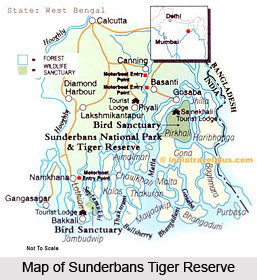
For the tourists to give the chance of fully exploring the beauty of the whole of Sundarbans Tiger Reserve, special amenities are being arranged by the forest department. The best way to move around is to get in to a motorboat from places like Canning, Basanti, Gosaba or Sonakhali. A whole night spends in the midst of flowing rivers or at the periphery of a tidal creek, is worth an experience. One can watch closely the thick drapes of mangrove trees, with the shy, stripped-down cat running here and there. According to official estimates, there are just about 250 tigers, and only one or two can be visible to the tourists who visit the place in great excitement with the high hopes of getting glance of these beautiful tigers. They are mostly seen near the thick water drenched forests. The Sunderbans Tiger Reserve is remarkable in the sense that it has nicely accommodated to the high saline water bodies. One can also see huge numbers of amphibians, roaming between islands. Also they are found slogging along the edge of a creek at low tides with its coat glistening with ooze, before getting disappeared into the dense forests.
Visiting Information
The Headquarters of Sundarban Tiger Reserve is located at Canning Town, South 24-Parganas District and is connected by broad gauge Railway line with Sealdah South Suburban station which is 46 km from Canning. The entry permits are available at Canning, Sonakhali, and Bagna and Sajnekhali. Tourists generally avail conducted tours organized by private tour operators as well as West Bengal Tourism Development Corporation .The Reserve can be approached by road from Calcutta up to embankment points at Canning, Sonakhali and Dhamakhali. The Reserve can also be approached from Basirhat and Hasnabad under North 24-Parganas District. Kolkata is the nearest major city well connected through air and rail.
Sundarbans Tiger Reserve enriches all the lives of city dwellers of West Bengal with its treasures and exuberances. . It hosts coastal preservation for wild creatures, by refining the intimidating world of tides and waves in its vicinity.
