 Blue-Tailed Bee-Eater is an Indian bird that bears a scientific name "Merops philippinus" and is recommended as a strong migratory bird.
Breeding Season of Blue-Tailed Bee-Eater
Blue-Tailed Bee-Eater is a near passerine bird in the bee-eater family Meropidae. It breeds in south-eastern Asia. It is strongly migratory, seen seasonally in much of peninsular India. This species is sometimes considered to be co-specific with the blue-cheeked bee-eater, M. persicus.
Structure of Blue-Tailed Bee-Eater
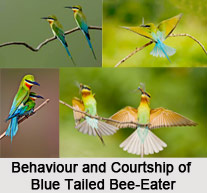
Blue-Tailed Bee-Eater is like other bee-eaters that is richly coloured, and it looks like a slender bird. It is predominantly green; its face has a narrow blue patch with a black eye stripe, and a yellow and brown throat; the tail is blue and the beak is black. It can reach a length of 23-26 centimetres, including the two elongated central tail feathers.
Sexes of Blue-Tailed Bee-Eater
The sexes of Blue-Tailed Bee-Eater are alike.
Concentration of Blue-Tailed Bee-Eater
Blue-Tailed Bee-Eater is a bird which breeds in sub-tropical open country, such as farmland, parks or rice fields. It is most often seen near large water bodies. Like other bee-eaters it predominantly eats insects, especially bees, wasps and hornets, which are caught in the air by sorties from an open perch.
Feeding of Blue-Tailed Bee-Eater
Blue-Tailed Bee-Eater probably takes bees and dragonflies in roughly equal numbers. The insect that are caught are beaten on the perch to kill and break the exoskeleton. This habit is seen in many other members of the coraciiformes order.
Nesting of Blue-Tailed Bee-Eater
Blue-Tailed Bee-Eater is gregarious, nesting colonially in sandy banks or open flat areas. They make a relatively long tunnel in which the 5 to 7 spherical white eggs are laid. Both the male and the female take care of the eggs.
Call of Blue-Tailed Bee-Eater
Blue-Tailed Bee-Eater also feed and roosts communally. The call of Blue-Tailed Bee-Eater is similar to that of the European bee-eater.