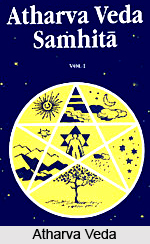
 Atharva Veda is the fourth and last of all the Vedas. It contains 6000 Mantras. It is a compilation of popular spells and incantations. Atharva Veda is considered by many to be a dark and mystic science, pertaining to the spirits and the afterlife is completely different from the other three Vedas and is next in importance to the Rig Veda with regard to history and sociology.
Etymology of Atharva Veda
The word "Atharva Veda" means "the Veda of the Atharvan" or the knowledge of "magic formulas and spells". Originally, however, the word Atharvan meant a fire-priest, and it is probably the oldest Indian name for priest in general, for the word dates back to the Indo-Iranian period. According to the legendary tradition, two clans of fire priest known as the Bhrigus (also called Atharvans) and Angirasas had composed Atharva Veda. The concept of Atharva Veda is an amalgamation of Aryan and non-Aryan ideals. The existence of demons and God is believed by the Atharva Veda and to induce the negative forces to abstain from doing harm they are offered homage.
The two expressions Atharvan and Angiras, however, designate two different species of magic formulas: Atharvan is "holy magic, bringing happiness", while Angiras means "hostile magic, black magic". Among the Atharvans, for example, are the formulae for the healing of diseases, while among the Angiras are the curses against enemies, rivals and evil magicians. The first is medicine and the second is witchcraft, and the two are mixed up in the concept of Atharva Veda. The old name "Atharvangirasah" thus means these two kinds of magic formulae, which form the chief contents of the Atharva Veda. The later name Atharva Veda is merely an abbreviation of "Veda of the Atharvans and Angiras".
Content of Atharva Veda
Atharva Veda consists of spells and charms prevalent at its time, and portrays a clearer picture of the Vedic society. Additionally, it also includes composition of certain other Indo-Aryan clans such as the Kaushikas, Vasishthas and Kashyapas. The modernity of Atharva Veda again cannot be denied as it is the very first Indo-Aryan text dealing with medicine. It identifies the causes of the disease that is the causative agent such as the Yatudhanya, the Kimidi, the Krimi and the Durnama. The Atharvans seek to kill them with a variety of drugs in order to counter the disease. This approach of treating the disease is sufficiently advanced and therefore Atharva Veda is regarded as one of the earliest texts to record uses of the antibiotic agents.
The Atharva Veda also informs about warfare. A variety of devices such as the arrow with a duct for poison and castor bean poison, poisoned net and hook traps, use of disease spreading bugs and smoke screens find a place in the Atharva Veda Samhita.
Several regular and special rituals of the Aryans are a major concern of the Atharva Veda, just as in the three other Vedas. The major rituals covered by the Atharva Veda are marriage in Kamda - XIV and the funeral in Kamda - XVIII. Along with these there are some rituals aimed at the destruction of the enemies particularly using the closing mantras of Kamda - XVI. It also provided as the ritual for the worship of late evolving popular deities like Kumara and Ganapati to capture the mainstream Hindu ritual. There are also hymns specific to the rituals of the Bhrigu Angirasas.
Composition of Atharva Veda
The Atharva Veda Samhita is a collection of 731 hymns, which contain about 6000 verses, in the recession which is best preserved. It is divided into 20 books. The language and metre of the hymns of the Atharva Veda are in essentials, the same as those of the Rig Veda Samhita.
Brahmanism in Atharva Veda
The Atharva Veda knows not only the four castes - Brahmin, Kshatriya, Vaishya and Sudras- but in a number of hymns, the highest privileges are already claimed by the priestly caste, and the Brahmins are already often called the "Gods" of this earth. The songs of magic in the Atharva Veda, which, according to their main contents, are certainly popular and very ancient, have no longer even their original form in the Samhita, but are Brahmanised. At every step, the collection was made by priests, and many of the hymns were also composed by priests. This priestly outlook of the compilers and partly also of the authors of the hymns of the Atharva Veda, reveals itself in occasional comparisons and epithets. A whole class of hymns of the Atharva Veda is concerned only with the interests of the Brahmins, the feeding of priests, the fees for the sacrifice and such like, which are of course the work of priests.