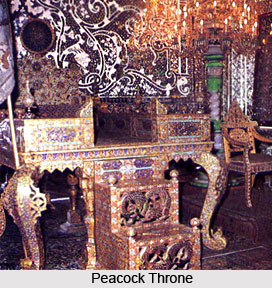
 The Peacock Throne was a pet project of the Mughal Emperor Shah Jahan and he invested a great deal of time and wealth into it. In fact the two grand preoccupations of the Emperor were the construction of the Taj Mahal and the crafting of the Peacock Throne. Between military expeditions and attending to affairs of state he would occupy himself with the minutest details of the plans for his two grand creations, selecting gemstones and expensive marble for them personally. He spent a lot of time in personally helping to develop the design and gather the gems required to decorate it. However, despite his efforts, the irony was that Shah Jahan was never able to sit on the Peacock Throne after its completion.
The Peacock Throne was a spectacular and dazzling symbol of Mughal splendour. The underside of the canopy is covered with diamonds and pearls, with a fringe of pearls all round and above the canopy, which is a quadrangular dome. Here is to be seen a peacock with elevated tail made of a number of Blue Sapphire and other coloured stones. The body is of gold inlaid with precious stones, having a large Ruby in front of the breast, from whence hangs a pear-shaped Pearl of 50 carats and of somewhat yellow water. On both sides of the peacock there is a large bouquet of the same height as the bird, with many kinds of flowers made of gold inlaid with precious stones. On the side of the throne, opposite the court, there is to be seen a jewel consisting of a diamond of 80 to 90 carats, with emeralds and rubies round it. When the king is seated, he has the jewel in full view. The table-cut emeralds, Badakshan cabochon rubies and pearls all set in gold.
It is said that behind the aesthetic beauty of the Peacock Throne, lies a concept of the highest mystic symbolism, which Shah Jahan adapted from Sihab al din Yahya Suhrawardi and his neo-platonic cosmology. The Peacock is a representation of the soul. In Zoroastrian mythology it is called the Simurg, which is a combination of the words Seena, the tree of life, and Meregh, bird, i.e., the sacred bird that nests in the tree of life. The cosmic universe is supposed to lie in its branches. Whatever the depths of this concept, Shah Jahan knew that the poetic and mythical bird of the Sufis symbolized union with God. The colourful displays of precious stones which decorated the Peacock Throne were not arranged only according to what looked best, but the result of intense metaphysical research. White, or the intellect, is represented by diamonds; green, the colour of knowledge and also of the soul regenerated as green foliage regenerates, is depicted by emeralds. One striking detail mentioned in Tavernier`s description is the yellow gleam of an enormous pearl in the canopy. In the zodiac and the chromatic dispersal of the prism studied by the Sufis, yellow signified the soul.
Thus it seems that the true meaning of the Peacock Throne is actually metaphysical, a blend of ancient Zoroastrian, neo-platonic, Sufi, and Shia concepts of the Simurg as the ultimate spiritual personification of grandeur. Therefore it is also likely that when the Persian conqueror Nadir Shah looted the Peacock Throne, he was not just robbing a prize, but he recognized the fundamentally Persian character of this treasure and was taking back what he valued personally and felt belonged conceptually to Persia.