Maritime history is associated with the activities related to the oceans and seas. Maritime history of India is enormous and comprehends several eras, right from the ancient times till date. Maritime history of India has been influenced largely by the different political activities and has been really imperative in the development of trade uplifting the economy of the country. Sea routes were indeed substantial as they supplied the means of business with foreign countries and establishing contacts with the foreign states in ancient and medieval times. Indian maritime history traces the advent of the Portuguese to the coasts of India and the activities that resulted in this influx of foreigners to a land of great resources and wealth.
Maritime history of India commences from the 3rd millennium BCE, when the denizens of the Indus Valley set into motion trading with Mesopotamia. Roman history states about an amplification in Roman trade with India following the Roman annexation of Egypt. By the period of Augustus, near about 120 ships were setting sail every year from Myos Hormos to India. Indians made their presence felt in Alexandria and the Christian and Jew settlers from Rome continued to live in India long after the fall of the Roman Empire. As trade relations between India and the Greco-Roman world amounted to larger degrees, spices became the main import from India to the Western world, leaving behind silk and other commodities. Indian commercial connection with South East Asia testified crucial to the merchants of Arabia and Persia during the 7th and 8th century. On the orders of Manuel I of Portugal, four vessels under the domination of navigator Vasco da Gama winded the Cape of Good Hope, continuing to the eastern coast of Africa to Malindi to sail across the Indian Ocean to Calicut (present day Kozhikode, Kerala). Indian and oriental treasures were now exposed to the Europeans to explore. The Portuguese Empire was one of the earliest European empires to grow from spice trade.
The world`s first tidal dock is believed to have been built at Lothal around 2300 B.C. during the Harappan civilisation, near the present day Mangrol harbour on the Gujarat coast. Sea gained a prominent position with time and maritime activities began to grow with the different conquests. With various invasions, the water-bodies came under the developmental procedures that they undertook as a means of fulfilling their own motives. Like, north- west India came under the influence of Alexander the great, who built a harbour at Patala and his army returned to Mesopotamia in ships built in Sindh. Similarly other kings from different dynasties like Maurya, Chola, Satavahanas etc. also contributed immensely to the Indian maritime history. Being surrounded on the three sides by water bodies India is in an advantageous position in terms of trade practises at home and abroad. Without proper navigational skills this achievement would not have been possible, two famous Indian astronomers, Aryabhatta and Varahamihira, helped in this regard by mapping the positions of celestial bodies, and developing a method of computing a ship`s position from the stars.
Naval expeditions, which occupied parts of Burma, Malaya and Sumatra, while suppressing the piratical activities of the Sumatra warlords, were also carried out from India in 984-1042 AD by the Chola kings. Indian maritime history mentions the sudden disappearance of the maritime power when the Portuguese arrived in India because they imposed a system of license for trade. Again the late seventeenth century, there is witnessed a notable revival of maritime activities with the alliance of Siddhis of Janjira allied and the Mughals. Indian shipbuilders continued to hold their own well into the nineteenth century in spite of the British domination. The Bombay Dock completed in July 1735 is still in use even today.
The significant aspects of the Indian maritime historical tradition from the days of ancient India render an astonishing panorama. Starting from the Indus Valley Civilization, Indian maritime history even surpasses western civilization in its origin. A myth had always overridden that the white man was a great adventurer and a superior being, who was invincible and could conquer many nations across the vast oceans. The Portuguese were pawns under the Europeans in maritime India. Having entrenched themselves along the coast, the Portuguese realised soon enough that they could not expand into interior India. Portugal did not have the resources, human and material for that. Once the futility of it all became ostensible, the Portuguese abandoned their mission in favour of remaining put in their tiny enclaves on the west coast until the time came for India to reclaim them. The encounter, which followed with western and northern Europe is a most significant interregnum in the long and chequered history of maritime India which begins with the Indus Civilization. Indians feared the sea as a result of which they remained a land bound people, despite their blessed maritime situation. Their sights have been fixed firmly towards the north, the northern passes which were the geneses of so much Indian history. The last of the conquerors of India came by sea, established their footholds along the coasts before expanding inland. There is, however, evidence available that ancient Indian crews did cross the Arabian Sea and Bay of Bengal to the opposite shores of Indian Ocean in large numbers and in gigantic ships that were indigenously built. Many of the Indian built ships were legendary in history. The reason behind it can be attributed to Indian teak, which was a superior timber to the European oak.
Growth of maritime power of southern India in Indian history in this regard was significant. By the time of Islamic invasions, especially in north of the Vindhyas, a feeling of Kala Pani, the sea being a medium, which should not be crossed at the fear of losing their Indian-ness, prevailed. South of the Vindhyas, people demonstrated much greater flexibility towards venturing out to sea. The Cholas exploited their maritime strength and nurtured overseas territorial ambitions. In this context of Indian maritime history, the geography of north Indian Ocean played an important role in making the people of the littoral seek the sea for trade and economic gain. The chief sea lanes of the north Indian Ocean served as conduits of trans-continental as well as inter-regional trade. Since the parallel silk route was too crowded, the emphasis shifted toward the seas.
Modern India is very much keeping its maritime traditions alive, a tradition of navigation and seamanship skills, of shipbuilding and innovation, which the sea-friendly civilization of Mohenjodaro and Harappa had displayed. Maritime history of India first had its seeds planted during this highly knowledgeable civilization. The Indus Valley refinement did survive through the ages, as shown in Rig Veda and Arthashastra, till the Kalingas, Cholas and the Andhras. The history of the Indian Ocean and India`s involvement in trade and commerce since times immemorial is the fundamental governing fact under Indian maritime history. This exactly demonstrates how active this area was long before the now developed world. Thriving trade existed in 2400 B.C. between the Indus valley and Mesopotamia. The dock at Lothal established the seafaring capabilities of the Harappans. Indians had already sailed through the Indian Ocean long before the Arabs, Egyptians and the Greeks. The monsoon winds enabled India to be at the centre of the trading network between the East and the West. The Chinese had started trading with Calicut (present day Kozhikode, Kerala) in the seventh century A.D. A benign Indian influence grew in Southeast Asia and blended with culture and religion. Till the end of tenth century, Sri Vijaya kingdom ruled the ocean, when the Cholas challenged their supremacy. Hindu sea power finally came to an end in the fourteenth century with the downfall of the Sri Vijaya Empire. The advent of the Portuguese followed. The Zamorins and the Marrakkars resisted but their navy, being coastal in nature could not match the Portuguese. The exploits of Kunjali admirals and later of Kanhoji Angre are a legend for passing years.
Geographically India lies across the major Sea Lanes of Communication (SLOC) in the Indian Ocean, which lends it a considerable strategic importance and potential. In the long history of India`s links with South-East Asia, the South-East Asian empire of the Sri Vijayas is a remarkable chapter. The city of Vijaynagar was a teeming marketplace for both exports and imports. Indian maritime history comprises the extensive dealings with foreign places, which even have a mention in the Bible and by Sappho. South India was along the trade routes for the export of spices like cinnamon and cassia which originated from China and south east Asia. During the Sultanate period, everyday usable articles as well as luxury articles were exported to Syria, Arabia and Persia from Bengal and Cambay. These included silks, exquisitely designed clay pots and pans, gold-embroidered cloth caps, knives, guns, and scissors. Other major things of export were indigo, sugar, oils, ivory sandalwood, diamonds, spices, other precious gems and coconuts. East Africa, Malaya, China and the Far East were the places where things were exported. Arab traders shipped Indian goods to European countries through the Red Sea and the Mediterranean ports. Indian textiles were in great demand in China.
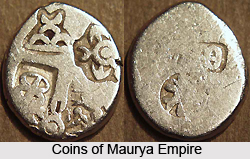
Chandragupta was the founder of the Mauryan Empire, ruling from 324 to 301 B.C. He along with the help of Chanakya (Kautilya) destroyed the Nanda rulers of Magadha and established the Mauryan Empire. After this the expansion continued with Punjab, Kabul, Khandahar, Gandhara and Persia from Seluces. Indian maritime history was much affected by the rise of the Mauryan kingdom. Indian maritime history has the reference of the first organisation of ships in the Mauryan Empire. Chandragupta`s reign was fraught with Roman connections and victories which necessitated brisk trade developments. Kautilya in the cases of navigation and seafaring guided him as well. In his much celebrated work, Kautilya included a whole chapter on the state department of waterways under `navadhyaksha` which after translated, means `superintendent of ships`. Chandragupta Maurya established an admiralty division under a Superintendent of ships as part of his war office, with a charter including responsibility for navigation on the seas, oceans, lakes and rivers. Mauryan Empire encouraged extensive maritime activities which helped in the boom of trade practices in the south. This expansion in the south was especially under Bindusara, whereas Chandragupta had expanded the territories to the northern side. Plenty of availability of pepper and other spices, the navigability of the rivers connecting the high mountains with the seas and the discovery of favourable trade winds which carried sailing ships precipitated overseas trading. Exports generally included silk goods and textiles, spices and exotic foods. The Empire was enriched further with an exchange of scientific knowledge and technology with Europe and West Asia.
The Cholas were a Tamil dynasty that ruled the south of India till the 13th century. Indian maritime history records extensive overseas venture in the south of India under the Chola dynasty. The Cholas encouraged sea trade by developing harbours and providing quarters, warehouses and workshops for Roman sailors and merchants. Trading relations in the south were improved and they had long trading correspondence with the west through trans-shipments at the Northern ports.
Navigational facilities were provided in the ports, which included repair yards, pilotage, wharfs, and even light houses. Malays and Indonesians participated in the growing exchange when the voyages between India and South east Asia became frequent. Muzirs, Poduca, and Sopatma were the important trading ports. Raja Rajendra was a powerful of the Chola dynasty in the 10th century, who knew the great importance of foreign trade and built a powerful navy meant for trade and war. The Chola dynasty no doubt helped to enhance the maritime activity which has contributed to the Indian maritime history. It was the failure of the Mughals to appreciate the magnitude of sea power that led to the subjugation of India by the British, which ended two hundred years later.
There was a huge scope of maritime development that took place from the beginning of the civilization prior to the western accomplishments. Tracing Indian maritime history, one comes across the extent of progress that was being made in this field, which aided in the development of trade and commerce in the country. Indian maritime history spans a huge era of seafaring, which is impressive till today, where one can still find its evidence, and is a part of the heritage. Maratha Navy also had participated hugely in Indian maritime history under Shivaji Bhonsle and Kanhoji Angre, which however did decline under Nanasaheb`s rule. It was then that the British East India Company took over the maritime business in early 17th century, with shipping of spices. Britain`s Royal Navy had full control of the Indian navy section in early 19th century, which had participated jointly in First World War. Indian ship-builders however did weaken under British supremacy, building some legendary vessels at the Bombay Dockyard.
Tracing down historical lines, the Andaman and Nicobar Islands were a significant bunch of islands, contributing much to Indian maritime history. Its history from the early period till the eighteenth century and thereafter under the British rule till independence of India are legendary in today`s ages. These islands had a strategic importance, which was realised by the Cholas and even Sri Vijaya rulers. There has been reference to these islands by the ancient sea voyagers of many countries including the Indians, Europeans, Arabs and the Chinese. Most of them, however, left these islands alone. Only in 1789 did the British make the first attempt to establish a settlement in the harbour now known as Port Blair. They were given a hostile reception by the locals and withdrew. It was after the Sepoy Mutiny in 1857 that the British found these islands to be ideally suited for a penal colony to hold the freedom fighters; something they continued to do till 1938.
Post Indian independence in 1947, the Republic of India`s navy consisted of 33 vessels and 538 officers to safe-lock a coastline stretching more than 4660 miles (7500 km) and 1280 islands. To add further to the rich Indian maritime history, the Indian Navy conducted annual Joint Exercises with other Commonwealth naval forces all through the 1950s. The navy wing witnessed severe action during several of the country`s wars, including Indian consolidation of Junagadh, the freedom of Goa, the 1965 and 1971 wars. After the ensuing commotion in receiving spare parts from the Soviet Union, India also went ahead in its gigantic indigenous naval designing and production programme, aimed at manufacturing destroyers, frigates, corvettes and submarines.
Maritime history of India assimilated within itself the Coast Guard Act, which was passed in August 1978. The India Coast Guard took part in Operation Cactus in Sri Lanka among other anti-terrorist operations. The Indian navy was also commissioned in numerous United Nations peacekeeping missions. The proud Indian navy also repatriated Indian nationals from Kuwait during the first Gulf War. The Kargil-Drass War in 1999 happened as a major turning point in maritime Indian history, placing Navy under direct international brilliance scanner. As a consequence of the escalating strategic ties with the western world, Indian navy has conducted joint naval exercises with its western counterparts, including the United States Navy. Bettered relations with the United States of America and Israel have led to joint patrolling of the Straits of Malacca. Besides the military sections, maritime history has also made giant strides in its civil sailing section, with the top ports bringing in bulk profits for Indian administration. Some of the hi-tech and sophisticated ports in India comprise: Paradip, Visakhapatnam, Chennai, Cochin, New Mangalor Port, Mormugao, Mumbai, J.N.P.T., Ennore and Kandla.