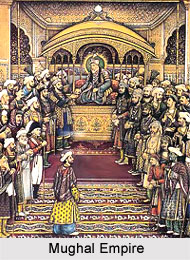
 The Mughal Empire which gave Indian History an era of resplendent accomplishments and paramount power disintegrated into dust with the irreparable mistakes of emperors like Aurangzeb.
Aurangzeb inherited a large empire, and instead of consolidating what he already had, he embarked an a myopic policy of annexation. His passion to stretch the empire to the farthest geographical limits made it impossible to implement a centralized government.
His conflict with the Rajputs yielded serious consequences. Akbar had the sagacity to analyze that enemity with the Rajputs will be a thorn in the bed of roses that he is manufacturing for himself.But , Aurangzeb , blinded by religious discriminations withdrew himself from Rajput-loyalty and challenged their sovereignty.He lost a pillar of strength which had defended the Mughal Empire against enemies for years.
The Deccan invasion by the Mughals depleted the financial resources.His bid to suppress the Marathas` claim for autonomy backfired at him.
The peace and order of his state was shattered at the very nerve-centre by the political uprisings of discontending groups, namely ,the Jats,the Satnamis and the Sikhs.
Aurangzeb`s religious orthodoxy severely invoked the wrath of the Hindus and the Shiah Muslims .Jeziya-payment was scorned by allnon-Muslims.A split in the Mughal social fabric was inevitable.The nobility was turned into warring factions. Administrative system became unstable.
Wealth squandered away by luxury-loving princes like Jahangir, or Shah Jahan had hit the royal treasury.
The Mughal nobility and aristrocracy during the last years of the empire were overbrimming with corruption.Thirst for power and acquisition of lucrative "jagirs"or grants drowned these vitiated nobility into nothingness.
The military force of the empire were robbed of energy after long wars.Again the disloyal mansabs also did not maintain properly their quota of soldiers, military contingents.
The peasants ,reeling in poverty faced oppression in the hands of the nobility , demanding excess amount of tax. The peasant-class lost their trust on the empire.
The empire went through dire straits in the weak rules of the later Mughals,like Bahadur Shah, Jalandhar Shah or Farrukh Siyar.
A final blow to the shaken constitution of the empire was given by the foreign invasions of Nadir Shah and Ahmed Shah. The treasury eas looted, the trade and industry was ruined and the military power erased.
Finally the colonial conquest by the British swallowed the skeleton of an once glorious empire, piece by piece.
Downfall of The Mughal Empire
The sun of the Mughul Empire set after the death of Aurangzeb and the succession war among the Mughul Princes.