Culture of West Bengal - Informative & researched article on Culture of West Bengal
  Indianetzone: Largest Free Encyclopedia of India with thousand of articles States of India


in  
Art & Culture | Entertainment | Health | Reference | Sports | Society | Travel
Forum  | RSS Feeds  | Free E-magazine
States of India : Indian States l Orissa l Kerala l Gujarat l Rajasthan l Punjab l Bihar l Tamil Nadu l West Bengal l Jharkhand l Assam l Manipur l Tripura l Sikkim l Nagaland , Indian State l Meghalaya l Mizoram l Jammu & Kashmir l Maharashtra l Madhya Pradesh l Karnataka l Andhra Pradesh l Uttar Pradesh l Uttarakhand l Himachal Pradesh l Arunachal Pradesh l Chhattisgarh l Goa l Haryana l Indian Union Territories
Home > Travel > States of India > West Bengal > Culture of West Bengal
Culture of West Bengal
The exuberance of Bengal history had added grandeur to its culture.

Culture of West Bengal boasts its enduring richness in the reformation movements, making the whole of Oriental culture an upheaval. The proponents of Bengal Renaissance, Ram Mohan Roy, Vidyasagar, and also the Young Bengalees had largely contributed in curbing the culture of West Bengal in the mold of Western thoughts. However the tradition and ethnicity were not uprooted, rather they were enmeshed with the new trends. Thus a cosmopolitan mindset was the natural outcome, embedding both the pros and cons of both the cultural practices. In the era of British imperialists, industrial development was opulent. Already being an agrarian society the region is prominent for its productive affluency. The Gangetic plains, the dense forest of Sundarbans shapes the demography of the region into a unique conglomeration. Immigrants from Bihar, Bangladesh and also the tribes like Santhals, Mundas etc have added new dimension to the culture of West Bengal as a whole. Music , dance, festivals, cuisine, lifestyle entitle the cultural embellishment of Bengal.

Music and Dance
kathakali
The whole of Bengal are mesmerized by the eloquent music and dance styles. Truly Bengali music and dance is an inseparable part of the culture of West Bengal. Music comprises a long tradition of religious and secular themes, belonging to the North Indian classical musical `gharana` . Tappa is a classical song, which had great vogue in nineteenth century Bengal . Ramnidhi Gupta or Nidhu Babu is its proponent and ha had penned a number of wonderful songs in Bengali . Thumri was a later arrival, having been introduced by Nawab Wazid Ali Shah of Oudh. Thumri was the lightest of all classical styles. Kazi Nazural Islam and Atulprasad Sen wrote bubbling love Thumri songs. Folk music too has a wide range of popularity.The Baul tradition is a popular folk music hummed by Baul community and is highly molded by territorial musical customs. Influenced by Bhakti movements and also shuphi, a form of Sufi song , the Baul music preaches religious mysticism .

Musical instruments are used to exuberate the musical splendor. The "ektara", a single string instrument, mostly expended by a Baul singer. Dugi, dotara, kartal, mandira and percussion instruments like dhol and khol are also used by the musicians during the performance.


Other folk music forms include Gombhira and Bhawaiya. Gambhira is also quite popular in Malda of West Bengal. It is executed with a particular cycle ; the two dancers personify as a man and his grandfather, carry on with the discussion on social matters. A special type of song sung by the coachman, Bhawaiya, popular in North Bengal. These songs render the day-to-day suffering of the commoners. The early 1990s, was marked by the arrival of new genre of what has been called Jeebonmukhi Gaan (a modern genre based on realism) Artists like Anjan Dutta, Nachiketa and bands like Chandrabindu, Cactus are the greatest advocates of this genre of modern Bengal.

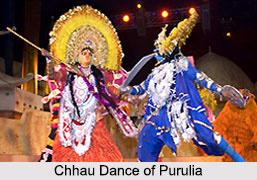
The popular dance forms belong to both classical Indian dance forms and desi dances of tribal populace. Bharatnatyam, Manipuri, Kathak, Kathakali retained the popularity among Bengali public till date. Chau dance of Purulia is a rare form of mask dance. Chhau dance of Purulia has some features of archaic `ritualistic` dance in its dynamism, fashion and support primarily the drum. Dancers applied as facial painting or body painting as the symbolic representations. They were thus distinguished as personifying the characters and the masks are worn afterwards.

Apart from these, the credit goes to danseuse Uday Shankar for attributing his innovative dance in the manner of European ballet.

Festivals
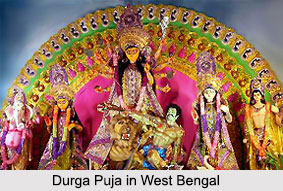
Durga-PujaThrough out the world, West Bengal is known for its plethora of festivals. The culture of West Bengal too is enriched by the festivals and also multiple rituals and rites associated with these festivals. There is hardly any Bengali left in the region who is not awe-struck and gets enthralled by the festivity and vivacity of Durga Puja. It is not only the main festival of West Bengal and it is feted in the autumn season. It commemorates the annual visit of Goddess Durga with her four children, namely Lakshmi, Saraswati, Ganesha and Kartikaya to her parents home on earth from her celestial residence on Mount Kailas. It is the largest Hindu festival and Bengalis celebrate it with new clothes and other gifts. It is a grand time for the Bengalis who wear gaily coloured new dresses and are also given edibles, especially sweets, to feed . The puja goes on for five days, commencing with the ritualistic induction of the goddess. The ceremony of worship continues for three days and ends with the dousing of the effigy in a river or a tank on the of `Vijaya Dashami`. Many thousands of pujas are organized in different `mohallas`, whirls a exalted display with a fair-like atmosphere in the streets of Calcutta.

Although it is a Hindu festival, the people of varied communities participate in this pomp and grandeur of Durgostav. The festive season continues till Kalipuja, which takes place about three weeks later. She is the Goddess of aboriginal ability, a Tantrik construct. Animal sacrifices are usually made to the Goddess except in the pujas organised by public subscription. Diwali is the festival of light and is feted on the night predating Kali-Puja. Every home of Bengalis is illuminated with lamps and a fantastic show of firecrackers is observed.

The festival of Sri-Panchami, i.e. the Vasant-Panchami held almost all over India on a date between the last week of January and the middle of February, thereby heralding the end of winter. The day marks the worship of Goddess of learning, Saraswati, whose adoration is feted with great grandeur by pupils and creative person.

West Bengal is an abode of multi religious and multilingual populace, so all the Indian Festivals are observed, thus incorporating own flavour of the region`s customes and practices. Pohela Baishakh (the Bengali New Year), Rathayatra, Dolyatra or Basanta-Utsab, Nobanno, Poush parbon (festival of Poush), kalipuja, saraswatipuja, laxmipuja, Christmas, Eid ul-Fitr and Eid ul-Adha are note worthy. In Calcutta, Buddha Purnima, which commemorates the birth of Gautama Buddha, is one of the most important Buddhist festivals while Christmas, called Borodin in Bangla is feted by the Christian residents.

Cuisine
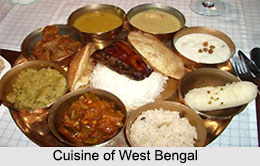
CuisineNo wonders, the delicious foods of Bengal are savored in great revel by all the foodies both within the country as well as abroad. Sumptuous cuisine is an integral element of the culture of West Bengal. Rice and fish have become the trademarks of the Bengali community. All fish-made dishes includes hilsa preparations, a deary among Bengalis. Sweets accommodate a status of pridefulness and prestige for the Bengalis. Sweet delicacies like sandesh, rosogolla , chanar payesh , Chômchôm, Kalojam and several kinds of Pithe. are held in high esteem by all the sweet-savors of the whole country. A Bengali and `Misti-doi` are tied together just like fish is inseparable from water. Bengali cook has also developed the expertise in preparing a special sweet from date palm jaggary called Patali gur. Every territory in Bengal has a especial confection of its own. Langcha and mihidana-sitabhog of Bardhaman, sharbhaja of Krishnanagar, chanabora of Murshidabad are worthy to mention. `Panta bhat` is a conventional dish devoured in all the Bengali village households. Every Bengali enlisted a whole lot of crispy and crunchy snacks in their meals. Luchi, cholaar dal, kochuri and alurdom to chop-cutlet and telebhaja , Beguni, Kati roll, phuchka are being relished by all the Bengalis of varied age to their hearts` content.

Lifestyle
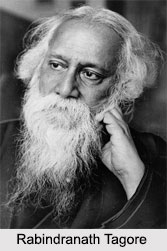
Hazarduari Palace_2181The popular saying, `what Bengal thinks, the rest of India will think tomorrow,` is enough to demarcate the socio- cultural heritage of Bengalis. The culture of West Bengal ,in every pulse of it , shows its exuberance in the modus vivendi (life style)of Bengalis. The Bangla language boasts a rich literary heritage, with a flamboyant tradition in folk literature, attested by the masterpieces like Shreekrishna Kirtana, Charyapada, Mangalkavya. In the nineteenth and twentieth century, Bengali literature was modernised in the influences of authors such as Bankim Chandra Chattopadhyay, Michael Madhusudan Dutt. In fact Rabindra nath Tagore had extended Bengali literature to its zenith in the arena of world art and culture. West Bengal is also glorified by its treasure of rich flora and fauna and also by the royal palaces, churches, and monuments reminiscing the era of foreign imperiats like Britons, Portuguese. The craftsmen and artists have tried their hands in producing some Kantha` Embroideryexcellent artworks. Kantha` embroidery is a dainty Bengali craft.
Today West Bengal is an epitome of cosmopolitan culture, juxtaposing the ethnicity and tradition of all the communities namely, Hindus, Muslims, Christians. Thus educationists, tourists, businessmen, and artistes throng it, thereby, initiating hoteliers to construct hotels, restaurants, multiplexes, bars, parks and pubs.

Language of Bengal
The Begali language is a blend of Indo-Aryan speech.Bengali is the first Indian language to adopt western secular literary styles, such as fiction and drama.

The culture of West Bengal is symbolic of concoction of modernity and tradition, richness and simplicity, regality and rural expertise. Musical melody, dancing damsels, culinary delights and exquisite Bengali lifestyle are what make the culture of West Bengal so rich and embellished.

More on West Bengal
Tribes of West Bengal Bengali Theatre Temples of West Bengal Colleges of West Bengal
Tribal jewellery of West Bengal Bengali Language Districts of West Bengal Medical colleges of West Bengal
Airports in West Bengal Crafts of West Bengal Cities of West Bengal West Bengal Cricketers
Monuments of West Bengal Bengali Wedding Personalities of West Bengal Bengali Literature
Folk Dances of West Bengal Bengali Folktale Museums of West Bengal Bengali Newspapers
Festivals of West Bengal Bengali Cinema Universities of West Bengal Places to See in West Bengal


(Last Updated on : 4/05/2009)
  More on West Bengal...
 
Culture of West Bengal Districts of West Bengal Geography of West Bengal
History of West Bengal Government & Politics in West Bengal Transport in West Bengal
Divisions of West Bengal Tourism In West Bengal Heritages of West Bengal
Pundras    
Recently Updated Articles in States of India
  • Kutch District
    Kutch District a land of colour, chronicle and culture is home to several temples as well as architectural masterpieces.
  •  
  • Water Sports in Uttarakhand
    Water Sports in Uttarakhand is varied and is equally interesting for the professionals as well as the amateurs.
  •  
  • Jalandhar District
    Jalandhar is one of the districts of the Indian state of Punjab which possesses various historical sites and architectures.
  •  
  • Skiing In Uttarakhand
    Skiing In Uttarakhand has become popular among tourists for the several mountain ranges of the region.
  •  
E-mail this Article | Post a Comment
Free E-magazine
Subscribe to Free
E-Magazine on States of India

 
Culture of West Bengal - Informative & researched article on Culture of West Bengal
Sitemap
Contact Us   |   RSS Feeds
Copyright © 2008 Jupiter Infomedia Pvt. Ltd. All rights reserved including the right to reproduce the contents in whole or in part in any form or medium without the express written permission of Jupiter Infomedia Pvt. Ltd.