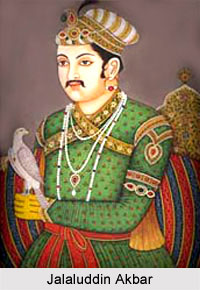
 Akbar was the greatest of all Mughal emperors and Mughal Empire saw its optimum progress during the reign of Akbar. He ascended the throne at a young age of thirteen after the death of his father Humayun. Akbar made the Mughal empire not only the strongest state in India but also one of the best administered state of his times, innovated certain policies which proved liberal, far-sighted and successful which added a new chapter in Indian medieval history and established the Mughal empire firmly in India. Therefore, he has been justly described as `the Great` among the Mughal emperors of India.
Early Life of Akbar
Jalaluddin Akbar had inherited from his father, Humayun, a Mughal Empire, which consists of only Kabul, Kandhar, and portions of Punjab and Delhi. The throne of Delhi was most insecure at that time. Humayun had got no time to stabilise his empire which he had won recently. Even Kabul, Kandhar and Badakshan were not safe. The greater part of north India was in the hands of the Afghans. The Rajputs were again reasserting themselves and Mewar was still a powerful state. Economically too Akbar`s position was poor. The treasury was empty, the revenue could be collected only on the point of sword and there was widespread famine in the areas near Delhi and Agra. Akbar faced numerous odds with the sudden death of his father. Still, he received immense mental strength and insurmountable courage under the genuine care, intensive guidance and tutelage of his regent and fatherly figure, Bairam Khan.
Tutelage of Bairam Khan
 Akbar appointed his guardian, Bairam Khan as the wazir of the empire and gave him the title of Khan -i- Khana at the time of accession. The credit of successfully eliminating the early difficulties of Akbar and safeguarding the Mughal Empire goes to Bairam Khan. He was a great support to Akbar in the second battle of Panipat which was fought against Hemu. The tutelage of Akbar under Bairam Khan lasted nearly for four years. Except the loss of Kandhar, this period had been that of conquest and consolidation. The sovereignty of Akbar in the territory from Kabul in the north to Jaunpur in the east and from the hills of Punjab to Ajmer in the south was re established. Bairam Khan was largely responsible for the success of Akbar during the early years of his reign. But he was asked to resign in 1560 A.D. Various reasons have been citied for the fall of Bairam Khan. Jealousies of the nobles and the ego of Bairam Khan are mainly held responsible for his downfall.
Extension of Akbar`s Empire
Akbar was an imperialist and frankly declared his desire to pursue the policy of the extension of the empire. He engaged himself in conquest all his life. He largely succeeded in doing so and his empire extended from Kabul in the west to the Bengal in the east and from Kashmir in the north to Vindhyas in the south. He initiated his conquest of southern India and partially succeeded. He conquered the entire north India and consolidated it, under his administration and provided a sound stability. The power of the Afghans was completely broken. They lost the ambition of an independent kingdom of their own and accepted service under the Mughal emperor. The same way, the Rajput states, except that of Mewar also acknowledged the suzerainty of Akbar and helped him in extending and consolidating the Mughal Empire. Akbar thus succeeded in fulfilling his ambition of conquering India to a large extent and also paved the way to complete the conquest of the remaining part of India by his successors.
Revolts During the Reign of Akbar
Various revolts took place during the reign of Akbar. The Uzbegs were the old nobility of Akbar. They were powerful and ambitious nobles and disliked the centralisation of administration by Akbar. They had another grievance that Akbar did not reward their services well. Their discontentment resulted in an open revolt in 1564 A.D., but eventually all of them were subdued. The Mirzas were part of the royal family and were among those nobles who were blood relatives of Akbar. Being members of the royal family, they desired best rewards from the emperor, failing which; they revolted during the period when Uzbegs revolted against Akbar. They were also defeated. Rebellions also took place in Bengal and Bihar and after one year of campaign, Akbar succeeded in suppressing the revolts. Thus, a number of revolts occurred during the reign of Akbar but none of them succeeded in disturbing the affairs of the state.
Policies of Akbar
Akbar was the greatest among all the Mughal emperors, one of the great rulers of India and also one among the most reputed and powerful rulers of the world. He possessed many humane virtues because of which he accepted the welfare of his subjects as one of his primary responsibilities and was most generous towards the poor and weaker sections of the society. Akbar was proficient of hard labour and was extraordinary courageous to face difficulties and even to risk his life in battles. He had absolute faith in God but was tolerant to all religions. As regards religion, he was pioneer of a new policy. Akbar was illiterate but, by coming in contact with scholars in different fields, he had acquired useful knowledge in philosophy, religion, literature, history etc. He justified it by bringing different innovations in religion and civil and military administration and also by implementing them successfully. Akbar was a daring soldier and a capable commander. He proved his valour and determination in many battles. He led many campaigns in person and brought them to success. The mobility of the Mughal army increased during his time. His campaign to suppress the revolt in Gujarat has been regarded as a `historic campaign.` He improved the fighting tactics, arms and organisation of the Mughal army so that it became invincible during his time.
Akbar proved himself as an innovator in many fields of administration. Besides, he possessed practical wisdom to implement those innovations successfully. The administration which he established survived successfully during the reigns of his powerful descendents and needed no change on principles. The duties and responsibilities of the emperor, the central and the provincial administration, the revenue system, the coinage, the Mansabdari system etc. as defined and established by him were taken over and carried on by his successors. It was Akbar who provided the administration which was universally applied throughout the territories of the Mughal Empire and provided same treatment to his all subjects.
As a ruler and statesman, the religious and the Rajput policy of Akbar were not only novel bur extremely successful. These provided a firm base and a new direction to the Mughal Empire and were largely responsible for power and glory of the Mughal Empire. Akbar also attempted to create a uniform culture among his subjects. The means which he adopted for the literary and artistic growth among his subjects led to a uniform Indian style in different fields and provided incentive to the progress of literature and fine arts.
Thus the character and personality of Akbar was that of a grand monarch. He was successful both as an individual and an emperor. His life and ideals were inspiring to others as a ruler, conqueror, administrator, statesman and a monarch. That is why Akbar alone has been regarded as `the great` among the Mughal emperors.
Akbar
Akbar was the greatest among the Mughal emperors and ascended the throne at a very early age, after the death of his father Humayun.