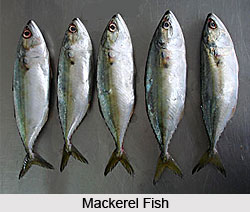
 Mackerel belongs to the family Scrombridae, which includes some of the most important food fishes of the world, second only to Herrings and Sardines in quantity and quality. In Indian waters two species of mackerel, Rastrelliger kanagurta and R.brachysoma, are found, the latter being restricted to Andaman waters. A third species has also been recorded. The first species represents the Indian mackerel for all practical purposes.
The Indian mackerel, being generally from twenty to twenty three centimetres long (maximum 32 cm), is much smaller than the Spanish or Atlantic mackerel which grows to more than sixty centimetres. The Indian species has an attractive streamlined body, terminal mouth with minute teeth, adipose eyelids, two dorsal fins and a forked caudal fin. Behind the dorsal and anal fins five to six detached finlets are present as also the normal pectorals. The iridescent greenish blue colour of the upper part of the body, with greyish oblique stripes and silvery belly makes the fish a beautiful denizen of the sea.
Being of oceanic habitat, mackerel migrate to coastal waters in large numbers from the month of September to the month of March on the west coast from Cape Comorin to Ratnagiri when the inshore water is cooler and contains more food material. The shoals are in thick masses of millions of individuals swimming close to each other and are near the surface that they can easily be spotted from a distance. The shoals are usually arrow-shaped. The period of migration varies from region to region, being earlier in the south and later in the north.
Their food consists of minute zooplanktons and phytoplanktonic organisms such as copepods, crustacean larvae, diatoms and algae. The period of their maturity is about two years, at a length of twenty to twenty three centimetres. Of the commercial catch the average size ranges from eighteen to twenty two centimetres, indicating that only a few might get a chance to breed. Normally the spawning season is estimated to be from April to September on the west coast and from October to March on the east coast though supplementary spawning in other months have also been recorded. Longevity is estimated to be five years. Ovarian eggs are about one millimetre in diameter but the size of actual spawning and fertilized eggs have not been studied. In early fry stages the individuals have thick spines or spikes on the head, and look quite different from the adult.
About eighty to ninety percent of the total landings of mackerel are from the west coast and the fluctuation in the numbers is so great that the total landings per annum vary from twenty thousand to two hundred thousand tonnes, the average being about sixty thousand tonnes.