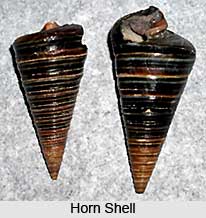
 Horn Shell is a group of adventurous and gregarious univalves plentiful along the seashores and in brackish and fresh water. The sea forms are common on mud banks and pools in the inter-tidal area and among the seaweeds on which they feed. The brackish water forms abound in the oozy slime flats of estuaries; and the freshwater forms on the sand and muddy banks of rivers and lakes. Horn Shells have a tendency to migrate from the sea to the land and adjust themselves to the new environment. They are often seen moving on semi-fluid slime, slowly creeping over low-laying land and browsing on the tiny vegetable growths on the bases of the trunks of coconut trees and mangrove trees. They return to the slimy beds after feeding. These univalves are capable of remaining out of water for several days because their breathing system is specialized - they have a well-developed siphon and their gill filaments are broken up into a close network of blood tubes. Zoologists say that some species can live out of water for three months.
These univalves possess shells which vary in size and sculpture, but all are elongated, tapering towards the apex and broad and bell-like at the mouth end. They resemble small `horns` or trumpets` and hence the name Horn Shells. The more common and abundant genera found in India are: Cerithium, Potamides, Telescopium and Tiara.
Cerithium is a purely marine form. It is found in plenty in tide-pools and muddy rocks at half-tide. The shells are about three centimetres long with many whorls, their mouth semi-circular and channelled at both ends. The whorls are slightly rounded, bearing a series of smooth nodules on the outside, black or red in colour. Sometimes thin lengthwise thickenings are also present.
Potamides is a brackish-water genus often found in multitudes on the mud flats of estuaries. Especially in the months of February and March the weed-grown shallows with slimy bottom will be found to be teeming with Potamides. They closely resemble Cerithium in size and sculpture but the outer lip is larger and turned out. The whorls are regular and rounded. The general colour is brown or brackish red, with a few whitish spiral lines. Telescopium is a large brackish-water genus, measuring nearly twelve centimetres. It has no tubercles or ridges. The aperture is strongly channelled. The surface colour is greyish brown but the interior is smoothed over with a thick layer of plum-coloured enamel. The animal thrives in soft exposed mud of backwaters.
Tiara looks like a small Potamides with rounded whorls, the surface of which is ornamented by thin transpiral ribs. The shell mouth is not channelled. It is a freshwater genus. Living specimens are found in plenty on the muddy and sandy banks of rivers and canals and in the shallow ditches dug around coconut palms for watering. Economically Horn Shells are very important and useful. In many parts of Indian - Konkan districts of the west, Godavari River and Krishna River in the east and Tinnevelly and Tuticorin in the south - the small shells of Cerithium and Potamides are collected in basketfuls, burnt in kilns and converted into quicklime. This lime slaked with water is ideal for whitewashing. The flesh of the large Telescopium is wholesome food.