Flying Fish, Indian Marine Species - Informative & researched article on Flying Fish, Indian Marine Species
  Indianetzone: Largest Free Encyclopedia of India with thousand of articles History of India


in  
Art & Culture | Entertainment | Health | Reference | Sports | Society | Travel
Forum  | Free E-magazine
History of India : Sources of History of India l Ancient History of India l Medieval History of India l Modern History of India l Indian Historical Dynasties l Indian Battles l Sepoy Mutiny 1857 l Indian Rulers l History of India l Indian Freedom Struggle l Indian Governor- Generals l British Indian Acts l Post Independence India l Iron Age in India
Home > Reference > Geography of India > Indian Natural History > Flying Fish
Flying Fish, Indian Marine Species
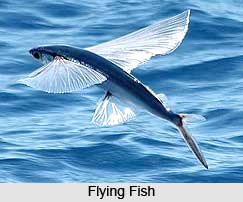
Flying Fish is mostly found in the south western Indian seas. This fish can fly a maximum distance of about four hundred metres over the surface of sea water.

Flying Fish, Indian Marine SpeciesFlying Fish is a type of fish which during its normal swimming movement in water can occasionally take to aerial flight by jumping into the air and gliding horizontally. The distance thus covered is at times as long as four hundred metres. These fishes occur on both east and west coasts of India, but more on the south-west where they form a fishery in winter months. They belong to the family Exocoetidae. The species are recorded from Indian seas, of which three, Cypselurus altipennis, Exocoetus volitans, and Paraexocoetus brachypterus are common.

There are small twenty five centimetres long fish with elongated roundish body and long broad pectoral fins extending up to the tail fin, the lower lobe of which also is elongated and pronounced. In some species the pelvic fin too is enlarged. Being pelagic, they swim usually in the upper strata of water. When they are about to fly, they accelerate their speed for a short distance, then suddenly jerk their head out of water and with powerful vibrations of the caudal portion of their body and the tail fin kick the water surface and become air-borne like a plane, spreading out their large pectoral fins for gliding. The pectoral fins are not flapped like birds` or butterflies` wings but kept distended.

The aerial flights are undertaken usually to escape enemies or when alarmed by approaching ships. But sometimes they may be purposeful; probably to cover distances quickly while catching small pelagic fish for food.

Fishermen off the south-western coast of India tie a broad piece of cloth to two poles on a catamaran or a small boat while moving in the fishing area. The flying fish in their flight strike the cloth and fall into the boat, to be merely collected by the fishermen. The leaping action of fishes such as chanos, mullets and rohu across nets are merely to escape the nets and although they cover some distance in air, the action is different from flying or gliding. The eggs of flying fish have long tendril-like processes by which they are entangled with each other or attached to weeds. They remain floating till the young ones hatch out.
(Last Updated on : 19/02/2010)
  More Articles in Indian Natural History
 
Indian Natural History in Mauryan Period Indian Natural History in Mughal period Indian Natural History in British Period
Indian Natural History after Independence Ants Ark Shells
Cowries Amphibians Bombay Duck
Crustaceans Algae Amoeba
Arachnids Clams Air Breathing Fishes
Sea Anemones Sea Cucumbers Sea Horse
Sea Lilies Sea Perches Sea Urchins
Scallops Slugs Small Cats
Snails Spider Sponges
Squids Mudskippers Mullets
Murrels Naticas Barnacles
Barracuda Tuna Perch
Piddocks Pomfret Mackerel
Mahseer Mantid Hydra
Loach Horn Shell Flying Fish
Cockroach Dugong, Sea Cow Garden Harvestmen
Caecilian Bristle Worm Trout
Volutes Water Spider Whelk
Termites Threadfin Thrip
Trapdoor Spider Sea Turtle Turtle
Recently Updated Articles in History of India
  • Mughal Architecture
    Mughal architecture is a combination of Islamic, Persian, Turkish and Indian architecture. It is a style that was developed under the Mughal dynasty in the sixteenth and seventeenth centuries.
  •  
  • Mansabdari System in Mughal Dynasty
    Akbar introduced the Mansabdari System in the Mughal army which primarily meant the ranking of officers on decimal system.
  •  
     
  • Deccan Policy of Mughal Dynasty
    Deccan Policy of the Mughal dynasty was weak during the reign of Babur and Humayun but after the accession of Akbar on the throne, the political situation changed and the Deccan policy was a success.
  •  
  • Coins of Pandyas
    Coins of Pandyas bear the legend of different Pandya ruler in different times.
  •  
  • Art and Architecture of Mughal Empire
    Art and architecture of Mughal Art offers an aesthetic degree to all art lovers. The subtlety of the finesse and the dazzle of the aura create huge amount of interest among tourist.
  •  
    E-mail this Article | Post a Comment
    RSS Feeds
    Forum
    Forum on Geography of India

    Free E-magazine
    Subscribe to Free
    E-Magazine on Indian Crafts
     
     
    Flying Fish, Indian Marine Species - Informative & researched article on Flying Fish, Indian Marine Species
    Sitemap
    Contact Us   |   RSS Feeds
    Copyright © 2008 Jupiter Infomedia Pvt. Ltd. All rights reserved including the right to reproduce the contents in whole or in part in any form or medium without the express written permission of Jupiter Infomedia Pvt. Ltd.