Crustaceans are lower animals such as shrimps, prawns and lobsters. There are males and females in prawns and lobsters. They form one of the principal classes of phylum namely, Arthropods. They include groups under 5 sub-classes and 20 orders, which are widely distributed mostly in the sea at depths measuring 3000 fathoms. In size, crustaceans vary from microscopic forms to those with legs measuring up to 15m long. Crustaceans are mostly aquatic in habitat, where other arthropods mostly live on land. Crustaceans are so called because their bodies are protected by a chiti or sub calcareous `crust` or cover. Many of the small crustaceans such as daphnia and cyclops and even small prawns serve as food for fishes and other larger aquatic animals.
Physical Features of Crustaceans
In a typical crustacean such as crayfish or spiny lobster, the body is elongate and is formed of segments and an anterior most terminal known as telson. The body may be divided into three regions namely, a head, a thorax and an abdomen. The segments of the head and thorax are fused to form a rigid `ce thorax`. Behind the cephalothorax is the flexible abdomen composed of six movable segments and the hindermost telson. Each segment bears a pair of appendages. The entire body of a typical crustacean is protected by a chitinous coating impregnated with lime. Strictly speaking, each segment or somite is covered with a separate chitinous ring or sclerite. These rings, however, get fused to form a shield or carapace over the rigid cephalothorax. The anterior part of the carapace projects forward to form a pointed beak or rostrum bearing a row of spines. Members of the smaller crustacean groups have as many as 41 to 63 thoracic segments and appendages. In all the highly organized crustaceans like lobster and crabs, the carapace completely covers the thorax and they have their characteristic well-developed walking legs, the first pair of which has pinching claws.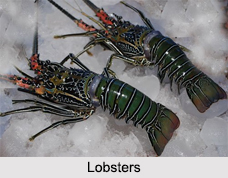
Physiological Systems of Crustaceans
Crustaceans possess all the important physiological systems of higher animals namely, the nervous, circulatory, respiratory, sensory, excretory, digestive and reproductive systems. The nervous system of a crustacean is simple like that of a worm. It consists of a brain situated above the oesophagus. Its circulatory system consists of a heart, several principal arteries and a number of spaces called sinuses into which blood passes from the arteries. The blood is colourless and contains slightly bluish coloured haemocynin in place of haemoglobin of higher vertebrates. Respiration in crustaceans is performed chiefly by a series of gills contained in a special chamber on either side of the thorax. The principal sense organs of a typical crustacean are a pair of compound eyes. In some other crustaceans both the male and female organs are in one. The excretory organs of a crustacean are a pair of glands placed laterally on either side of the gullet.
Food of Crustaceans
Principal food of a crustacean includes small animals (like snails, tadpoles and planktons), decaying organic matter, eggs and insect larvae. Crustaceans even prey upon each other. A few of them are wholly plant-eaters. It is during the early morning and at dusk that these animals are most active at catching and eating their prey. Since all crustaceans feed on decaying matter along with other food, they are known as scavengers of the sea.