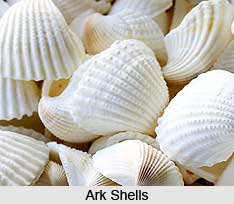
 Ark Shells are widely distributed along the Indian shores. The shells are readily recognised by their long and straight upper margin which bears numerous, tiny plate-shaped teeth. This particular arrangement is present in arks alone and not found in any other group of bivalves. An ark-shell with closed valves looks like a small box and that may be the reason as to why it is called Arca, which in Latin means a box.
Arks are more primitive than oysters and clams. Their foot is normal and bears a byssus. Their breathing organs are simple gills formed of thread-like filaments arranged parallel to one another. The lower parts of their filaments are folded upwards and connected by hair-like cilia. The mantle consists of two lobes covering the gills as in other bivalves but their lower edges are free, i.e. they are not united at any point to form a siphon as in higher bivalves like clams. The animal keeps the mantle margins gaping to allow fresh water to enter into and the used water to escape from the mantle cavity. This kind of simple gills and open mantles are found in mussels and scallops also.
 There are many species of arks varying widely in appearance, size and habits. Their shells are invariably ribbed, generally white, grey or brown in colour. In life most of them are covered by a greenish or dirty black bristly protective coating called the periostracum. Their habits vary. Many members live buried where mud is mixed with sand. Some attach themselves to mud-covered rocks and coral reefs, some to masses of pebbles and clusters of broken shells, and some find their way into crevices of stones and hardened mud. Their habitat or the nature of surface on which these animals settle and grow-affects the symmetry and appearance of the shells. Arks are not gregarious and do not form regular beds as oysters or mussels do.
Some of the popular species within the family of the Ark Shells are:
1. Area granosa is a handsome, heart-shaped ark which is 4 to 5 cms long. Its valves are thick and white with knobs along their ribs. Their blood and flesh are reddish in colour instead of light bluish as in other molluscs: hence they are called Blood Arks. The flesh is said to be tough and highly nutritious. This species is found in plenty in knee-deep mud by seashores, in backwaters and estuaries. Some of them ascend rivers far interior.
2. Arca symmetrica are the smallest of all common arks and is scarcely one cm long. Shell valves are symmetrical, dainty, finely ribbed and pure white in colour. Arks arc not generally gregarious but this species conga-gale are found under stones in the littoral region or attach themselves in assemblages to blocks of dead coral reefs.
3. Arca fusca, popularly known as the Banded Ark, is marked by deep chestnut colour, three whitish bands radiating from the centre of the upper margin and finely sculptured ribs. In life the shell is mostly covered by a black hairy coating. This species lives 4 to 5 fathoms deep, lying half buried in the muddy sand bottom.
4. Area tortuosa is the most curious ark. Its shell has more length than breadth and has a twisted appearance: the front portion is twisted to the left and the hind portion to the right. It is believed that the abnormal distortion is because the animal tries hard to fit itself into habitats like rock cervices and mud banks.