About North Indian Classical Music
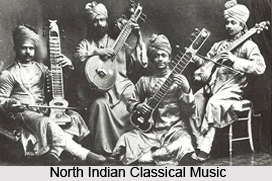 The Muslim conquest of Deccan region by Ala ud-Din Khilji led to a gradual differentiation between north and south Indian music is noticed. Although orthodox Islam frowned upon music, the acceptance of the Sufi doctrines (in which music was often an integral part) by Islam made it possible for many Muslim rulers and noblemen to extend their patronage to this art.
History evidences that musicians from Iran, Afghanistan, and Kashmir were at the courts of the Mughal Emperors Akbar, Jahangir, and Shah Jahan in the sixteenth and seventeenth centuries. It is quite evident that it was Indian music which captured the imagination of the Muslim rulers. Famous Indian musicians such as Svami Haridas, Tansen, and Baiju Bavra have left their impress on the history of north Indian music as per¬formers and innovators. Muslim musicians took to the performance of Indian music and added to the repertoire by inventing new ragas, taals, and musical forms, as well as musical instruments. This Muslim influence was largely effective in the north of India and undoubtedly helped to further the differen¬tiation between north and south Indian music, the two classical systems which are now generally referred to as Hindustani and Karnatak (Carnatic) music, respectively.
The Muslim patronage of music has had two main effects on the music of north India. The first was to de-emphasize the importance of the words of classical songs, which were originally composed in Sanskrit. Sanskrit songs were gradually replaced by compositions in various dialects such as Bhojpuri and Dakhani. There were also compositions in Urdu and Persian, some of which can still be heard. The textual themes of the songs were often based on Hindu mythology and yet Muslim musicians sang these songs and the songs were well accepted by the listeners and singers as well. On the reverse side of it, the Hindu musicians sometimes sang songs dedicated to Muslim saints. The best example of this attitude is to be seen in the poetry of the Muslim ruler Ibrahim Adil Shah II of the Deccan, who, in his Kitah-i-Nauras, composed at the beginning of the seventeenth century, wrote poems in praise of both Hindu deities and Muslim saints. These poems were sung in specified ragas by both Hindu and Muslim musicians.
The second effect of court patronage on Indian music was to produce an atmosphere of competition between musicians, which placed no little em¬phasis on display of virtuosity and technique. A great deal of importance was also placed on the creative imagination of the performing musician and gradually the emphasis shifted from what he was performing to how he was performing it. Traditional themes remain the basis of Indian music, but, in north India particularly, it is the performer"s interpretation, imagination, and skill in rendering these that provide the main substance of modern Indian music.
Beginning about the sixteenth century, a direct connection between the textual literature and modern performance practice was seen. An im¬portant feature of most of these texts is that a new system of classifying ragas in terms of scales was introduced. These scales are called mela in south India and that in north India. The north Indian music was evolving through its contact with the Muslims and the north Indian musicians were little influenced by the musical literature written in Sanskrit because many of them were Muslim and had no back¬ground in the language. In addition, most Hindu musicians were unable to understand Sanskrit, which had become a scholarly language in north India. South India had, however, become the centre of Hindu learning, and Sanskrit literature continued to play an important part in the development of its music. Thus north Indian music seems to have developed, for the most part, quite intuitionally during this period, and it is only in this century that musical theory has once again begun to come to grips with performance practice and to influence its development.
There are about ten more scales used in north Indian music. In north Indian music, the beginnings of a different method of raga classification are observed. There a number of ragas are given generic names, such as Kalyan, Malhar, and Kanhara, with specific names used to distinguish the various ragas within the same genus.
Role of Guru in North Indian Classical Music
Role of Guru in North Indian Classical Music is of utmost importance. He is a central figure in the system of classical music in India and has the most important role to play in the growth and development of the musician as an artist. A musician`s Guru is arranged early on in one`s formative years and he continues to be a decisive figure throughout his lifetime. The student`s connection itself is form the Guru. The Guru conducts the daily regimen of practice and learning, and regulating all facets of the musical growth of the disciple (Shishya).
Earlier, the contact between the Guru and the disciple was even more intimate. The student lived with or near the guru and attended to the needs of the rhythm of his/her household- shopping, cleaning, cooking, and serving whenever called upon. In a ceremony early in the relationship, a thread was tied around the wrist of the student, symbolically binding him or her into a permanent relationship. The student was usually financially dependent on the Guru as well, so the student was not free to come and go at will. The music, of course, was the bond, and assumed a role as language of communication, devotion, and profession. The guru taught the music directly through oral repetition- hear, repeat, practice, repeat, hear again, practice. An entire body of knowledge of Raaga and Taal was accumulated slowly along with the technical abilities which had to be executed with greater and greater refinement and discernment of ear. The student was continually required to prove that he or she was ready for the next step. The Guru`s knowledge was a highly guarded treasure and not just given out at the student`s request. The years of slowly measured progress and refinement developed attitudes of patience, respect, and humility in the student. This is readily apparent in the music.
The teacher is of a musical family implied by the guru-as-the-father (or mother) and is called a Gharana (from ghar, `house`). Another word, Khandan (family) is also heard, but it refers more to the bloodlines and inter-marriages of musical families. The Gharana system also includes the inherited musical style of a teacher including the selection of Raagas, and compositions within them, as well as the choices of how to expand the Raaga in performance. The Gharana system was especially powerful in the old days of aristocratic patronage, where geographic centrality in a Gharana was implicit. Many such Gharanas are known by their court names: Gwalior Gharana, Lucknow Gharana, Patiala Gharana, Rampur Gharana, Maihar Gharana and so on. Others are known by the founding personalities or place of origin: Alladiya Khan (a Khayal singer) Gharana, Imdad Khan (a sitar/surbahar player) Gharana, Kirana Gharana (a village) and so on. Though the old sense of the term Gharana is becoming quite scattered in contemporary urban classical music, the idea still plays an important part in a musician`s life and music, since the bulk of his training will have come through a single guru. He may acknowledge that a given composition he plays is from another Gharana, but he will still render it within the style he learned, using ornaments and expansions particular to his own training.
The student`s attitude, conceptions, and technical prowess is both the product and responsibility of the guru. Thus the Guru-Shishya relationship is not one to be taken lightly as it involves a great commitment from both sides.
Riyaaz in North Indian Classical Music
Riyaaz in North Indian Classical Music refers to the practice sessions of the music. Riyaaz also spelled "Riyaz" is an Urdu language term. Riyaaz is one of the most important aspects of Indian Classical Music as any art form requires consistent and regular practice in order to be mastered. It is said that a musician is in a constant spiritual quest for sound, affect, technique, and composition and all these can be obtained by regular practice or Riyaaz.
The Procedure of Riyaaz : When a musician practices, he or she sits down, and the word `sit` often substitutes for practice. In fact, when some musician says `come sit with me` it is an invitation to a fellow student to come and practice a lesson together, or for an accompanist to join in. During the session of Riyaaz, the musician"s routines of exercises and scales, technique and literature are practiced over and over, again and again, until they attain the kind of polish and lustre which makes them presentable in concert. The world over know well this aspect of preparation. When a musician shows polish and completion in his work, it is said that he has `Taiyan`. This is like saying that his practice has been successful and he is ready and blooming. This very same term can also be used in a negative sense in that it may be said of a musician that he has talent but no Taiyan due to lack of practice.
Sadhana : Several years of Riyaaz add up to Sadhana, which means spiritual practice. This term signifies realization and fulfilment which are worthy of great respect. A younger musician might be praised for his Riyaaz, in that he devotes long hours to honing his skills; but an older musician would be respected for his Sadhana, which would include his lifework in music. This means one who has spent many years teaching, performing, and in Riyaaz.