After the Gonds and the Santhals, the Bhil Tribe, native to the western and central India is known to be the third largest tribal community in the country. The Bhil people are indigenous to the Indian states of Madhya Pradesh, Gujarat, Rajasthan, Maharashtra, and Chhattisgarh and even in the far- eastern corner of India in the state of Tripura.
History of Bhil Tribe
There are several hypotheses regarding the origin of the Bhil tribe but it is known that they belong to a race of Indo- Aryans. The name `Bhil` is derived from the word Villu or Billu, which according to the Dravidian language is known as bow. And thus, the Bhils are popularly known as the bow men of Rajasthan.
There also has been mention of the Bhils in sacred historical texts like the Ramayana and the Mahabharata. Their contributions from the ancient era are also highlighted when the Bhils were considered to be the great warriors who fought against the Mughals, Marathas and the British Empire.
Sub- Divisions of Bhil Tribe
The Bhils are known strictly to marry in their own specific social or ethnic group and thus they are divided into a number of endogamous territorial divisions. They are known to have quite a number of clans and lineages. The main division of the Bhil tribe in Gujarat and Rajasthan are the Barda, Bhil Garasia, Dholi Bhil, Dungri Bhil, Dungri Garasia, Bhil Pateliya, Rawal Bhil, Tadvi Bhil, Bhagalia, Bhilala, Pawra, Vasava or Vasave, Dungri Garasia, and Vasava. While in Maharashtra, the Bhil Mavchi and Kotwal are their main sub-groups.
 Religion of Bhil Tribe
Traditionally following the religion of Hinduism, the Nirdhi Bhil is an exception that follows Islam along with the few sub groups in Dang following Christianity. The Bhil people still continue to worship tribal deities such as Dev Mogra Mata and Sitla Mata and every village has its own local deity or Gramdev. Each family are also known to have their own Kuldev or household deity which is symbolised by a stone.
Languages Spoken by Bhil Tribe
Throughout the geographic distribution of the Bhil Tribe, the primary language spoken by them is Bhili, which is also known as Bhagoria, Bhilboli and Garasia. Based on Gujarati, Bhili has about 36 different dialects and pronunciations and differs by region. The dialects gradually merge into more widely-spoken languages such as Marathi in the southeast and Rajasthani in the northwest. It is said that most of the Bhil people also speak the language of the region they reside in, such as Marathi, Gujarati, Sindhi, Hindi or a Hindustani dialect.
Costumes of Bhil Tribe
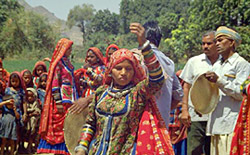
The costumes of the Bhil tribes display a distinct characteristic that goes well with the rustic but ethnic lifestyle. The Bhil woman wears an upper garment called the kapada, a ghagra and an odhna. The kapada is a short-sleeved cotton blouse, which is held by cloth ties at the back around the neck and the waist. The ghagra is ankle- length and is ingeniously turned into a pair of trousers, while working in the fields.
 The costume of a Bhil man comprises a turban or `feto`, an angi, tunic and a lower garment called `potario`. The turban is made of a white hand spun, hand- woven fabric and the tunic is made of hand spun, unbleached cotton. And both the genders are fond of tattooing and wearing brass ornaments.
Culture of Bhil Tribe
The Bhil Tribe has a unique, rich indigenous culture with their traditional folk dances and art. The Ghoomar dance, which is a traditional folk dance symbolising womanhood, is one of the popular aspects of Bhil culture. Another entertaining aspect is the Swang, which consists of storytelling combined with dancing and music with an abundance of drinking.
The art done of the people of Bhil Tribe are also marvellous and is characterised by the use of multi-coloured dots as in-filling. Bhuri Bai, an Indian Bhil artist was the first Bhil artist to paint using readymade colours and paper. There are other well known Bhil artists like Lado Bai, Sher Singh, Ram Singh and Dubu Bariya.
Presently, the main community of the Bhil Tribe are settled farmers with agriculture and animal husbandry being their primary occupation. They cultivate their food in their own lands and their main foods are maize, onion, garlic and chilli, while wheat and rice are used for special occasions and festivals.
The Baneshwar fair is the main festival celebrated among the Bhils. This fair is held during the period of Shivaratri in the months of January or February. The fair is dedicated to Baneshwar Mahadev also known as Lord Shiva and is actually the combination of 2 fairs, which are held in reverence of Lord Shiva and the other one that commenced after the setting up of the Vishnu temple by Jankunwari. The Hindu festivals of Holi and Dusshera are the other major festivals celebrated among the Bhil Tribes in India.