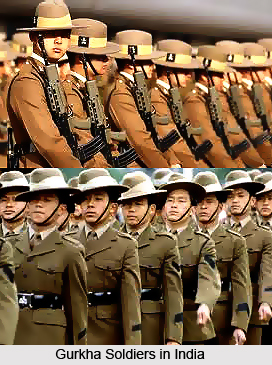
 Gurkha, also spelled as Gorkha or Gurka, hail from Nepal but they are also the inhabitants of northeast India. This clan has derived their name from the eighth century Hindu warrior-saint Guru Gorakhnath. His disciple Bappa Rawal, born Prince Kalbhoj, founded the house of Mewar in Rajasthan (Rajputana). Later descendants of Bappa Rawal invaded further east and founded the house of Gorkha, which was later established as the Kingdom of Nepal. The word Gorkha is derived from the Prakrit words "go rakkha", literally meaning "livestock-protector".
The clans of Gurkhas are best known for their history of gallantry and strength in the British Army`s Brigade of Gurkhas and the Indian Army`s Gorkha regiments. British officials designated the Gurkhas as a "Martial Race". They were thought to be naturally warlike and hostile in battle, and were valourous, loyal, self competent, flexible, disciplined and have the ability to work hard for long periods of time. The British recruited heavily from these martial races for service in their army during their reign.
According to the Gurkhas their origin is from the Hindu Rajputs and Brahmins of Northern India, who entered modern Nepal from the west. Most of the early Gurkhas were from the Thakuri that includes the Shah dynasty and Rana dynasty of Nepal, Chetri and Brahmin ethnic groups, whereas the contemporary Gurkha soldiers are mainly from the Rai, Gurung, Limbu and Magar ethnic groups. They joined the Gurkha group during 17th century expansion of the Gorkha kingdom. However, even today the Thakuris and Chetris comprise the majority of Gurkha officers in Nepal, while the main pillars of support of the Gorkha army is mainly contributed to the Limbu, Rai, Gurung and Magar people. This particular combination of warriors from different ethnic groups made the Gurkhas a central military force in history of the Indian subcontinent since the 18th century.
The Gurkhas served as troops under agreement to the East India Company in the Pindaree War of 1817, in Bharatpur in 1826 and the First and Second Anglo-Sikh Wars in 1846 and 1848 as well. During the Indian Rebellion of 1857, Gurkhas fought in favour of the British, and became part of the British Indian Army on its formation. The 2nd Gurkha Rifles or The Sirmoor Rifles made a particularly notable contribution during the conflict. Around twenty-five Indian Order of Merit awards were made to men from that regiment during the Siege of Delhi. Three days after the mutiny began, the Sirmoor Rifles were decreed to transfer to Meerut, where the British garrison was hardly holding on.
From the end of the Indian Rebellion of 1857 until the beginning of the First World War the Gurkha Regiments witnessed active service in Burma, Afghanistan, the Northeast and the North-West Frontiers of India, Cyprus, Malaya, Malta (the Russo-Turkish War, 1877-78), China (the Boxer Rebellion of 1900) and Tibet (Younghusband`s Expedition of 1905). Between 1901 and 1906, the Gurkha regiments were renumbered from the 1st to the 10th as the Gurkha Rifles. During World War I (1914-18), more than 200,000 Gurkhas served in the British Army, suffering roughly 20,000 casualties, and receiving approximately 2,000 gallantry awards. During World War II (1939-45), there were almost ten Gurkha regiments, with two battalions each making a total of twenty pre-war battalions.
Since partition of India, the Gurkha regiments that were transferred to the Indian Army are well established as permanent and vital part of the independent Indian Army. Indeed, whilst Britain has reduced its Gurkha contingent India has continued to employ Gurkhas in large numbers. In 1997 the Indian Army had a Gurkha contingent that numbered around 120,000 men in forty-six battalions, spread across seven regiments each with five battalions, working in states like Assam, Jammu and Kashmir and other sensitive states.