


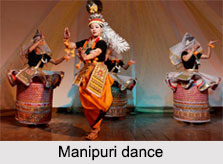
 Northeast Indian Dances are effortless and are presented to convey joy and happiness among themselves. The colourful and vibrant land of North East India is the possessor of diverse culture with a variety and homogeneity. A mosaic of cultures, customs and art blend harmoniously with each other in the land and keeping their own identity intact. Northeast Indian Dances are effortless and are presented to convey joy and happiness among themselves. The colourful and vibrant land of North East India is the possessor of diverse culture with a variety and homogeneity. A mosaic of cultures, customs and art blend harmoniously with each other in the land and keeping their own identity intact.
North east India called the seven sisters comprise of Assam, Arunachal Pradesh. Nagaland, Manipur, Mizoram, Tripura, Meghalaya. Everyone in the state take delight in the dances of the region. Furthermore, the various aboriginal tribes that exist in the region portray the sense of fun and zest in their life through their dances. The rich natural beauty and serenity accompanied with the multihued Northeast Indian Dances make the states magnificent. Different Northeast Indian Dances Most of the dances are accompanied by songs sung generally in chorus. The dances of the tribes are mostly group dances where both men and women take part. Northeast Indian Dances are thus a display of variety and affluent cultural heritage. Following are the Different Northeast Indian Dances: Manipuri dance: The Manipuri dance of Manipur is a renowned Indian Classical Dance that finds mention in the Natya Shastra written by Bharat Muni. This dance form has a long history. It is the form of dance that is closely associated with the worship of Vishnu. The fascinating dance Ras Lila is created to grace Lord Krishna. 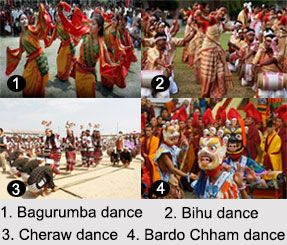 Bihu dance: Bihu dance is a well-liked and most significant festival of Assam which is celebrated three times in a year. Both men and women present a group dance during these festivals which is widely known as Bihu dance. Bihu dance: Bihu dance is a well-liked and most significant festival of Assam which is celebrated three times in a year. Both men and women present a group dance during these festivals which is widely known as Bihu dance.
Laho dance: Throughout the ‘Behdienkhlam festival’ in Meghalaya, people of Meghalaya, particularly the ‘Pnar Tribe’, takes part in laho dance with multi-coloured attire. Two men stand in both side of a woman and they connect each other’s arms to present in particular steps. Cheraw dance: The male participants move the bamboo staves, which are kept in cross and horizontal forms, in particular rhythm and female dancers step in and out the blocks with beats in this dance. When the bamboos are clapped, they sound like a rhythm. Cheraw dance is considered to be the oldest dance form in Mizoram. Hojagiri dance: ‘Lakshmi Puja’ or the ‘hojagiri festival’ in Tripura carries a lot of delight in the local people in forms of music, dance, dishes etc. Four or six members in a team, all women, sing and poise on earthen pitchers, taking a bottle on the head and earthen lamp on the hand. Bardo Chham Dance: It is a dance form of Arunachal Pradesh. Locals of Arunachal Pradesh consider that there are good and evil in every human being, which evidently is seen in their dance form named ‘bardo chham’. The tribal dancers perform a dramatic flight between these two entities to bring joy and peace, wearing colourful masks. Chang Lo dance: Chang lo dance form is a very popular dance now-a-days. It is often called ‘sua lua’ and performed during three days of ‘Poanglem festival’. It is perhaps named after the ‘Chang’ tribe of Nagaland. Nongkrem dance: 'Nongkrem' dance is performed in Meghalaya, in autumn. The ‘Khasis’ are a tribe of Meghalaya, who also commemorate the ripening of paddy for threshing, by dances and songs. Sattriya dance: Sattriya dance also finds importance as a classical dance form in the Natya Shastra. Sattriya represents the culture and tradition of the entire region of Assam. Besides, classical dances, north east India offers the world enthralling variety of folk dances. Pung Chalom dance: This is a famed Manipuri Dance which is said to be the soul of ‘Sankirtana’ Music of Manipur. This is an exclusive dance that is an introduction to the famous ‘Ras Lila’ Dance. This dance moves to the beat of the ‘pung’ which is a kind of hand operated drum wherein the male and the female dancers move in work. Bagurumba dance: Bagurumba is a folk dance of local ‘Bodo’ tribe in Assam and Northeast India. It is a traditional dance which is usually inherent to one generation to other generations. The Bodo women perform the ‘Bagurumba’ dance with their colourful ‘dokhna’, ‘jwmgra’ and ‘aronai’. |
| |||



Northeast Indian Dances
| Northeast Indian Dances are multihued and comprise the essence of tribal, folk as well as classical dance. |
| ||||||||||||||||||||||||||||

