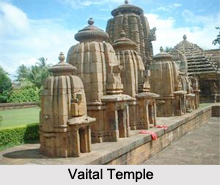
 The Vaital Temple is located in the Indian state of Orissa and was built in the 8th century. More specifically, this temple is situated near Bindu Sarovar in Bhubaneswar, the capital city of Orissa. This shrine is known to belong to a subsidiary of the Kalinga School or the Khakhara order. It can be defined as a tantric temple and is dedicated to goddess, Chamunda. This goddess is also known to be the tantric form of goddess Durga. To worship the shrine of the temple the fundamentals of two sects namely, Buddhism and Hinduism is followed. The tantric worship has elaborate rituals comprising of magic spells, secret rituals and sacrificial offerings. This temple attained popularity due to its remarkable architectural design, especially of the tower and the noteworthy sculptures all over the temple. This temple is also known as the Vaital Deul Temple. It is considered to be the main hub for tantric devotion and teaching. The Vaital is also considered to be one of the most highly revered Hindu temples. This temple is frequented by a large number of devotees who come here to worship the goddess along with offerings on some auspicious days.
Architectural Design of Vaital Temple
The Vaital Temple is rectangular in shape, positioned at right angle to the jagmohana or the porch. It is known to showcase an extremely accomplished style of sculptural beautification. The entrance of the Vaital Temple is adorned with a four-faced linga known to be decorated with unusual and remarkable carvings. The most striking feature of the Vaital is the deul or tower. The eastern side of the tower has an image of Lord Surya which is flanked by his sisters Usha and Pratyusha. The tower walls are decorated with a representation of the third Pandava, Arjuna who is depicted driving his chariot. The outer defensive walls or fortifications of this temple are decorated with many images. Some of these are the panels of Hindu deities, mostly Shiva and his wife Parvati in her Shakti form, hunting processions and wild elephants. On top of the left of the jagamohana, the front wall of the tower has two chaitya windows. The lower one is decorated by imprinted figure of the sun god, Surya celebrated for its countenance, with his sisters, Usha (Dawn) and Pratyusha, shooting arrows on either side and with Arjuna ahead of them driving a chariot of seven horses. The upper chaitya window has a medallion. What is evident looking at the medallion is a 10-armed "Nataraja", which is considered to be the dancing form of Lord Shiva. A rock post with two figures, recognized as seated in the dharma-chakra-pravartana mudra can be located in the front of the smooth roofed jagamohana. These two figures are considered to be that of Buddha. The roof vault of the temple is derived from earlier free-standing buildings made of wood and thatch. The interior of the Vaital Temple has an inner sanctum. This sanctum is almost completely dark as the esoteric rites are believed to have been performed here.
Inside the temple, goddess Chamunda sits on a corpse with a dazzling red tongue protruding out. She is depicted as wearing a necklace of skulls. Owl and a jackal can be seen seated on the corpse. These are usually hidden by her robes. She is also recognized as the eight-armed slayer of the buffalo demon. In her arms she is seen holding a snake, a bow, a shield, a trident and a thunderbolt. The arrow with which she is piercing the neck of the demon, is considered to be the most terrifying aspect of the goddess Kali. The goddess has sunken eyes and shrunken belly too. The sunken eyes and shrunken belly are again indicative of her terrible form. The Chamunda is orbited by a number of other deities which are engraved in the subordinate parts of the bulwarks. They are small in size and are connected with each other. Each of them is located in a slot disconnected by a pilaster. A carcass form of Bhairava forms the counter part of Chamunda. The figure of Bhairava in this form is located on the eastern wall, to the right of the door. Thus, from the darker facets of the sculpture"s content, the tantric practices in the temple and the fear inducing setting of the temple with a number of strange images filling the niches around the sanctum, it can be said that the entire atmosphere of the temple may make a person feel very uncomfortable.
Visiting Information
Winter (October to March) is generally considered to be the best time to visit the Vaital Deul Temple.
Since the Vaital is located in Bhubaneswar, its transport system is of relevance to it. Bhubaneswar has its own airport named Biju Patnaik Airport. Regular flights operate to and from Bhubaneswar to all the other states and major cities in India. This airport is located about 3 km from the city. As far as railway is concerned, it is important to note that Bhubaneswar is considered to be one of the most important railway stations in Eastern India. Bhubaneswar is therefore connected to many other states and major cities of India by railway lines. It is again important to note that Bhubaneswar is the capital city of Orissa. It is therefore well connected to all parts of the state and nearby states by road. There is regular bus service to and from all major cities. The main bus stand is located at a distance of about 8 km from the city"s centre.
Related Articles:
Indian Regional Temples
East India Temples
North Indian Temples
West India Temples
Central India Temples
Indian Temples