Introduction
Languages of Andhra Pradesh belong to the Dravidian language group. Telugu is the official language in Andhra Pradesh including Telengana region. In October 1953, the state was constituted and Telugu was acknowledged with this status. India comprises of different linguistic communities, each sharing a common language of their own. The Indian languages belong to four classes of languages, namely Mon-Khmer, Sino-Tibetan, Indo-European and Dravidian. These languages are grouped on the basis of geographical locations in India.
The main languages that are spoken by people of Andhra Pradesh are Telugu, Hindi, Banjara, Urdu and English. Along with these, there are other languages like Odia, Marathi, and Lambadi, that are also spoken in the state.
Telugu Language
Telugu Language is one of the 23 official languages of India. The subtlety of the language emphasizes the language`s profundity. Telugu is an exceptionally robust language and is highly moulded by Sanskrit influence. It was also referred to as "Tenugu" in the past. Amongst the Dravidian languages, Telugu is mostly spoken by the people. In terms of population, Telugu ranks second to Hindi among the Indian languages. The Telugu alphabet is called "Onamaalu". In Andhra Pradesh, Telugu is the first official language and is spoken by majority of people in the state.
Kolami Language
Kolami is another language of Andhra Pradesh is also widely used in Andhra region. Like all other South Indian languages, it also belongs to the category of Dravidian language group. This language is also spoken in Maharashtra and Telangana. It is the most widely spoken Central Dravidian language.
Kannada Language
Since, Telugu has a close resemblance with Tamil, Kannada and Tulu, Kannada is also one of the spoken languages in Andhra Pradesh. Though Kannada is the official language of Karnataka, it has some significant linguistic minorities in Andhra Pradesh. Kannada is considered to be one of the oldest living languages.
Urdu Language
With the advent of the Muslim rule, several Persian and Arabic words entered into the Telugu language. Urdu is another language that came to the Deccan, late in the 15th century. It flourished during the reign of the Qutub Shahi Dynasty.
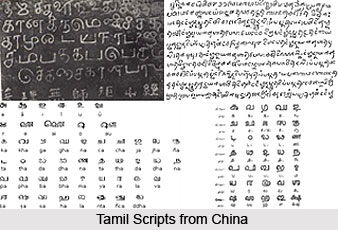
Tamil Language
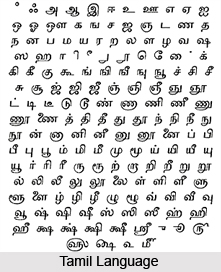
Tamil is the official language of Tamil Nadu and Puducherry, but is also spoken by significant minorities in the four other South Indian states of Kerala, Karnataka, Andhra Pradesh and Telangana and the Union Territory of the Andaman and Nicobar Islands. It is one of the 22 scheduled languages of India.
Hindi
In Andhra Pradesh, many people speak Hindi as it is the most widely spoken language in India. It is commonly used as a second language or for communication between different regions.
Odia
Bengali
In Andhra Pradesh, a small group of people speaks Bengali, primarily in cities like Visakhapatnam and Vijayawada. These individuals have typically migrated to these urban centers for work or business opportunities, bringing their language and culture with them.
Marathi
In certain parts of Andhra Pradesh, a small number of people
speak Marathi, likely due to migration from Maharashtra. Marathi speakers in
the state are primarily concentrated in urban areas and developed cities,
reflecting their roots in Maharashtra and the cultural ties brought along
through migration.
English
In Andhra Pradesh, a small percentage of the population aged
12 and above can read and understand English. While there are not many native
English speakers in the state, a segment of the population is fluent in the
language, often using it for communication in educational, professional, or
social settings.
Tribal Languages in Andhra Pradesh
Tribal languages are integral to preserving the heritage and
traditions of indigenous communities in Andhra Pradesh. They embody the deep
bond between tribal populations and their ancestral lands, reflecting their
unique cultural identity. These languages also enrich the multicultural
diversity of the state, showcasing its vibrant traditions.
Duruwa or Parji
Duruwa, also called Parji, is a Dravidian language
predominantly spoken by the Dhurwa tribe. It is primarily used in Odisha,
Andhra Pradesh, and Chhattisgarh. The language features four main dialects:
Dharba, Kukanar, Nethanar, and Tiriya, with Nethanar being the most widely
spoken among them.
Gondi
Gondi is a tribal Dravidian language spoken by around two
million people of the Gond tribe. The Gondi-speaking population is distributed
across Madhya Pradesh, Gujarat, Telangana, Maharashtra, Chhattisgarh, and
Andhra Pradesh. The language features several major dialects, including Dorla,
Koya, Madiya, Muria, and Raj Gond, highlighting its rich linguistic diversity.
Lambadi
Lambadi, also known as Lambani, Lamani, or Banjari, is a
Western Indo-Aryan language spoken by the Banjara community, a nomadic tribal
group in Andhra Pradesh. The language lacks a native script but follows the
Telugu script in the state. Lambadi is spoken by a small number of people,
particularly in tribal regions.
Ollari
Ollari, also known as Ollar Gadaba, is a tribal Dravidian
language spoken in the border regions of Odisha and Andhra Pradesh,
particularly in Koraput and Srikakulam districts. The language is also referred
to by various names, including Ollaro, Hallari, Allar, and Hollar Gadbas,
reflecting its diverse linguistic heritage.
Koya
Koya is a tribal Dravidian language spoken by the Koya people of Andhra Pradesh. Although it is sometimes mistakenly identified as a dialect of the Gondi language, Koya is an independent language with its own unique identity.
Muthvan
Muthvan, also known as Mudavan, Muduva, Muduvan, Muduvar, and Mutuvar, is a language spoken in specific regions of Andhra Pradesh, Kerala, and Tamil Nadu. This language reflects the cultural identity of the communities that use it, contributing to the linguistic diversity of South India.
Kui
Kui, also known as Kandh, Khondi, Khond, Khondo, Kanda, Kodu, Kodulu, Kuinga, and Kuy, is a language spoken by the Khond tribe. Closely related to the historical Kalinga language, Kui holds cultural significance for the community. It is primarily spoken in the border regions of Odisha and Andhra Pradesh.
Konda
Konda, also called Konda-Dora, is a tribal Dravidian language spoken by members of the Konda-Dora tribe. This language is primarily used by tribal communities residing in various regions of Andhra Pradesh, Odisha, and Assam.
Kuvi
Kuvi is one of the two languages spoken by the Khond tribe.
Although often regarded as a dialect of the more widely spoken Kui language,
Kuvi is a distinct language in its own right. It is primarily used by certain
tribal communities in Andhra Pradesh, reflecting their unique linguistic
identity.
Chenchu
Chenchu is the primary language spoken by the Chenchu tribes living in Andhra Pradesh and Telangana. It is also referred to as Chenchukulam, Chenchwar, Chenswar, or Chencharu. This language plays a significant role in preserving the cultural and linguistic heritage of the Chenchu tribal community.
Yerukula
Yerukula, also referred to as Kurru Bhasha or Kulavatha, is
the language spoken by the Yerukula tribe. This tribal community is spread
across various regions of South India, where their language reflects their
unique cultural heritage and traditions.