


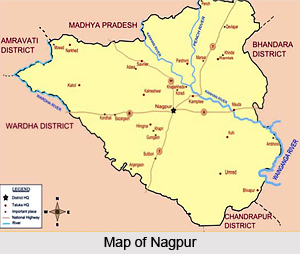
Nagpur is also famous throughout the country as “Orange City” for being a major trade center of oranges cultivated in the region. The city was established by Bhakt Buland, a prince of the Gond tribe during the first half of 18th century. It has 14 Talukas and 12 Assembly Segment Constituencies. Due to the presence of several tiger reserves in and around the city, it also called the Tiger Capital of India or the Tiger Gateway of India. The regional office of National Tiger Conservation Authority is in Nagpur. Etymology of Nagpur Nagpur is named after the river Nag that flows through the city. The word “pur” means city and is the name commonly given to Indian cities. Mahal, the present name of the old Nagpur city, is situated on north banks of the river Nag. Nagpur was earlier known as "Fanindrapura", a word derived from the Marathi language. The word “fana” means the hood of a snake. History of Nagpur Nagpur lies in central India and has the Zero Mile Stone, which was used by the British to measure all distances within the Indian subcontinent. The city founded by Gond people, later became a part of the Maratha Empire under the Bhonsles. The British East India Company plays a key role in the history of Nagpur. Nagpur is a 3000 years old city as human existence is can be traced back to the 8th century BCE. The presence of Megalithic culture is evident from the existence of Mehir burial sites at the Drugdhamna. Historical inscriptions of 940 CE mention the presence of Nagpur. During the 3rd Century the region was ruled by King Vindhyasakti which was later passed to the Vakataka Dynasty around 4th Century. Nagpur later came under the rule of the Badami Chalukyas, the Rashtrakutas and then the Paramaras in the 11th century. Subsequently, the region came under the Yadavas of Devagiri. In 1296, Allauddin Khilji invaded the Yadava Kingdom after capturing Deogiri and in 1317 Tughlaq Dynasty came to power in Nagpur. In the 17th Century, Nagpur was conquered by the Maratha Empire but the administration was run by the Gonds of modern day Madhya Pradesh. Bhonsles of Maharashtra established their kingdom in Nagpur during the 18th Century. Nagpur was burnt subsequently in 1765 and 1811 by Pindaris but the city continued its development under different rulers despite all odds. British Empire took over the city in 19th century and made it the capital of Central Provinces and Berar. After first state restructuring, it lost the capital status but was made second capital of Maharashtra. Tata Group started its first textile mill in Nagpur. In 1920 the non-cooperation movement was launched in the Nagpur session. The city witness riots in 1923 and 1927 after which RSS gained further popularity in Nagpur and the organization grew nationwide. Nagpur is an important location for Dalit Buddhist movement and Hindu nationalist organizations like RSS and VHP. Geography of Nagpur Nagpur is important location wise as it is situated at the crossroads of India's North-South and East-West routes by road rail and air. The city lies on the Deccan plateau and is blessed with several artificial and natural lakes. The Nag River is a tributary of the Kanhan River, which flows in a meandering path through the old city of Nagpur. Ambazari Lake is the largest lake here. Nagpur is accredited for being one of the cleanest and the second greenest city in India (as per 2010 reports).  Climate of Nagpur
Nagpur city lying on the Deccan plateau of the Indian Peninsula enjoys a tropical wet and dry climate, with dry conditions prevailing for most of the year, since it is far from Bay of Bengal and Arabian Sea. The region has a typical monsoon weather pattern that sets in from July. Nagpur city receives an annual rainfall of 1,205 mm (47.44 in) during the monsoon. The highest recorded rainfall was 304 mm on July 14, 1994. Summers are extremely hot lasting from March to June, with maximum temperatures in May. The peak temperatures are usually reached in May/June and can be as high as 48 degrees C. Winter continues from November to January with temperatures dropping up to 10 degrees C or even below that. Administration of Nagpur Nagpur is administered by Nagpur Municipal Corporation (NMC), which is democratically elected civic governing body. The seal of Nagpur Municipal Corporation depicts a cobra in the water of a river. According to the Nagpur pact, one session of state legislature and the state legislative council takes place in Vidhan Bhavan, Nagpur. ?It is usually the winter session exception being in 1966, 1971 and 2018 when monsoon sessions took place. The city has its own district court and its own bench of the Bombay High Court established on 9 January 1936. There are 6 Vidhan Sabha constituencies namely Nagpur West, Nagpur South, Nagpur South West, Nagpur East, Nagpur North and Nagpur Central. These are part of the Nagpur Lok Sabha constituency. Languages spoken in Nagpur Most of the people living in Nagpur speak Marathi, the official language of Maharashtra. Varhadi dialect of Marathi is spoken in and around Nagpur city. Hindi is also widely spoken in Nagpur. Apart from that a tiny percentage of the population also speaks other Indian languages like Chhattisgarhi, Sindhi, Gujarati, Punjabi, Telugu, Bengali, and Gondi. Culture of Nagpur Owing to its central location, Nagpur has become a multi-ethnic in nature with large amount of residents from the neighboring states of Madhya Pradesh, Chhattisgarh, and Andhra Pradesh. The city's culture is cosmopolitan as it includes a large number of people from other Indian states as well as people belonging to the world's major faiths and religion. Nagpur plays host to a variety of cultural events throughout the year. Economy of Nagpur Nagpur is important for the banking sector as the city has the regional office of Reserve Bank of India opened on 10 September 1956. Sitabuldi market is the major commercial market located at the heart of the city. Nagpur is home the famous ice cream manufacturer Dinshaws, packaged snacks manufacturer Haldiram's, ready-to-cook food manufacturer Actchawa, spice manufacturer Suruchi International, Ayurvedic beauty and healthcare companies Vicco and Baidyanath and is also the center of explosives and ammunition company Solar Industries. Nagpur is known for its extensive orange cultivation and is a major centre of orange trade. The Maharashtra Agro Industrial Development Corporation has its multi fruit processing division called Nagpur Orange Grower's Association (NOGA). Cotton, silk, and handloom industries are major contributors to the economy of Nagpur. It sector and pharmaceutical industries are also flourishing in this city. Tourism in Nagpur Nagpur has always attracted tourists from all over the country for its ancient religious monuments, festivals, unique craftsmanship, and rich forest areas. The largest hollow or dome shaped Stupa called Deekshabhoomi is located in Nagpur. It is an important place of the Buddhist movement. There are about 30 Jain temples in Nagpur including some of the ancient ones like Sengan Jain temple Ladpura, Parwarpura Jain temple, Kirana oli Jain temple, and Juna oli Jain temple. Tekdi Ganesh Mandir is one of the famous Hindu temples in Nagpur. The most famous shrine or dargah of Tajuddin Muhammad Badruddin is located at Tajabad. Annual Urs and Muharram are celebrated here in great enthusiasm. The St. Francis De Sales Cathedral and All Saints Cathedral church are also among the most visited sites in Nagpur. The city is also famous for some of the ancient south Indian temples like Sarveshwara Devalayam, Balaji temple in seminary hills, 2 Ayyapa temples, Raghvendraswami Mutt, Murugananda Swami, Nimishamba Devi temple and Subramanyiam devastanam. Traditional art form like folk paintings and sculptures are popular among people visiting Nagpur from other states. The city also boasts of some finest textiles like silk woven sarees and woolen garments. Nagpur has some of the largest tiger reserves in India. The natural beauty of the city is also marked by beautiful gardens and lakes. Maharajbagh zoo, Gorewada Zoo, Gorewada Lake, Khindsi Lake, Ambazari Lake, Futala Lake, Shukrawari Lake, Sakkardara Lake, Zilpi Lake, Divyang Park, Nagpur Central Museum, Raman Science Centre, and Dwarka River Farms and Amusement Park are some of the famous tourist spots in the city. Cuisine of Nagpur Varhadi or Savji style cuisine forms the traditional food of the native people in Nagpur. The main feature of the cuisine is the use of different spices ranging from dried herbs to fruit type spices. Desserts and snacks have a special place in Nagpur cuisine. Although vegetarian recipes and quite popular in the region, non-vegetarian delicacies are also enjoyed by the people of Nagpur.3 |
| |||



Nagpur City
| Nagpur is the largest city in central India and also the second capital or winter capital of Maharashtra. It ranks 13 in largest population and is one of the fastest growing cities in the country. |
| ||||||||||||||||||||||||||||

