Mansabdari System, Indian History - Informative & researched article on Mansabdari System, Indian History
  Indianetzone: Largest Free Encyclopedia of India with thousand of articles History of India


in  
Art & Culture | Entertainment | Health | Reference | Sports | Society | Travel
Forum  | Free E-magazine
History of India : Sources of History of India l Ancient History of India l Medieval History of India l Modern History of India l Indian Historical Dynasties l Indian Battles l Sepoy Mutiny 1857 l Indian Rulers l History of India l Indian Freedom Struggle l Indian Governor- Generals l British Indian Acts l Post Independence India l Iron Age in India
Home > Reference > History of India > Medieval History of India > Mughal Dynasty > Mughal Emperors > Akbar > Mansabdari System
Mansabdari System, Indian History
Mansabdari system was a fundamental grading process of military personnel during the prolonged rule of the Mughals.

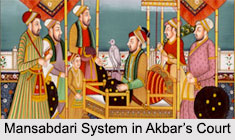
Mansabdari System, Indian HistoryMansabdar implies the generic term for the military-kind grading of all royal functionaries of the Mughal Empire. The mansabdars governed the realm and controlled exercise upon its armies in the emperor`s name. Though these men were normally aristocrats, yet, they could not organise a feudal aristocracy, because neither the offices nor the estates that supported them were earned in heredity. The phrase mansabdari system is derived from `Mansab`, implying rank. Thus, Mansabdar literally stands for a rank-holder. Ushered in by the Mughal emperor Akbar, mansabdari was a system common to both the military and the civil department. In essence, the mansabdari system was borrowed from Persia and its inter-country ruling. It was hugely ubiquitous during the reign of Mughal emperors Babur and Humayun. However, Akbar made some significant changes to the system and made it even more resourceful. Mansabdar was referred to as the official, rank, or the dignity.

There existed two grades that outlined the mansabdars. Those mansabdars whose rank stood in one or two hazari or who was ranked 12,000 or more were named the omkars. And those mansabdars whose rank stood below 1000, but not less than 20 were called the mansabdars. On the whole, the mansabdars can also be referred to as the lower omkars. The ostensible mansabdari system was originally set up by the Mughal emperor Akbar approximately in 1575. Unlike a feudal elite of the European or Japanese type, mansabdari was an open, non-hereditary order, casting talented administrators and commanders from India, Iran and Turan. During long periods, the system absorbed some eighty per cent of the empire`s land revenue and in return it recruited and maintained armies in the Mughal service. And these were, according to the umpteen rules of a personnel and administrative system of great sophistication, the best cavalry to be had in a vast area.

The mansabdari system was like a constitution regulating and managing a service that presided over the military labour market. It rendered rules that coordinated the tasks, remuneration, rank and careers of thousands of proud and ambitious men of varying cultural and religious status: the mansabdars. Operating this apparatus of rule was almost tantamount to rule itself.

Indeed, however ingenious the mansabdari system regulations and the successive reforms of the service to adapt it to new challenges to the empire, a major contradiction remained. On the level of everyday administration, the problem of how to induce the mansab holders of the state to utilise and spend most of their income on the number and quality of military units and horses required, would never be entirely solved. Yet, the centre was not entirely at a loss on how to tackle the difficulty. First of all, there existed Akbar`s instrument of the branding of horses (dagh). Then again, a regular practice existed of registrations, parades and inspections; there also existed strict book-keeping, control of territorial salary assignments (jagir) and a practice of frequent transfers of mansabdari executive officers as well as a well-organised flow of information to the centre about their doings. On the other hand, the vast and well-regulated imperial camp and a system of obligatory attendance at court facilitated a check on all-too-private pastimes of a major proportion of mansab-holders. In spite of all this, Akbar and his successors were always worried by the yawning divergence between the nominal and effective strengths of units engaged to serve the empire`s central campaigns. Given the way the labour market worked, this phenomenon was acted out otherwise. The open options and the fluidity that were an essential feature of the supply side of that market was successfully geared to an ambitious state like that of the Mughals. To the degree this was triumphantly done: the Mughal state moved towards the model of a so-called `early-modern` state. But as it would turn out to be, it was some of the regions of the empire, not its centre, that would take over and develop in this direction.

This process of `regional centralisation` begins to be better comprehended, uneven though it was. As far as there existed an `early-modern` element in these successor states, it appears to have been verbalised in various forms of military fiscalism and in methods of recruitment un-mediated by rather static aristocratic services like the mansabdari system. What emerges instead in the eighteenth century is a full-fledged category of broker-captains, also popular as the jamadars. For instance, in 1647, after the Balkh expedition, during the march back across the Hindu Kush, thousands of soldiers died of cold in the snow and the surviving animals became too weak to carry the army`s treasure. Then, the imperial commander had ordered the treasure to be assigned in numbered bags to the jamadars, who from then on carried them on their horses. During that time, it might have been the ambition of many of these subcontractors on the military labour market to obtain imperial mansabs for themselves. Soon a number of captains, amongst whom clansmen like Chhatrasal Bundela would perhaps be the best known, alternated between the service of the emperor and free enterprise as a warlord.

A sound example of the Mughal mansabdari system is Muhammad Khan Bangash in whose career the mamluk tradition of slave or chela soldiering merged with jamadari entrepreneurship. Soon after 1700, he grew from a small mercenary middleman, strongly egalitarian in practice and outlook, first into the leader of a captivating military sect that developed into a recruitment network of Afghan professional soldiers. Then, Muhammad Khan Bangash leaped into the founder of yet another state in the plains of Hindustan. Others followed suit. It appears that the Mughal empire in its heyday demanded surety from all captains employed, thus binding the money-market even closer to the imperial interest than it already was on account of its involvement in the collection of land revenue. But this implied that every middleman had to consider even more carefully which segment of the market seemed most profitable to him: the majestic mansabdari system, or the more fluid field of the remaining employment options. Naturally, there was not one unequivocal moment of swing away from the mansabs. The `middleman phenomenon` is as crucial to an understanding of the workings of the Mughal state as to the interpretation of the manner it lost the military initiative. Indeed, the increasing liberalisation of the jamadars from imperial employment was crucial in the shift of political emphasis within the Mughal Empire away from the mansabdari regulations to the regional barracks and the jamadars.

The mansabdars were severalised on the basis of Zat and Sawar Rank. The Zat pertained to the number of troops maintained by the mansabdar and the Sawar referred to the number of horses maintained by the mansabdar.

The category can be listed as below:
  • No. of Sawar = No. of Zat ` 1st Class Mansabdar

  • No. of Sawar = 1/2 the No. of Zat ` 2nd Class Mansabdar

  • No. of Sawar < 1/2 the No. of Zat ` 3rd Class Mansabdar


  • A mansabdar had to render service for the state and was obligated to deliver service whenever asked. In addition, they were ranked on the number of armed cavalrymen, or sowars, which each had to maintain for service in the imperial army. Thus all mansabdars had a zat, or personal ranking and a sowar, or a troop ranking. All servants of the empire, whether in the civil or military departments were ranked in this ubiquitous mansabdari system. There existed thirty-three grades of mansabdars ranging from `commanders of 10` to `commanders of 10,000`. Till halfway of Akbar`s reign, the highest rank an ordinary officer could hold was that of a commander of 5000; the more rarefied ranks between commanders of 7000 and 10,000 were reserved for the royal household. During the period following the reign of Akbar, the ranks were increased up to 20,000 or even more.

    The emperor had sole and exclusive rights to appoint, promote, suspend or dismiss any mansabdar. No portion of a mansabdar`s property was considered hereditary; a mansabdar`s children had to start his life in his own way. A mansabdar did not always however begin at the rank; the emperor, if gratified, could and actually did award higher or even rank to any person. There were made no differentiation between civil and military departments; both civil and military officers held mansabs and were liable to be transferred from one branch of the administration to another. Each mansabdar was required to hold an ordained number of horses, elephants, equipment, etc., based upon his rank and dignity. These rules, though initially strictly enforced, were later relaxed.
    Senior mansabdars were awarded a jagir (personal fief) instead of a salary. Rates of salary, which included both the mansabdar`s salary and so much per sowar, were matched by jagirs affording a similar total pay. If their specified yield added up to more, the surplus was hoarded onto the imperial treasury; if the jagirdar could extract more than the specified yield, he kept it for himself.

    (Last Updated on : 25/01/2012)
      More Articles in Akbar
     
    Akbarnamah Mughal Architecture during Akbar Mansabdari System
    Battle of Rajmahal Battle of Haldighati Birbal
    Second Battle of Panipat Abul-Fazl Religious Policy of Akbar
    Bairam Khan Rajput Policy of Akbar Conquests of Akbar
    Recently Updated Articles in History of India
  • Mughal Architecture
    Mughal architecture is a combination of Islamic, Persian, Turkish and Indian architecture. It is a style that was developed under the Mughal dynasty in the sixteenth and seventeenth centuries.
  •  
  • Mansabdari System in Mughal Dynasty
    Akbar introduced the Mansabdari System in the Mughal army which primarily meant the ranking of officers on decimal system.
  •  
     
  • Deccan Policy of Mughal Dynasty
    Deccan Policy of the Mughal dynasty was weak during the reign of Babur and Humayun but after the accession of Akbar on the throne, the political situation changed and the Deccan policy was a success.
  •  
  • Coins of Pandyas
    Coins of Pandyas bear the legend of different Pandya ruler in different times.
  •  
  • Art and Architecture of Mughal Empire
    Art and architecture of Mughal Art offers an aesthetic degree to all art lovers. The subtlety of the finesse and the dazzle of the aura create huge amount of interest among tourist.
  •  
    E-mail this Article | Post a Comment
    RSS Feeds
    Forum
    Forum on History of India

    Free E-magazine
    Subscribe to Free
    E-Magazine on Indian Crafts
     
     
    Mansabdari System, Indian History - Informative & researched article on Mansabdari System, Indian History
    Sitemap
    Contact Us   |   RSS Feeds
    Copyright © 2008 Jupiter Infomedia Pvt. Ltd. All rights reserved including the right to reproduce the contents in whole or in part in any form or medium without the express written permission of Jupiter Infomedia Pvt. Ltd.