 The battle of Rajmahal launched the Mughal rule in Bengal. The independent sultanate of Bengal came to an end in 1538 with the decline of Ghiyasuddin Mahmud Shah, the last Husain Shahi Sultan. Mughal Emperor Humayun soon occupied the capital city of Gaur, which he could not keep under his rule for long. The battle of Chausa (1539) provided the Sur Afghans, in the person of Sher Shah, the reign over Bengal, which lasted for almost a quarter of a century (1538-1563).
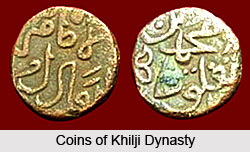
Bengal once again recovered its independence with the surfacing of the Karranis. Daud Khan Karrani, the last of the Karranis, was not willing to admit the superiority of Akbar and issued coins and read the Khutba with his own name. For various reasons he had to face the Mughal attack and was defeated in the battle of Tukaroi (1575) by Munim Khan. The warfare came to an end with the signing of the treaty of Katak (12 April 1575) by which Daud surrendered practically the whole of Bengal and Bihar to the Mughals holding on to only Orissa under his control.
But the treaty of Katak was short-lived. The death of Munim Khan encouraged Daud to come out of Orissa and summon up the lost territories as far as Teliagarhi. The remaining of the Mughal officers left Gaur and Tanda and hurried over to Patna. Daud once again became the master of west and north Bengal along with Orissa. Eastern Bengal was under Isa Khan and his associates. Isa Khan thronged away the Mughal flotilla of war-boats under Shah Bardi.
Aggression reopened and Akbar awarded the title of Khan-i-Jahan on Husain Quli Beg and handed over him with the commission of taking away Bengal from the hands of Daud. Daud, on his part was fully prepared with reinforcements by the army of Kalapahad, Junaid and Qutlu Khan. These Afghan leaders never measured the treaty of Katak to be obligatory upon them. Daud appointed three thousand selected Afghans at Teliagarhi to protect the pass and himself with the rest of his armed forces took position in the Rajmahal hills, near the narrow passage between the spur of the hills and the River Ganges.
Husain Quli Beg encountered the Afghans at Teliagarhi, who gave a brutal fight and about half of them fell in the battle. Teliagarhi pass, consequently, came under the ownership of Husain Quli Beg, who now moved against Daud at Rajmahal. The Afghans stood like one man and one unit and it did not seem easy to extricate them from their positions. On the other hand Mughals came across different hazards and obstacles - there was the Shia-Sunni strife amidst the Mughal camp, the monsoon was about to set-in and, above all, there was insufficiency in ration supply and weaponry support.
Khan-i-Jahan Husain Quli Beg decided a particular time at Rajmahal for about four months. In the meantime, at the orders of the emperor, Muzaffar Khan Turbati, governor of Bihar, arrived with 5000 horsemen and boatloads of necessities and ammunitions in order to help Khan-i-Jahan.
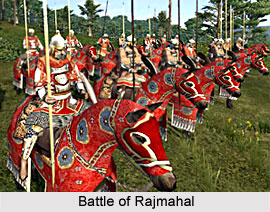
The unbreakable Mughals ran into the Afghans at Rajmahal on 12 July 1576 (15 Rabi II 984 AH). Junaid controlled the left of Daud`s army, Kalapahad the right and Daud himself looked after the center. Qutlu Khan commanded the vanguard. Junaid was struck by a cannon ball and instantly met a brutal death. This disheartened Daud`s army and they started to run away in all directions. Kalapahad and Qutlu Khan managed to escape, but Daud was taken as a prisoner as his horse was stuck in swamp. Khan-i-Jahan, considering Daud`s life to be a source of constant disturbance and rebellion, ordered for his urgent execution.
Thus the battle of Rajmahal came to an end that brought the Afghan rule in Bengal to an end and started the process of Mughal subjugation. But Afghan conflict continued at least for three decades under the leadership of Isa Khan, the Chief of the Bara-Bhuiyans. The defeat and capital punishment of Daud removed a resolute and formidable enemy of the Mughals, but it did not, in any way, protected the Mughal reign over Bengal, nor did it put an end to the Afghan struggle.