 In 1813, the East India Company Charter was renewed at twenty-years and two decisions were taken that affected both language and culture of the nation. The long-standing ban prohibition on missionaries was removed and the British officers allowed a rapid penetration of Christian missionary organizations into company territory. An annual £10,000 expenditure of government funds for education was allotted within the new Charter. As a result, the different objectives of the Orientalists and Anglicizers sparked a ceremonial debate as to what kind of education, English or classical Indian, should be funded in the country.
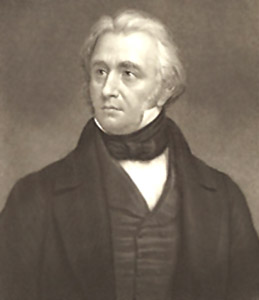
During the governor-generalship of Lord William Bentinck (1828-35) this debate was formally settled and in 1835, Thomas Babington Macaulay`s decree on Education condemned the use of South Asian languages and the study of Indian knowledge was not encouraged. It was the duty of the British-Indian government to fund an education that was English in content and language. The promotion of western education in British India was mainly credited to Thomas Babington Macaulay. He predicted the creation of a class that would act as a link between the rulers and ruled, as well as be a source of low-cost manpower for the lower levels of the administration. Even before this debate was concluded, the transfer to English language was well under way. In 1826 the government was inclined in junior law appointment to the Indians with suitable English certificates. Consequently knowledge of English was necessary for all individuals and a key to government service and to careers in a number of associated fields, such as law, medicine, business, teaching, and journalism All forms of employment that brought individuals into regular contact with the new rulers require knowledge in English.
Indian response to new opportunities created by the British was determined largely by their position in pre-British society. At the height of the Orientalist period, such institutions hired scholars of Sanskrit, Arabic, Persian, and of South Asian learning as Ft. William College. With the transfer to English education those castes that were already literate supplied the students of this new language; in practice this meant basically Bengali Hindus of the Brahman, Baidya, and Kayastha castes. In earlier generations individuals from these groups ruled the Persian to put on employment under the Mughal and post-Empire Muslim rulers. Now English was taught all over the nation.
By the second decade of the nineteenth century, a new anglicized privileged class began to establish institutions to serve its own interests. In 1816, they formed the Hindu College. The instructions given in this school included elements of both the Orientalist concern for classical languages and the Anglicizers` aspiration to communicate English education.
Almost half the student body of Hindu College studied western subjects and the English language even though they were not required to do so. In the following year, the Calcutta Book Society was established through the joint efforts of Indians and Englishmen to provide cheap textbooks for elementary schools. The society also encouraged the establishment of new elementary schools. The solitary aim of the Calcutta School Society founded in 1818 was to endorse education beyond the curriculum that was initiated by the government.
In 1824, the British officers launched the Sanskrit College, an institution that also taught English and western science. Development of educational facilities proceeded at a steady pace. In 1829, Gour Mohan Addy opened the Oriental Seminary, a Hindu-supported school that taught English language and literature, western mathematics, and sciences. Unlike some of the earlier schools, the Oriental Seminary was open to all castes. The missionaries that reached a new degree of effectiveness and notoriety sponsored a third source of English education. When Alexander Duff inaugurated his school in Calcutta, a new wave of enthusiasm was seen among the students. Duff offered a free English education for anyone who wished to attend this school. Thus the educational institutions in British period proved to be of great benefit for the Indians, if western education is considered.