 Medical conditions during 19th century British India was a somewhat changed scenario, with serious grounding of hospitals equipped with scientific knowledgeable men, publishing of thesis papers and administering of fresh inoculations for contaminations. The extensive medical shock of Indians was gradually removed in this period.
In 1824, the Calcutta Native Medical Institution was established for the training of Indians to coach sub-assistant surgeons, dressers and apothecaries. In 1826, a similar institution began in Bombay. In order to mend the dismal medical conditions in 19th century, urgent steps were being taken for safeguarding common man.
In 1826, Whitelaw Ainsliel 1767-1837) published Materia India, a book-length study of India`s ancient pharmacopoeia and traditional medicines. From these studies Ainslie concluded that the Indian and Greco-Roman civilisations possessed a common origin.
During the 1830s, the London Missionary Society began its medical work in south India. In 1835, the Calcutta Medical College was established, uniting and replacing medical classes taught at the Calcutta Madrassa and at the Sanskrit College. In 1839 a teaching hospital was attached to the Medical College. This can be regarded as a huge development towards the sagging medical conditions during 19th century India, contrary to which even more loss of lives would have to be incurred.
In 1835, James Ranald Martin (1796-1874) received the British East India Company`s approval to conduct and report on his studies regarding Calcutta`s medical and topographical relationships. His Notes on the Medical Topography of Calcutta (1837) defined the genre and was followed by numerous other studies elsewhere in India.
In 1837, John Forbes Royle (1798-1858) wrote An Essay on the Antiquity of Hindoo Medicine, demonstrating an early British interest in Indian pharmacopoeia and ayurveda, or indigenous medicine.
During the span of 1838-46, Dr. James Esdaile (1808-1859) established a hospital in Calcutta for the practice of mesmerism. Hypnosis was particularly employed when removing tumours associated with elephantiasis as suffered by the Indians. The British medical establishment allowed the hospital to continue, as it was believed that hypnosis appealed to the Indian sense of superstition or magic. British intelligence changed everything, taking up a serious duty to amend medical conditions in India, starting from 19th century.
Within the period of 1842-44, William O`Shaughnessy (1809-1889) furthered the study of pharmacology with the publication of his The Bengal Dispensatory (1842) and Bengal Pharmacopeia (1844).
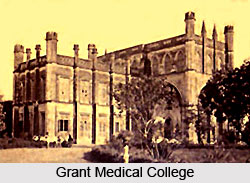
In 1845, with the financial assistance of Jamsetji Jeejeebhoy (1783-1859), the Grant Medical College opened in Bombay, replacing its Native Medical Institution. Charles Moreland (1807-1882) served as its first Principal.
In 1850, the Smallpox Commission presented its report recommending the suppression of Indian smallpox inoculations. The Commission held the view that native `tikadars` were responsible for the spread of smallpox. A later committee of doctors however overturned this recommendation.